Advertisements
Advertisements
प्रश्न
Two polaroids P1 and P2 are placed with their pass axes perpendicular to each other. An unpolarised light of intensity I0 is incident on P1. A third polaroid P3 is kept in between P1 and P2 such that its pass axis makes an angle of 30° with that of P1. Determine the intensity of light transmitted through P1, P2 and P3
Advertisements
उत्तर
As given in the question, the polaroids P1 and P2 are placed with their pass axes perpendicular to each other. Also, polaroid P3 is placed at an angle of 30° with respect to P1.
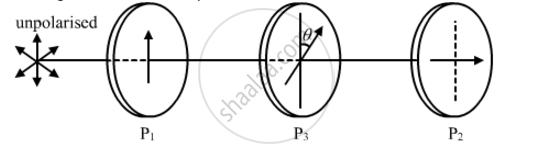
Now, we have:
Intensity of light after falling on P1 `I'=I_0/2`
Intensity of light after falling on P3, I" =
`I'cos^2(theta)=I_0/2cos^2(30^@)=(3I_0)/8`
Therefore, a light of intensity `(3I_0)/8`will pass through the P3, and the angle between P3 and P2 will be 60° because of the condition given in the question.
Intensity of light after falling on P2, I"' = I" `cos^2(theta)=(3I_0)/8cos^2(60^@)=(3I_0)/32`
APPEARS IN
संबंधित प्रश्न
Why does an unpolarised light incident on a polaroid get linearly polarised ?
Find an expression for intensity of transmitted light when a polaroid sheet is rotated between two crossed polaroids. In which position of the polaroid sheet will the transmitted intensity be maximum?
What does a polaroid consist of? How does it produce a linearly polarised light?
A ray of light is incident on a transparent medium at a polarizing angle. What is the angle between the reflected ray and the refracted ray?
Light transmitted by Nicol prism is ______.
What is a analyser?
What is unpolarised light?
What is the angle of polarisation and obtain the equation for an angle of polarisation?
A plane mirror produces a magnification of
Figure shown a two slit arrangement with a source which emits unpolarised light. P is a polariser with axis whose direction is not given. If I0 is the intensity of the principal maxima when no polariser is present, calculate in the present case, the intensity of the principal maxima as well as of the first minima.

