CBSE Science (English Medium) Class 12 Important Questions for Physics - Alternating Current
Advertisements
Advertisements
Chapter wise important questions with answers and solutions for Physics in CBSE Science (English Medium) Class 12.
The teachers of Geeta’s school took the students on a study trip to a power generating station, located nearly 200 km away from the city. The teacher explained that electrical energy is transmitted over such a long distance to their city, in the form of alternating current (ac) raised to a high voltage. At the receiving end in the city, the voltage is reduced to operate the devices. As a result, the power loss is reduced. Geeta listened to the teacher and asked questions about how the ac is converted to a higher or lower voltage.
1) Name the device used to change the alternating voltage to a higher or lower value. State one cause for power dissipation in this device.
2) Explain with an example, how power loss is reduced if the energy is transmitted over long distances as an alternating current rather than a direct current.
3) Write two values each shown by the teachers and Geeta.
Chapter: [7] Alternating Current
A series LCR circuit is connected across an a.c. source of variable angular frequency 'ω'. Plot a graph showing variation of current 'i' as a function of 'ω' for two resistances R1 and R2 (R1 > R2).
Answer the following questions using this graph :
(a) In which case is the resonance sharper and why?
(b) In which case in the power dissipation more and why?
Chapter: [7] Alternating Current
A group of students while coming from the school noticed a box marked "Danger H.T. 2200 V" at a substation in the main street. They did not understand the utility of a such a high voltage, while they argued, the supply was only 220 V. They asked their teacher this question the next day. The teacher thought it to be an important question and therefore explained to the whole class.
Answer the following questions:
(i) What device is used to bring the high voltage down to low voltage of a.c. current and what is the principle of its working ?
(ii) Is it possible to use this device for bringing down the high dc voltage to the low voltage? Explain
(iii) Write the values displayed by the students and the teacher.
Chapter: [7] Alternating Current
A voltage V = V0 sin ωt is applied to a series LCR circuit. Derive the expression for the average power dissipated over a cycle. Under what condition (i) no power is dissipated even though the current flows through the circuit, (ii) maximum power is dissipated in the circuit?
Chapter: [7] Alternating Current
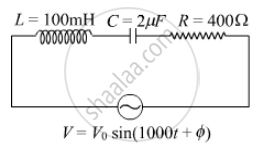
(i) Find the value of the phase difference between the current and the voltage in the series LCR circuit shown below. Which one leads in phase : current or voltage ?
(ii) Without making any other change, find the value of the additional capacitor C1, to be connected in parallel with the capacitor C, in order to make the power factor of the circuit unity.
Chapter: [7] Alternating Current
A power transmission line feeds input power at 2200 V to a step-down transformer with its primary windings having 300 turns. Find the number of turns in the secondary to get the power output at 220 V.
Chapter: [7] Alternating Current
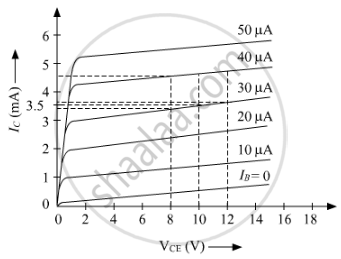
Output characteristics of an n-p-n transistor in CE configuration is shown in the figure.
Determine:
(i) dynamic output resistance
(ii) dc current gain and
(iii) ac current gain at an operating point VCE = 10 V, when IB = 30 μA.
Chapter: [7] Alternating Current
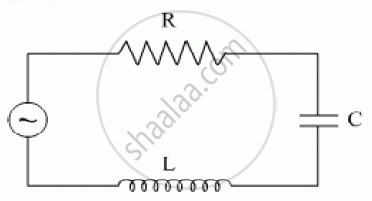
The figure shows a series LCR circuit with L = 10.0 H, C = 40 μF, R = 60 Ω connected to a variable frequency 240 V source, calculate
(i) the angular frequency of the source which drives the circuit at resonance,
(ii) the current at the resonating frequency,
(iii) the rms potential drop across the inductor at resonance.
Chapter: [7] Alternating Current
An alternative voltage given by V = 140 sin 314t is connected across a pure resistor of 50 Ω. Find
- The frequency of the source.
- The rms current is through the resistor.
Chapter: [7] Alternating Current
Define 'quality factor' of resonance in a series LCR circuit. What is its SI unit?
Chapter: [7] Alternating Current
Write the function of a transformer.
Chapter: [7] Alternating Current
A device 'X' is connected to an ac source V = V0 sin ωt. The variation of voltage, current and power in one cycle is shown in the following graph:
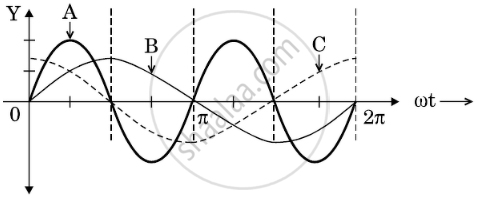
(a) Identify the device 'X'.
(b) Which of the curves A, B and C represent the voltage , current and the power consumed in the circuit? Justify your answer.
(c) How does its impedance vary with frequency of the ac source? Show graphically.
(d) Obtain an expression for the current in the circuit and its phase relation with ac voltage.
Chapter: [7] Alternating Current
State the principle of transformer working with the help of a diagram
Chapter: [7] Alternating Current
Mention various energy losses in transformer device
Chapter: [7] Alternating Current
The primary coil of an ideal step-up transformer has 100 turns and the transformation ratio is also 100. The input voltage and power are 220 V and 1100 W, respectively. Calculate the
(a) number of turns in secondary
(b) current in the primary
(c) a voltage across secondary
(d) current in secondary
(e) power in secondary
Chapter: [7] Alternating Current
Show that the current leads the voltage in phase by π/2 in an AC circuit containing an ideal capacitor ?
Chapter: [7] Alternating Current
Mention the two characteristic properties of the material suitable for making core of a transformer.
Chapter: [7] Alternating Current
State the underlying principle of a transformer. How is the large scale transmission of electric energy over long distances done with the use of transformers?
Chapter: [7] Alternating Current
A series LCR circuit is connected to an ac source. Using the phasor diagram, derive the expression for the impedance of the circuit. Plot a graph to show the variation of current with frequency of the source, explaining the nature of its variation.
Chapter: [7] Alternating Current
State the principle of a step-up transformer. Explain, with the help of a labeled diagram, its working ?
