Advertisements
Advertisements
Draw a circuit diagram of a p-n-p transistor and explain how it works as a transistor amplifier
Concept: Junction Transistor >> Transistor as an Amplifier (Ce-configuration)
Write clearly, why in the case of a transistor (i) the base is thin and lightly doped
Concept: Transistor and Characteristics of a Transistor
Write clearly, why in the case of a transistor (ii) the emitter is heavily doped.
Concept: Transistor and Characteristics of a Transistor
What causes the setting up of high electric field even for small reverse bias voltage across the diode?
Concept: Semiconductor Diode
If a small voltage is applied to a p-n junction diode, how will the barrier potential be affected when it is (i) forward biased
Concept: Special Purpose P-n Junction Diodes
If a small voltage is applied to a p-n junction diode, how will the barrier potential be affected when it is(ii) reveres biased?
Concept: Special Purpose P-n Junction Diodes
Derive an expression for voltage gain of the amplifier and hence show that the output voltage is in opposite phase with the input voltage.
Concept: Junction Transistor >> Transistor as an Amplifier (Ce-configuration)
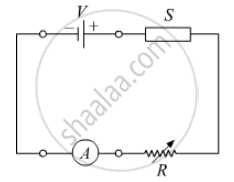
In the following diagram 'S' is a semiconductor. Would you increase or decrease the value of R to keep the reading of the ammeter A constant when S is heated? Give reason for your answer.
Concept: Semiconductor Diode
State its any ‘two’ uses of photodiode.
Concept: Special Purpose P-n Junction Diodes
Draw its I – V characteristics of photodiode
Concept: Semiconductor Diode
A zener diode is fabricated by heavily doping both p- and n- sides of the junction. Explain, why?
Concept: p-n Junction
Explain briefly with the help of necessary diagrams, the forward biasing of a p-n junction diode. Also draw characteristic curves.
Concept: p-n Junction
Explain briefly with the help of necessary diagrams, the reverse biasing of a p-n junction diode. Also draw characteristic curves.
Concept: p-n Junction
In the following diagram, is the junction diode forward biased or reverse biased ?
Concept: Semiconductor Diode
Write the functions of the three segments of a transistor.
Concept: Transistor and Characteristics of a Transistor
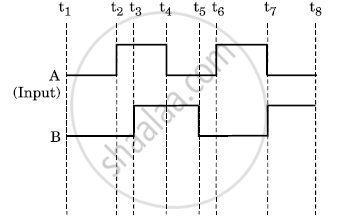
The figure shows the input waveforms A and B for ‘AND’ gate. Draw the output waveform and write the truth table for this logic gate.
Concept: Transistor and Characteristics of a Transistor
Draw a circuit diagram for studying the input and output characteristics of a n-p-n transistor in common emitter configuration. Using the circuit, explain how input, output characteristics are obtained
Concept: Junction Transistor >> Transistor as an Amplifier (Ce-configuration)
Draw logic symbol of an OR gate and write its truth table.
Concept: Digital Electronics and Logic Gates
Describe, with the help of a circuit diagram, the working of a photodiode.
Concept: Special Purpose P-n Junction Diodes
Sunil and his parents were travelling to their village in their car. On the way his mother noticed some grey coloured panels installed on the roof of a low building. She enquired from Sunil what those panels were and Sunil told his mother that those were solar panels.
(a) What were the values displayed by Sunil and his mother? State one value for each.
(b) In what way would the use of solar panels prove to be very useful?
(c) Name the semiconductor device used in solar panels. Briefly explain with the help of a diagram, how this device works
Concept: Special Purpose P-n Junction Diodes
