Advertisements
Advertisements
Give reasons for the following statement:
Zn, Cd, and Hg are soft metals.
Concept: Physical Properties of the Transition Elements (d-block)
Define coagulation.
Concept: Properties of Colloidal Solutions
Name the method of refining of metals such as Germanium.
Concept: Refining of Crude Metals
What is the role of silica in the extraction of copper?
Concept: Occurrence of Metals
How do you convert the following :
Phenol to anisole
Concept: Preparation of Ethers
Write the structures of the following molecule:
XeOF4
Concept: Group 18 Elements - The Noble gas Family
Write the mechanism of the following reaction :

Concept: Chemical Reactions of Alcohols and Phenols >> Reactions Involving Cleavage of Carbon–Oxygen (C–O) Bond in Alcohols
How do you convert the following:
Ethanol to Propan-2-ol
Concept: Commercially Importance Alcohols
Draw the zwitter ion structure for sulphanilic acid.
Concept: Classification of Amino Acids
An element has atomic mass 93 g mol−1 and density 11.5 g cm–3. If the edge length of its unit cell is 300 pm, identify the type of unit cell. (NA = 6.023 × 10²³ mol−1)
Concept: Number of Atoms in a Unit Cell
Calculate the number of unit cells in 8.1 g of aluminium if it crystallizes in a f.c.c. structure. (Atomic mass of Al = 27 g mol–1)
Concept: Number of Atoms in a Unit Cell
Give reasons:Ferrimagnetic substances show better magnetism than antiferromagnetic substances.
Concept: Properties of Solids: Magnetic Properties
Why are aquatic species more comfortable in cold water in comparison to warm water?
Concept: Colligative Properties and Determination of Molar Mass >> Reverse Osmosis and Water Purification
Calculate the degree of dissociation (α) of acetic acid if its molar conductivity (Λm) is 39.05 S cm2 mol−1.
(Given \[\ce{\lambda^{\circ}_{(H^+)}}\] = 349.6 S cm2 mol−1 and \[\ce{\lambda^{\circ}_{(CH_3COO^-)}}\] = 40.95 S cm2 mol−1)
Concept: Conductance of Electrolytic Solutions >> Variation of Conductivity and Molar Conductivity with Concentration
Account for the following:
E° value for the Mn3+/Mn2+ couple is highly positive (+1.57 V) as compare to Cr3+/Cr2+.
Concept: Galvanic Cells - Measurement of Electrode Potential
Which of the following cell was used in the Apollo space programme?
Concept: Fuel Cells
For a reaction A + B ⟶ P, the rate is given by
Rate = k [A] [B]2
How is the rate of reaction affected if the concentration of B is doubled?
Concept: Factors Influencing Rate of a Reaction
For a reaction A + B ⟶ P, the rate is given by
Rate = k [A] [B]2
What is the overall order of reaction if A is present in large excess?
Concept: Factors Influencing Rate of a Reaction
For a chemical reaction R → P, the variation in the concentration (R) vs. time (t) plot is given as:
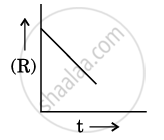
(i) Predict the order of the reaction.
(ii) What is the slope of the curve?
(iii) Write the unit of rate constant for this reaction.
Concept: Factors Influencing Rate of a Reaction
