Advertisements
Advertisements
Describe the following term briefly:
Breakdown voltage in reverse biasing
Concept: Semiconductor Diode
Write the functions of the following in communication systems:
Transmitter
Concept: Basic Terminology Used in Electronic Communication Systems
Write the functions of the following in communication systems:
Receiver
Concept: Basic Terminology Used in Electronic Communication Systems
What is the electric flux through a cube of side 1 cm which encloses an electric dipole?
Concept: Electric Flux
An electric dipole of dipole moment`vecp` consists of point charges +q and −q separated by a distance 2a apart. Deduce the expression for the electric field `vecE` due to the dipole at a distance x from the centre of the dipole on its axial line in terms of the dipole moment `vecp`. Hence show that in the limit x>> a, `vecE->2vecp"/"(4piepsilon_0x^3)`
Concept: Electric Dipole
Given the electric field in the region `vecE=2xhati`, find the net electric flux through the cube and the charge enclosed by it.
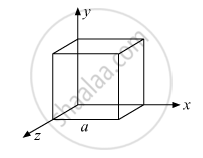
Concept: Electric Flux
Deduce the expression for the torque acting on a dipole of dipole moment `vecp` in the presence of a uniform electric field `vecE`
Concept: Dipole in a Uniform External Field
Consider two hollow concentric spheres, S1 and S2, enclosing charges 2Q and 4Q respectively as shown in the figure. (i) Find out the ratio of the electric flux through them. (ii) How will the electric flux through the sphere S1 change if a medium of dielectric constant 'εr' is introduced in the space inside S1 in place of air ? Deduce the necessary expression
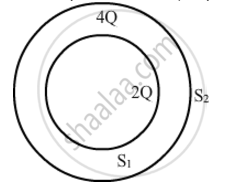
Concept: Electric Flux
Define electric dipole moment. Is it a scalar or a vector? Derive the expression for the electric field of a dipole at a point on the equatorial plane of the dipole.
Concept: Electric Dipole
Define capacitor reactance. Write its S.I units.
Concept: Capacitors and Capacitance
Two capacitors of unknown capacitances C1 and C2 are connected first in series and then in parallel across a battery of 100 V. If the energy stored in the two combinations is 0.045 J and 0.25 J respectively, determine the value of C1 and C2. Also calculate the charge on each capacitor in parallel combination.
Concept: Combination of Capacitors
A capacitor 'C', a variable resistor 'R' and a bulb 'B' are connected in series to the ac mains in circuit as shown. The bulb glows with some brightness. How will the glow of the bulb change if (i) a dielectric slab is introduced between the plates of the capacitor, keeping resistance R to be the same; (ii) the resistance R is increased keeping the same capacitance?
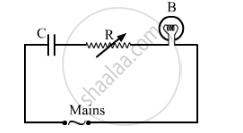
Concept: Combination of Capacitors
Obtain the expression for the energy stored per unit volume in a charged parallel plate capacitor.
Concept: Energy Stored in a Charged Capacitor
The electric field inside a parallel plate capacitor is E. Find the amount of work done in moving a charge q over a closed loop a b c d a.
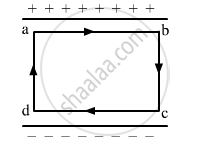
Concept: Combination of Capacitors
Considering the case of a parallel plate capacitor being charged, show how one is required to generalize Ampere's circuital law to include the term due to displacement current.
Concept: The Parallel Plate Capacitor
A parallel plate capacitor of capacitance C is charged to a potential V. It is then connected to another uncharged capacitor having the same capacitance. Find out the ratio of the energy stored in the combined system to that stored initially in the single capacitor.
Concept: Capacitors and Capacitance
Find out the amount of the work done to separate the charges at infinite distance.
Concept: Potential Energy of a System of Charges
What is the geometrical shape of equipotential surfaces due to a single isolated charge?
Concept: Equipotential Surfaces
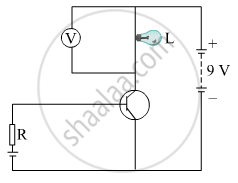
In the given circuit diagram a voltmeter ‘V’ is connected across a lamp ‘L’. Ho would (i) the brightness of the lamp and (ii) voltmeter reading ‘V’ be affected, if the value of resistance ‘R’ is decreased? Justify your answer.
Concept: Effect of Dielectric on Capacitance
Draw the equipotential surfaces due to an electric dipole. Locate the points where the potential due to the dipole is zero.
Concept: Equipotential Surfaces
