Please select a subject first
Advertisements
Advertisements
Derive the equation of the balanced state in a Wheatstone bridge using Kirchhoff’s laws.
Concept: Kirchhoff’s Laws
A conductor of 10 Ω is connected across a 6 V ideal source. The power supplied by the source to the conductor is ______.
Concept: Electrical Power
Two cells of emf E1 and E2 and internal resistances r1 and r2 are connected in parallel, with their terminals of the same polarity connected together. Obtain an expression for the equivalent emf of the combination.
Concept: Cells in Series
The potential difference applied across a given conductor is doubled. How will this affect (i) the mobility of electrons and (ii) the current density in the conductor? Justify your answers.
Concept: Drift of Electrons and the Origin of Resistivity
A potential difference (V) is applied across a conductor of length 'L' and cross-sectional area 'A'.
How will the drift velocity of electrons and the current density be affected if another identical conductor of the same material were connected in series with the first conductor? Justify your answers.
Concept: Drift of Electrons and the Origin of Resistivity
- Assertion (A): The given figure does not show a balanced Wheatstone bridge.
- Reason (R): For a balanced bridge small current should flow through the galvanometer.
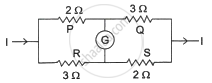
Concept: Wheatstone Bridge
Two conductors, made of the same material have equal lengths but different cross-sectional areas A1 and A2 (A1 > A2). They are connected in parallel across a cell. Show that the drift velocities of electrons in two conductors are equal.
Concept: Drift of Electrons and the Origin of Resistivity
An ammeter of resistance 0.81 ohm reads up to 1 A. The value of the required shunt to increase the range to 10 A is ______.
Concept: Measurement of Internal Resistance of a Cell
Write Maxwell's generalization of Ampere's circuital law. Show that in the process of charging a capacitor, the current produced within the plates of the capacitor is `I=varepsilon_0 (dphi_E)/dt,`where ΦE is the electric flux produced during charging of the capacitor plates.
Concept: Ampere’s Circuital Law
Write Maxwell's generalization of Ampere's circuital law. Show that in the process of charging a capacitor, the current produced within the plates of the capacitor is `I=varepsilon_0 (dphi_E)/dt,`where ΦE is the electric flux produced during charging of the capacitor plates.
Concept: Ampere’s Circuital Law
Use Biot-Savart law to derive the expression for the magnetic field on the axis of a current carrying circular loop of radius R.
Draw the magnetic field lines due to a circular wire carrying current I.
Concept: Magnetic Field on the Axis of a Circular Current Loop
Why does a galvanometer show a momentary deflection at the time of charging or discharging a capacitor? Write the necessary expression to explain this observation.
Concept: Moving Coil Galvanometer
What can be the causes of helical motion of a charged particle?
Concept: Solenoid and the Toroid - the Toroid
State the principle of a cyclotron.
Concept: Cyclotron
Show that the time period of revolution of particles in a cyclotron is independent of their speeds. Why is this property necessary for the operation of a cyclotron?
Concept: Cyclotron
Sketch the change in flux, emf and force when a conducting rod PQ of resistance R and length l moves freely to and fro between A and C with speed v on a rectangular conductor placed in uniform magnetic field as shown in the figure
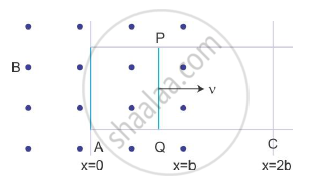
Concept: Force on a Current - Carrying Conductor in a Uniform Magnetic Field
Electron drift speed is estimated to be of the order of mm s−1. Yet large current of the order of few amperes can be set up in the wire. Explain briefly.
Concept: Ampere’s Circuital Law
Derive the expression for the magnetic field due to a solenoid of length ‘2l’, radius ‘a’ having ’n’ number of turns per unit length and carrying a steady current ‘I’ at a point
on the axial line, distance ‘r’ from the centre of the solenoid. How does this expression compare with the axial magnetic field due to a bar magnet of magnetic moment ‘m’?
Concept: Solenoid and the Toroid - the Solenoid
Define the term self-inductance of a solenoid.
Concept: Solenoid and the Toroid - the Solenoid
How does one understand this motional emf by invoking the Lorentz force acting on the free charge carriers of the conductor? Explain.
Concept: Force Between Two Parallel Currents, the Ampere
