Please select a subject first
Advertisements
Advertisements
Calculate the standard cell potential of a galvanic cell in which the following reaction takes place:
\[\ce{2Cr_{(s)} + 3Cd{^{2+}_{(aq)}} -> 2Cr{^{3+}_{(aq)}} + 3Cd_{(s)}}\]
Calculate the ΔrG° and equilibrium constant of the reaction.
Concept: Galvanic Cells - Measurement of Electrode Potential
Define conductivity for the solution of an electrolyte.
Concept: Conductance of Electrolytic Solutions >> Measurement of the Conductivity of Ionic Solutions
Write the name of the cell which is generally used in transistors. Write the reactions taking place at the anode and the cathode of this cell.
Concept: Electrolytic Cells and Electrolysis
The cell in which the following reaction occurs:
`2Fe^(3+) (aq) + 2I^(-) (aq) ---> 2Fe^(2+) (aq) + I_2 (s)` has `E_"cell"^@` = 0.236 V at 298 K. Calculate the standard Gibbs energy of the cell reaction. (Given : 1 F = 96,500 C mol−1)
Concept: Nernst Equation >> Electrochemical Cell and Gibbs Energy of the Reaction
How many electrons flow through a metllic wire if a current of 0·5 A is passed for 2 hours? (Given : 1 F = 96,500 C mol−1)
Concept: Electrochemical Cells
Following reactions occur at cathode during the electrolysis of aqueous copper(II) chloride solution :

On the basis of their standard reduction electrode potential (E°) values, which reaction is feasible at the cathode and why ?
Concept: Electrolytic Cells and Electrolysis
Although chlorine is an electron withdrawing group, yet it is ortho-, para- directing in electrophilic aromatic substitution reactions. Why?
Concept: Concept of Electrochemistry
Write the reaction that occurs at anode on electrolysis of concentrated 2 4 H SO using platinum electrodes.
Concept: Concept of Electrochemistry
Following reaction takes place in the cell:
`Zn(s) + Ag_2O(s)+H_2O(l) -> Zn^{2+}(aq) + 2Ag (s) + 2OH^- (aq)`
Calculate `Delta_r G^0` of the reaction
[Given ; `E^0_(Zn^{2+}//Zn)` = -0.76V
`E_((Zn^{2+}//Zn)) = 0.76V`
`E_(Ag^4//Ag)^0 = 0.80V, 1F = 96,500 C mol^-1 ]`
Concept: Nernst Equation >> Electrochemical Cell and Gibbs Energy of the Reaction
How can you determine limiting molar conductivity, 0 m for strong electrolyte and weak electrolyte?
Concept: Conductance of Electrolytic Solutions >> Variation of Conductivity and Molar Conductivity with Concentration
A steady current of 2 amperes was passed through two electrolytic cells X and Y connected in series containing electrolytes FeSO4and ZnSO4 until 2.8g of Fe deposited at the cathode of cell X. How long did the current flow? Calculate the mass of Zn deposited at the cathode of cell Y.
(Molar mass: Fe=56g mol-1,Zn=65.3g mol-1,1F=96500C mol-1)
Concept: Conductance of Electrolytic Solutions >> Variation of Conductivity and Molar Conductivity with Concentration
In the plot of molar conductivity (∧m) vs square root of concentration (c1/2) following curves are obtained for two electrolytes A and B : 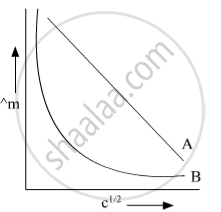
Answer the following:
(i) predict the nature of electrolytes A and B.
(ii) What happens on the extrapolation of ∧m to concentration approaching for electrolytes A and B?
Concept: Conductance of Electrolytic Solutions >> Variation of Conductivity and Molar Conductivity with Concentration
E°cell for the given redox reaction is 2.71 V
Mg(s) + Cu2+ (0.01 M) → Mg2+ (0.001 M) + Cu(s)
Calculate Ecell for the reaction. Write the direction of flow of current when an external opposite potential applied is
(i) less than 2.71 V and
(ii) greater than 2.71 V
Concept: Electrochemical Cells
Solve the following question.
A steady current of 2 amperes was passed through two electrolytic cells X and Y connected in series containing electrolytes FeSO4 and ZnSO4 until 2.8 g of Fe deposited at the cathode of cell X. How long did the current flow? Calculate the mass of Zn deposited at the cathode of cell Y.
(Molar mass : Fe = 56 g mol–1, Zn = 65.3 g mol–1, 1F = 96500 C mol–1)
Concept: Electrolytic Cells and Electrolysis
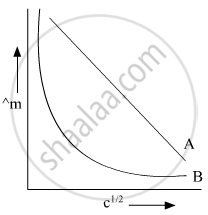
In the plot of molar conductivity (∧m) vs square root of concentration (c1/2), following curves are obtained for two electrolytes A and B:
Answer the following:
(i) Predict the nature of electrolytes A and B.
(ii) What happens on extrapolation of ∧m to concentration approaching zero for electrolytes A and B?
Concept: Conductance of Electrolytic Solutions >> Variation of Conductivity and Molar Conductivity with Concentration
Why on dilution the m Λm of \[\ce{CH3COOH}\] increases very fast, while that of \[\ce{CH3COONa}\] increases gradually?
Concept: Conductance of Electrolytic Solutions >> Variation of Conductivity and Molar Conductivity with Concentration
Solutions of two electrolytes ‘A’ and ‘B’ are diluted. The Λm of ‘B’ increases 1.5 times while that of A increases 25 times. Which of the two is a strong electrolyte? Justify your answer. Graphically show the behavior of ‘A’ and ‘B’.
Concept: Conductance of Electrolytic Solutions >> Variation of Conductivity and Molar Conductivity with Concentration
The molar conductivity of CH3COOH at infinite dilution is 390 Scm2/mol. Using the graph and given information, the molar conductivity of CH3COOK will be:

Concept: Conductance of Electrolytic Solutions >> Variation of Conductivity and Molar Conductivity with Concentration
Why does the cell voltage of a mercury cell remain constant during its lifetime?
Concept: Batteries >> Primary Batteries
Write the reaction occurring at anode and cathode and the products of electrolysis of aq KCl.
Concept: Electrolytic Cells and Electrolysis >> Products of Electrolysis
