What type of deviation from Roult’s Law is expected when phenol and aniline are mixed with each other? What change in the net volume of the mixture is expected?
Advertisements
Question
What type of deviation from Roult’s Law is expected when phenol and aniline are mixed with each other? What change in the net volume of the mixture is expected? Graphically represent the deviation.
Advertisements
Solution
Negative Deviation is expected when phenol and aniline are mixed with each other. The net volume of the mixture will decrease, ΔV < 0 due to stronger intermolecular interactions.
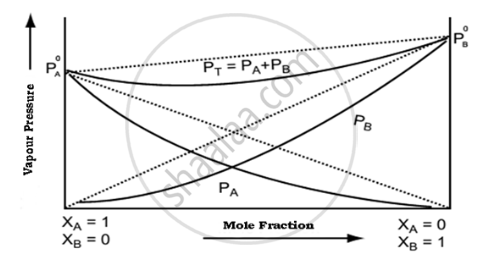
Diagram showing negative deviation from Raoult’s law
APPEARS IN
RELATED QUESTIONS
The KH for the solution of oxygen dissolved in water is 4 × 10⁴ atm at a given temperature. If the partial pressure of oxygen in air is 0.4 atm, the mole fraction of oxygen in solution is ______.
Assertion: An ideal solution obeys Raoults Law.
Reason: In an ideal solution, solvent – solvent as well as solute – solute interactions are similar to solute-solvent interactions.
Concentration terms such as mass percentage, ppm, mole fraction and molality are independent of temperature, however molarity is a function of temperature. Explain.
Why soda water bottle kept at room temperature fizzes on opening?
Assertion: When a solution is separated from the pure solvent by a semipermeable membrane, the solvent molecules pass through it from pure solvent side to the solution side.
Reason: Diffusion of solvent occurs from a region of high concentration solution to a region of low concentration solution.
Explain the terms ideal and non-ideal solutions in the light of forces of interactions operating between molecules in liquid solutions.
Which of the following gave the idea of a nucleus of the atom?
If liquids A and B form an ideal solution, the ______.
Suggest the most important type of intermolecular attractive interaction in the following pair:
I2 and CCl4
5 moles of liquid X and 10 moles of liquid Y make a solution having a vapour pressure of 70 torr. The vapour pressures of pure X and Y are 63 torr and 78 torr respectively. Which of the following is true regarding the described solution?
