Advertisements
Advertisements
प्रश्न
What type of deviation from Roult’s Law is expected when phenol and aniline are mixed with each other? What change in the net volume of the mixture is expected? Graphically represent the deviation.
Advertisements
उत्तर
Negative Deviation is expected when phenol and aniline are mixed with each other. The net volume of the mixture will decrease, ΔV < 0 due to stronger intermolecular interactions.
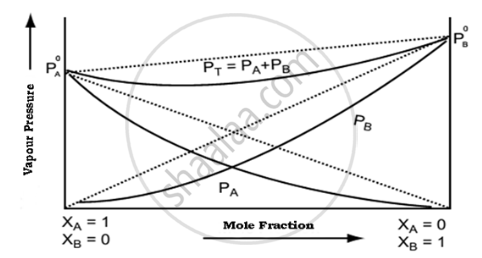
Diagram showing negative deviation from Raoult’s law
APPEARS IN
संबंधित प्रश्न
Heptane and octane form an ideal solution. At 373 K, the vapour pressures of the two liquid components are 105.2 kPa and 46.8 kPa respectively. What will be the vapour pressure of a mixture of 26.0 g of heptane and 35 g of octane?
Vapour pressure of pure acetone and chloroform at 328 K are 741.8 mm Hg and 632.8 mm Hg respectively. Assuming that they form ideal solution over the entire range of composition, plot Ptotal, `P_"chloroform"` and `P_"acetone"` as a function of `chi_"acetone"`. The experimental data observed for different compositions of mixtures is:
| `bb(100 xx chi_"acetone")` | `bb(P_"acetone"//"mm Hg")` | `bb(P_"chloroform"//"mm Hg")` |
| 0 | 0 | 632.8 |
| 11.8 | 54.9 | 548.1 |
| 23.4 | 110.1 | 469.4 |
| 36.0 | 202.4 | 359.7 |
| 50.8 | 322.7 | 257.7 |
| 58.2 | 405.9 | 193.6 |
| 64.5 | 454.1 | 161.2 |
| 72.1 | 521.1 | 120.7 |
Plot this data also on the same graph paper. Indicate whether it has a positive or negative deviation from the ideal solution.
The molality of a solution containing 1.8 g of glucose dissolved in 250 g of water is
Two liquids X and Y on mixing gives a warm solution. The solution is ______.
The mass of a non – volatile solute (molar mass 80 g mol-1) should be dissolved in 92g of toluene to reduce its vapour pressure to 90% ______.
Assertion: An ideal solution obeys Raoults Law.
Reason: In an ideal solution, solvent – solvent as well as solute – solute interactions are similar to solute-solvent interactions.
If two liquids A and B form minimum boiling azeotrope at some specific composition then ______.
Intermolecular forces between two benzene molecules are nearly of same strength as those between two toluene molecules. For a mixture of benzene and toluene, which of the following are not true?
(i) ∆mix H = zero
(ii) ∆mix V = zero
(iii) These will form minimum boiling azeotrope.
(iv) These will not form ideal solution.
On increase in pressure for dissociation ofN2O4 into NO2, equilibrium shift towards
Which of the following gave the idea of a nucleus of the atom?
