Please select a subject first
Advertisements
Advertisements
Answer the following question.
JTM Ltd. launched 'Buddy line', an exercise book and comprehensive stationery brand name comprising of ball pens, gel pens, and geometry boxes after identifying the target market and understanding the needs and wants of the consumers of that market. All their products were of good quality and eco-friendly but expensive. They wanted to distinguish their products from that of their competitors. They spent a lot of effort, time, and money in creating the brand name, as they knew that without a brand name, they can only create awareness for the generic products and can never be sure of the sale of their products. The effort paid off and the demand for the products started growing. The customers liked the brand and became habitual to it. They did not mind paying a higher price. Over a period of time, it became a status symbol to buy the 'Buddy line' brand because of its quality. The consumers felt pride in using them.
Identify the marketing management philosophy followed by JTM Ltd.
Concept: Marketing Management Philosophies
Answer the following question.
'VOICE' is an important consumer organization. It organized workshops in the months of December in Delhi/NCR for consumers. The theme was 'Organic Food – From Farm to Plate', to spread awareness on the importance of organic farming and to encourage consumers to switch from conventional food, that contains chemicals and pesticides to organic food. Expert speakers from farmers' community explained the harmful effects of usage of pesticides in farming and the importance of organic food.
People were informed that the organization regularly tests samples to detect adulteration like the presence of heavy metals or pesticides. The results of the tests are published in their monthly magazine 'Consumer Voice' to make people aware of the quality of different products. It also provides aid and legal advice to the consumers in seeking a remedy.
State the functions performed by the Consumer Voice for the protection and promotion of consumer interest by quoting lines from the above para.
Concept: Concept of Consumer Protection
An economy is in equilibrium. Find investment expenditure :
National income =1200
Autonomous consumption expenditure=150
Marginal Propensity to consume =0.8
Concept: Methods of Measurement of National Income >> Expenditure Method
Answer the following question.
Explain the meaning of opportunity cost with the help of a production possibility schedule.
Concept: Concepts of Production Possibility Frontier
What was the two-fold motive behind the systematic deindustrialisation effected by the British in pre-independent India?
Concept: India's Economy Before Independence
Choose the correct alternative from given options:
In the given figure, the movement on the production possibility curve from point A to point B shows _____________.
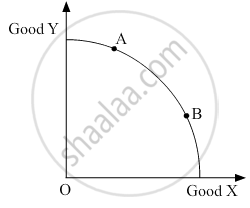
Concept: Concepts of Production Possibility Frontier
Identify and discuss the nature of the following newspaper reports in terms of positive or normative economic analysis:
(i) "India jumped 23 points in the World Bank's ease of doing business index to 77th place, highest in 2 years." – The Economic Times
(ii) "Government should further liberalise the business rules." – The Economic Times
Concept: Positive and Normative Economics
Answer the following question.
Gross Domestic Product (GDP) Does Not Give Us a Clear Indication of Economic Welfare of a Country. "Defend Or Refute the Given Statement with Valid Reason.
Concept: GDP and Welfare
Distinguish between positive externalities and negative externalities.
Concept: Factor Cost, Basic Prices and Market Prices
Discuss any two merits and demerits of the Green Revolution in the agricultural sector in the Indian economy.
Concept: Agriculture
State the meanings of the following:
Operating Surplus
Concept: Factor Cost, Basic Prices and Market Prices
Explain the role of microcredit in meeting credit requirements of the poor.
Concept: Credit and Marketing in Rural Areas
Distinguish between ‘Green Revolution’ and ‘Golden Revolution’.
Concept: Diversification into Productive Activities
"In India women participation rate is lower in urban areas than in the rural areas." Explain with valid arguments.
Concept: State of India’s Environment
“In rural areas of India more members of a family are engaged on work, yet the gross income of the family is generally low.”
Identify the type of unemployment indicated in the above statement and explain the paradox associated with it.
Concept: Concept of Unemployment
Give two examples of fixed costs.
Concept: Fixed Cost and Variable Cost
What happens to the difference between Average Total Cost and Average Variable Cost as production is increased?
Concept: Relationship Between Average Variable Cost and Average Total Cost and Marginal Cost
Choose the correct alternative from given options:
The average product curve in the input-output plane, will be ____________.
Concept: Shapes of Product Curves
Answer the following question.
"Indian Rupee (₹) plunged to an all-time low of ₹ 74.48 against the US Dollar ($)".
− The Economic Times
In light of the above report, discuss the impact of the situation on Indian Imports.
Concept: Determination of Equilibrium Income in the Short Run >> Effect of an Autonomous Change in Aggregate Demand on Income and Output
On the basis of following schedule, answer the given questions:
| Income (in ₹ crores) |
Savings (in ₹ crores) |
| 0 | -20 |
| 50 | -10 |
| 100 | 0 |
| 150 | 30 |
| 200 | 60 |
- Calculate Marginal Propensity to Save (MPS) at ₹ 150 crores level of income.
- What is the value of Autonomous Consumption?
Concept: Aggregate Demand and Its Components >> Consumption
