Definitions [14]
The collection of all anti-derivatives of a function is called its indefinite integral.
If \[ F'(x) = f(x), \]
then \[ \int f(x)\, dx = F(x) + C \]
Here: f(x) = integrand, dx = variable of integration, C = constant of integration.
A definite integral is connected with finding the area under a curve over a given interval. The chapter introduction presents area as one of the central motivating ideas behind integral calculus.
If the derivative of a function F(x) is f(x), then F(x) is called an antiderivative or integral of f(x). The set of all such antiderivatives is written as:
where C is an arbitrary constant called the constant of integration.
Integration by substitution is a method in which we replace a part of the integral by a new variable to simplify the integration.
General Formula:
If \[x = g(t), \ dx = g'(t) dt\] then \[\int f(x) dx = \int f(g(t))g'(t) dt\]
Integration using trigonometric identities means converting a trigonometric expression into an easier form with the help of standard identities before integrating.
Proper Rational Function
A rational function \[ \frac{P(x)}{Q(x)} \] is called proper if \[ \deg P(x) < \deg Q(x). \]
Improper Rational Function
It is called improper if \[ \deg P(x) \geq \deg Q(x). \]
An improper rational function must first be reduced to a proper rational function by long division.
Integration by partial fractions is a method used to integrate rational functions, that is, functions of the form
\[\frac{p(x)}{q(x)}\], where both numerator and denominator are polynomials.
A proper rational function can be expressed as a sum of simpler rational functions called partial fractions.
A rational function is a function of the form \[ \frac{P(x)}{Q(x)} \] where P(x) and Q(x) are polynomials and Q(x) \neq 0.
Integration by parts is a method of integration based on the product rule of differentiation.
If u and v are differentiable functions, then \[ \boxed{\int u\, dv = uv - \int v\, du} \]
For a product f(x)g(x), \[ \boxed{\int f(x)g(x)\, dx = f(x)\int g(x)\, dx - \int\left[f'(x)\int g(x)\, dx\right]dx} \]
A definite integral represents the value of a function accumulated between two limits.
It can also be interpreted geometrically as the net area between the graph of y = f(x) and the x-axis from x = a to x = b.
If a function f is continuous on an interval, the area function is defined by
This means that A(x) gives the area accumulated from x = a to a variable point x.
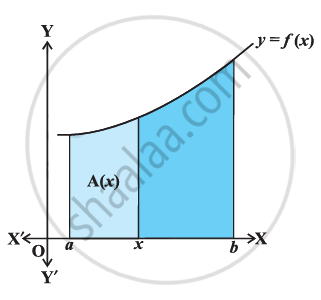
If f(x) is a continuous function defined on an interval [a, b] and if Φ(x) is the antiderivative of f(x), i.e., \[\frac{d}{dx}[\phi(x)]=f(x)\] then the definite integral of f(x) over [a, b] denoted by \[\int_{a}^{b}f(x)dx\] is defined as
\[\int_{a}^{b}f(x)dx=
\begin{bmatrix}
\phi\left(x\right)
\end{bmatrix}_{a}^{b}=\phi\left(b\right)-\phi\left(a\right)\]
\[\mathrm{If~}\frac{d}{dx}[F(x)]=f(x),\mathrm{~then~}\int f(x)dx=F(x)\]
Integration is the inverse process of differentiation.
\[\int f(x)dx=F(x)+c\]
- The arbitrary constant 'c' is called the constant of integration.
- F(x) + c is called the indefinite integral.
Formulae [12]
| No. | Derivatives | Integrals (Anti-derivatives) |
|---|---|---|
| (i) | \[\frac{d}{dx} \left( \frac{x^{n+1}}{n+1} \right) = x^n\]; | \[\int x^n dx = \frac{x^{n+1}}{n+1} + \text{C}, n \neq -1\] |
| \[\frac{d}{dx} (x) = 1\]; | \[\int dx = x + \text{C}\] | |
| (ii) | \[\frac{d}{dx} (\sin x) = \cos x\]; | \[\int \cos x dx = \sin x + \text{C}\] |
| (iii) | \[\frac{d}{dx} (-\cos x) = \sin x\]; | \[\int \sin x dx = -\cos x + \text{C}\] |
| (iv) | \[\frac{d}{dx} (\tan x) = \sec^2 x\]; | \[\int \sec^2 x dx = \tan x + \text{C}\] |
| (v) | \[\frac{d}{dx} (-\cot x) = \text{cosec}^2 x\]; | \[\int \text{cosec}^2 x dx = -\cot x + \text{C}\] |
| (vi) | \[\frac{d}{dx} (\sec x) = \sec x \tan x\]; | \[\int \sec x \tan x dx = \sec x + \text{C}\] |
| (vii) | \[\frac{d}{dx} (-\text{cosec} x) = \text{cosec} x \cot x\]; | \[\int \text{cosec} x \cot x dx = -\text{cosec} x + \text{C}\] |
| (viii) | \[\frac{d}{dx} (\sin^{-1} x) = \frac{1}{\sqrt{1-x^2}}\]; | \[\int \frac{dx}{\sqrt{1-x^2}} = \sin^{-1} x + \text{C}\] |
| (ix) | \[\frac{d}{dx} (-\cos^{-1} x) = \frac{1}{\sqrt{1-x^2}}\]; | \[\int \frac{dx}{\sqrt{1-x^2}} = -\cos^{-1} x + \text{C}\] |
| (x) | \[\frac{d}{dx} (\tan^{-1} x) = \frac{1}{1+x^2}\]; | \[\int \frac{dx}{1+x^2} = \tan^{-1} x + \text{C}\] |
| (xi) | \[\frac{d}{dx} (e^x) = e^x\]; | \[\int e^x dx = e^x + \text{C}\] |
| (xii) | \[\frac{d}{dx}\left(\log|x|\right)=\frac{1}{x};\] | \[\int\frac{1}{x}dx=\log|x|+\mathrm{C}\] |
| (xiii) | \[\frac{d}{dx} \left( \frac{a^x}{\log a} \right) = a^x\]; | \[\int a^x dx = \frac{a^x}{\log a} + \text{C}\] |
-
\[\int \frac{dx}{x^2 - a^2} = \frac{1}{2a} \log \left| \frac{x - a}{x + a} \right| + C\]
-
\[\int \frac{dx}{a^2 - x^2} = \frac{1}{2a} \log \left| \frac{a + x}{a - x} \right| + C\]
-
\[\int \frac{dx}{x^2 + a^2} = \frac{1}{a} \tan^{-1} \left(\frac{x}{a}\right) + C\]
-
\[\int \frac{dx}{\sqrt{x^2 - a^2}} = \log \left| x + \sqrt{x^2 - a^2} \right| + C\]
-
\[\int \frac{dx}{\sqrt{a^2 - x^2}} = \sin^{-1} \left(\frac{x}{a}\right) + C\]
-
\[\int \frac{dx}{\sqrt{x^2 + a^2}} = \log \left| x + \sqrt{x^2 + a^2} \right| + C\]
- \[\int[f(x)]^nf^{\prime}(x)dx=\frac{[f(x)]^{n+1}}{n+1}+c\quad(n\neq-1)\]
-
\[\int\frac{f^{\prime}(x)}{f(x)}dx=\log|f(x)|+c\]
| Expression | Equivalent Form |
|---|---|
| \[\sin^2x+\cos^2x\] | 1 |
| \[1+\tan^2x\] | \[sec^2x\] |
| \[1+\cot^2x\] | \[cosec^2x\] |
| \[\sin^2x\] | \[\frac{1-\cos2x}{2}\] |
| \[\cos^2x\] | \[\frac{1+\cos2x}{2}\] |
| sin x cos x | \[\frac{1}{2}\sin2x\] |
| sin x cos y | \[\frac{1}{2}[\sin(x+y)+\sin(x-y)]\] |
| cos x sin y | \[\frac{1}{2}[\sin(x+y)-\sin(x-y)]\] |
| cos x cos y | \[\frac{1}{2}[\cos(x+y)+\cos(x-y)]\] |
| sin x sin y | \[\frac{1}{2}[\cos(x-y)-\cos(x+y)]\] |
| 1 - cos x | \[2\sin^2\frac{x}{2}\] |
| 1 + cos x | \[2\cos^2\frac{x}{2}\] |
| \[\sin^3x\] | \[\frac{1}{4}(3\sin x-\sin3x)\] |
| \[cos^3x\] | \[\frac{1}{4}(3\cos x+\cos3x)\] |
| Function | Integral |
|---|---|
| \[\int\tan x\mathrm{~}dx\] | \[\log|\sec x|+c\] |
| \[\int\cot x\mathrm{~}dx\] | \[\log|\sin x|+c\] |
| \[\int\sec x\operatorname{d}x\] | \[\log|\sec x+\tan x|+c\] |
| \[\int cosecxdx\] | \[\log|\left(\csc x-\cot x\right)|+c\] |
\[\int e^x\left[\left.f(x)+f^{\prime}(x)\right.\right]dx=e^xf(x)+c\]
If, u = f(x) ⇒ \[\frac{du}{dx}=f^{\prime}(x)\]
then \[\int[f(x)]^nf^{\prime}(x)dx=\frac{[f(x)]^{n+1}}{n+1}+c\quad(n\neq-1)\]
Linear Substitution Rule:
If u = ax + bu = , then
\[\int(ax+b)^ndx=\frac{(ax+b)^{n+1}}{a(n+1)}+c\quad(n\neq-1)\]
| No. | Differentiation | Integration |
|---|---|---|
| 1 | \[\frac{d}{dx}(x^{n+1})=(n+1)x^n\] | \[\int x^ndx=\frac{x^{n+1}}{n+1}+c\] |
| 2 | \[\frac{d}{dx}(\log x)=\frac{1}{x}\] | \[\int\frac{1}{x}dx=\log\mid x\mid+c\] |
| 3 | \[\frac{d}{dx}(e^x)=e^x\] | \[\int e^{x}dx=e^{x}+c\] |
| 4 | \[\frac{d}{dx}(a^x)=a^x\log_ea\] | \[\int a^{x}dx=\frac{a^{x}}{\log_{e}a}+c(a>0,a\neq1)\] |
| 5 | \[\frac{d}{dx}(\sin x)=\cos x\] | \[\int\cos xdx=\sin x+c\] |
| 6 | \[\frac{d}{dx}(\cos x)=-\sin x\] | \[\int\sin xdx=-\cos x+c\] |
| 7 | \[\frac{d}{dx}(\tan x)=\sec^2x\] | \[\int\sec^2xdx=\tan x+c\] |
| 8 |
\[\frac{d}{dx}(\cot x)=-\mathrm{cosec}^{2}x\] |
\[\int\mathrm{cosec}^2xdx=-\cot x+c\] |
| 9 | \[\frac{d}{dx}(\sec x)=\sec x\tan x\] | \[\int\sec x\tan xdx=\sec x+c\] |
| 10 | \[\frac{d}{dx}(\operatorname{cosec}x)=-\operatorname{cosec}x\cot x\] | \[\int\operatorname{cosec}x\cot xdx=-\operatorname{cosec}x+c\] |
| 11 |
\[\frac{d}{dx}(\sin^{-1}x)=\frac{1}{\sqrt{1-x^2}}\] \[\frac{d}{dx}(\cos^{-1}x)=\frac{-1}{\sqrt{1-x^{2}}}\] |
\[\begin{aligned} & \int{\frac{1}{\sqrt{1-x^{2}}}}dx=\sin^{-1}x+c \\ \mathrm{OR} & =-\cos^{-1}x+c \end{aligned}\] |
| 12 |
\[\frac{d}{dx}(\tan^{-1}x)=\frac{1}{1+x^2}\] \[\frac{d}{dx}(\cot^{-1}x)=\frac{-1}{1+x^{2}}\] |
\[\int\frac{1}{1+x^{2}}dx=\tan^{-1}x+c\mathrm{OR}=-\cot^{-1}x+c\] |
| 13 |
\[\frac{d}{dx}(\sec^{-1}x)=\frac{1}{x\sqrt{x^{2}-1}}\] \[\frac{d}{dx}(\mathrm{cosec}^{-1}x)=\frac{-1}{x\sqrt{x^{2}-1}}\] |
\[\int\frac{1}{x\sqrt{x^{2}-1}}dx=\sec^{-1}x+cOR=-cosec^{-1}x+c\] |
| 14 | \[\frac{d}{dx}\left(\sin^{-1}\frac{x}{a}\right)=\frac{1}{\sqrt{a^{2}-x^{2}}}\] | \[\int\frac{dx}{\sqrt{a^{2}-x^{2}}}=\sin^{-1}\frac{x}{a}+c\] |
| 15 | \[\frac{d}{dx}\left(\tan^{-1}\frac{x}{a}\right)=\frac{a}{a^2+x^2}\] | \[\int\frac{dx}{a^{2}+x^{2}}=\frac{1}{a}\tan^{-1}\frac{x}{a}+c\] |
| 16 | \[\frac{d}{dx}\left(\sec^{-1}\frac{x}{a}\right)=\frac{a}{x\sqrt{x^{2}-a^{2}}}\] | \[\int\frac{dx}{x\sqrt{x^{2}-a^{2}}}dx=\frac{1}{a}\sec^{-1}\frac{x}{a}+c\] |
Statement:
If f(x) and g(x) are any two differentiable functions of x and G(x) is the antiderivative of g(x), i.e., \[G(x)=\int g(x)dx\]. Then
\[\int f(x)g(x)dx=f(x)G(x)-\int f^{\prime}(x)G(x)dx\]
| Integral | Result |
|---|---|
| \[\int\frac{dx}{x^2+a^2}\] | \[\frac{1}{a}\tan^{-1}\left(\frac{x}{a}\right)+c\] |
| \[\int\frac{dx}{x^2-a^2}\] | \[\frac{1}{2a}\log\left|\frac{x-a}{x+a}\right|+c\] |
| \[\int\frac{dx}{a^2-x^2}\] | \[\frac{1}{2a}\log\left|\frac{a+x}{a-x}\right|+c\] |
(A) Non-repeated linear factors
\[\frac{Ax+B}{(x-a)(x-b)}=\frac{A}{x-a}+\frac{B}{x-b}\]
(B) Repeated linear factor
\[\frac{Ax+B}{(x-a)^n}=\frac{A_1}{x-a}+\frac{A_2}{(x-a)^2}+\cdots+\frac{A_n}{(x-a)^n}\]
(C) Quadratic factor (not factorisable)
\[\frac{Ax+B}{ax^2+bx+c}\]
1.\[\int\sqrt{(a^{2}-x^{2})}dx=\frac{1}{2}x\sqrt{(a^{2}-x^{2})}+\frac{1}{2}a^{2}\sin^{-1}\left(\frac{x}{a}\right)+c\]
2. \[\int\left(\sqrt{a^{2}+x^{2}}\right)dx=\frac{1}{2}x\sqrt{(a^{2}+x^{2})}+\frac{1}{2}a^{2}\log|x+\sqrt{(a^{2}+x^{2})}|+c\]
Theorems and Laws [4]
Prove that: `int sqrt(a^2 - x^2) * dx = x/2 * sqrt(a^2 - x^2) + a^2/2 * sin^-1(x/a) + c`
Let I = `int sqrt(a^2 - x^2) dx`
= `int sqrt(a^2 - x^2)*1 dx`
= `sqrt(a^2 - x^2)* int 1 dx - int [d/dx (sqrt(a^2 - x^2))* int 1 dx]dx`
= `sqrt(a^2 - x^2)*x - int [1/(2sqrt(a^2 - x^2))*d/dx (a^2 - x^2)*x]dx`
= `sqrt(a^2 - x^2)*x - int 1/(2sqrt(a^2 - x^2))(0 - 2x)*x dx`
= `sqrt(a^2 - x^2)*x - int (-x)/sqrt(a^2 - x^2)*x dx`
= `xsqrt(a^2 - x^2) - int (a^2 - x^2 - a^2)/sqrt(a^2 - x^2)dx`
= `xsqrt(a^2 - x^2) - int sqrt(a^2 - x^2)dx + a^2 int dx/sqrt(a^2 - x^2)`
= `xsqrt(a^2 - x^2) - I + a^2sin^-1(x/a) + c_1`
∴ 2I = `xsqrt(a^2 - x^2) + a^2sin^-1(x/a) + c_1`
∴ I = `x/2 sqrt(a^2 - x^2) + a^2/2 sin^-1(x/a) + c_1/2`
∴ `int sqrt(a^2 - x^2)dx = x/2 sqrt(a^2 - x^2) + a^2/2sin^-1(x/a) + c`, where `c = c_1/2`.
If f is continuous on [a, b] and
If f is continuous on [a, b] and F is any antiderivative of f, then
This is the formula most often used in exams to evaluate definite integrals.
Theorem 1:
Let f be a continuous function on the closed interval [a, b] and let A (x) be the area function. Then A′(x) = f (x), for all x ∈ [a, b]
Theorem 2:
Let f be a continuous function defined on the closed interval [a, b], and F be an antiderivative of f. Then \[\int_a^bf(x)dx=\left[\mathbf{F}(x)\right]_a^b=\mathbf{F}(b)-\mathbf{F}(a)\]
Key Points
- Primitive
Another name for anti-derivative. - Indefinite Integral
The family of all anti-derivatives of a function. - Definite Integral
An integral taken between two fixed limits, commonly used to represent area or total accumulation. - Integral Calculus
The branch of calculus dealing with anti-derivatives, accumulation, and areas under curves.
-
Integration is the inverse process of differentiation.
-
The result of indefinite integration is called the antiderivative or primitive.
-
The indefinite integral is written as: ∫f(x) dx = F(x) + C.
-
The constant C must always be added in indefinite integrals.
| Property | Formula |
| Reverse of differentiation | \[\frac{d}{dx}\left(\int f(x) dx\right) = f(x)\] |
| Same derivative | \[F'(x) = G'(x) \Rightarrow F(x) = G(x) + C\] |
| Sum rule | \[\int (f + g)dx = \int fdx + \int gdx\] |
| Difference rule | \[\int (f - g)dx = \int fdx - \int gdx\] |
| Constant multiple rule | \[\int k f(x)dx = k \int f(x)dx\] |
| General linearity | \[\int (kf \pm lg)dx = k \int fdx \pm l \int gdx\] |
-
Integration by substitution is the reverse process of the chain rule.
-
Choose the substitution so that the integral becomes simpler, not more complicated.
-
Always rewrite both the function and \(dx\) in terms of the new variable.
-
For indefinite integrals, back-substitute and add \(C\).
-
For definite integrals, limits should also be changed if the solution is continued in the new variable.
-
Trigonometric substitution is mainly used for radicals involving \(a^2-x^2\), \(x^2+a^2\), and \(x^2-a^2\).
-
First inspect the pattern in the integrand.
-
Do not integrate complicated trigonometric expressions directly if an identity can simplify them first.
-
After simplification, integrate term by term carefully.
-
Always add the constant of integration, \(C\).
-
First check whether the rational function is proper or improper.
-
Use long division before decomposition if the fraction is improper.
-
Factorise the denominator completely before choosing partial fractions.
-
For each distinct linear factor, use a constant numerator such as A, B, or C.
-
For a repeated linear factor, include every power separately.
-
For an irreducible quadratic factor, use a linear numerator of the form Bx + C.
-
After decomposition, integrate each term separately using standard formulas.
-
Formula:
\[\int u dv = uv - \int v du\] -
Choose u by LIATE
-
For log x and inverse trig, multiply by 1
-
Repeated parts may be needed for \[e^x \sin x\], \[e^x \cos x\].
-
Convert the integrand into a known standard form before integrating.
-
For \[x^2 - a^2\], factorize and use partial fractions.
-
For \[x^2 + a^2\], the answer usually involves \[\tan^{-1}\].
-
For \[\sqrt{a^2 - x^2}\], the answer usually involves \[\sin^{-1}\].
-
For general quadratics, complete the square first.
-
For \[px + q\] in the numerator, relate it to the derivative of the denominator.
-
Always write the constant of integration C in the final answer.
-
Used to find exact accumulated value over a fixed interval.
-
Written as \[\int_{a}^{b} f(x) \, dx\].
-
Evaluated using \[F(b) - F(a)\].
-
Gives a unique numerical value.
-
Represents net area geometrically.
-
The theorem connects differentiation and integration.
-
If \[A(x) = \int_{a}^{x} f(t) \, dt\], then \[A'(x) = f(x)\].
-
If F'(x) = f(x), then \[\int_{a}^{b} f(x) \, dx = F(b) - F(a)\].
-
The result is used to evaluate definite integrals quickly.
-
The function should be continuous on the interval for direct use of the theorem.
-
Look for an inner function and its derivative.
-
Choose substitution carefully.
-
If the integral is continued in the new variable, change the limits accordingly.
-
Integrate in the new variable.
-
Do not add +C in a definite integral.
- Once the limits have been changed to the new variable, there is no need to substitute back to the original variable.
For choosing the first function:
L I A T E
-
Logarithmic
-
Inverse trigonometric
-
Algebraic
-
Trigonometric
-
Exponential
1.\[\frac{d}{dx}{\left[\int f(x)dx\right]}=f(x)\]
2. \[\int cf(x)dx=c\int f(x)dx\]
3. \[\int(u+v-w)dx=\int udx+\int vdx-\int wdx\]
Important Questions [131]
- Find : ∫ ( X 2 + 1 ) ( X 2 + 4 ) ( X 2 + 3 ) ( X 2 − 5 ) D X .
- Anti-derivative of tanx-1tanx+1 with respect to x is ______.
- If f(x) =∫x0 t sin t dt, then write the value of f '(x).
- int x^2 e^(x^3) dx equals
- Write the antiderivative of (3√x+1/√x).
- Evaluate : ∫(sin^6x+cos^6x)/(sin^2x.cos^2x)dx
- Find :∫(x2+x+1)/((x2+1)(x+2))dx
- Evaluate : π 4 ∫ 0 Tan X D X .
- If ddxf(x)=2x+3x and f(1) = 1, then f(x) is ______.
- Find Integral Dx by 5−8x− X Sqrt
- Prove that int_0^"a" "f(x)" "dx" = int_0^"a" "f"("a"-"x")"dx" ,and hence evaluate int_0^1 "x"^2(1 - "x")^"n""dx".
- Find Integral Cos Theta by 4 + Sin Square Thetax5 - 4 Cos Square Theta
- Evaluate `Int (Cos 2x + 2sin^2x)/(Cos^2x) Dx`
- Evaluate : π ∫ 0 X Tan X Sec X + Tan X D X .
- Find: ∫(x+3)3-4x-x2dx
- Evaluate : ∫(x+2)/√(x2+5x+6)dx
- Evaluate: ∫1/cos4x+sin4x dx
- Evaluate : ∫1/(sin^4x+sin^2xcos^2x+cos^4x)dx
- Find α∫dxsin3xcos(x-α).
- Evaluate ∫log2log31(ex+e-x)(ex-e-x)dx.
- Find ∫(3 sin 𝜃 − 2)cos𝜃/5 − cos^2𝜃 − 4 sin 𝜃 𝑑𝜃
- Find : ∫ Sin 2 X ( Sin 2 X + 1 ) ( Sin 2 X + 3 ) D X
- Find ∫x+2x2-4x-5dx.
- Find ∫√x/√(a^3−x^3)dx
- Find : int((2x-5)e(2x))/(2x-3)3dx
- Find the particular solution of the differential equation x2dy = (2xy + y2) dx, given that y = 1 when x = 1.
- Evaluate ∫-aaf(x)dx, where f(x) = 9x1+9x.
- ∫secxsecx-tanxdx equals ______.
- Evaluate : ∫(x−3)√(x2+3x−18x) dx
- Evaluate : ∫(√cotx+√tanx)dx
- Find ∫ Sin ( X − a ) Sin ( X + a ) D X
- Evaluate : ∫sin(x−a)/sin(x+a)dx
- Evaluate :∫π/3 π/6 dx/(1+√cotx)
- Find: ∫ Sin − 1 ( 2 X ) D X .
- Find: Intsqrt(1 - Sin 2x) Dx, Pi/4 < X < Pi/2
- Find: Int Sec^2 X /Sqrt(Tan^2 X+4) Dx.
- Integrate the function cos("x + a")/sin("x + b")w.r.t. x.
- Find ∫ Sin X − Cos X √ 1 + Sin 2 X D X , 0 < X < π 2
- Find: ∫ Cos X ( 1 + Sin X ) ( 2 + Sin X ) D X
- Find the Area of the Triangle Whose Vertices Are (-1, 1), (0, 5) and (3, 2), Using Integration.
- Find `Integral Dx/(X^2 + 4x + 8)`
- Find ∫ ( Log X ) 2 D X
- Evaluate: int_0^π (x sin x)/(1 + cos^2x) dx.
- Evaluate `3by2integral0|X Sin Pi X|Dx`
- Find `Integral(2x)By((Xsquare2 + 1)(Xpower4 + 4))`Dx
- Find Integral((3 Sin X - 2) Cos X)/(By3 - Cos^2 X- 7 Sin X) Dx
- Evaluate : π ∫ 0 X Tan X Sec X ⋅ C O S E C X D X .
- Find: int"dx"/sqrt(5-4"x" - 2"x"^2)
- Find Integral (Sin 2 X - Cos 2x)By(Sin X Cos X) Dx
- Find : ∫ Sin ( X − a ) Sin ( X + a ) D X
- Find: ∫x2(x2+1)(3x2+4)dx
- Find : ∫x2x4+x2−2dx
- Evaluate: ∫ x^2/(x^4+x^2-2)dx
- Find Integral(E^X Dx)By((E^X - 1)Square2 (Ex + 2))`
- Evaluate: ∫-215-4x-x2dx
- Find `Int (2cos X)/((1-sinx)(1+Sin^2 X)) Dx`
- Find: I=intdx/(sinx+sin2x)
- Find: ∫x4(x-1)(x2+1)dx.
- Evaluate: ∫0π4dx1+tanx
- Evaluate ∫π0 e^2 x.sin(π/4+x) dx
- Find : ∫ ( Log X ) 2 D X
- Find: ∫ex.sin2xdx
- Find: ∫2x(x2+1)(x2+2)dx
- Find the general solution of the differential equation: edydx=x2.
- Find ∫ecot-1x(1-x+x21+x2)dx.
- Find ∫sin-1x(1-x2)3/2dx.
- Find ∫ex(1-sinx1-cosx)dx.
- Find: ∫ex2(x5+2x3)dx.
- Find `Integral (2x)By(Xsquare2 + 1)(Xsquare2 + 2)Square2 Dx`
- Evaluate: ∫(x+3)e^x/(x+5)^3dx
- find : ∫(3x+1)√(4-3x-2x^2)dx
- Find ∫dx4x-x2
- Find Integral of Dx by (5 - 8x - X2)
- Evaluate 3integral2 3 Powerx Dx`
- Find: int_(-pi/4)^0 (1+tan"x")/(1-tan"x") "dx"
- Find : ∫ ( 2 X + 5 ) √ 10 − 4 X − 3 X 2 D X .
- Evaluate: ∫(5x-2)/(1+2x+3x^2)dx
- Evaluate : ∫x^2 (x^2+4) (x^2+9)dx
- Find: ∫(x^3−1)/(x^3+x) dx
- Find: ∫dxx2-6x+13
- Find : ∫ B a Log X X Dx
- Evaluate Each of the Following Integral: ∫ π 2 0 E X ( Sin X − Cos X ) D X
- Prove that ∫ B a ƒ ( X ) D X = ∫ B a ƒ ( a + B − X ) D X and Hence Evaluate ∫ π 3 π 6 D X 1 + √ Tan X
- Evaluate : π ∫ 0 / 4 Sin X + Cos X 16 + 9 Sin 2 X D X .
- Evaluate : 2 π ∫ 0 Cos 5 X D X .
- Evaluate : \[\Int E^{2x} \Cdot \Sin \Left( 3x + 1 \Right) Dx\] .
- Evaluate : ∫ D X Sin 2 X Cos 2 X .
- Evaluate: π / 2 ∫ − π / 2 Cos X 1 + E X D X .
- Evaluate : π ∫ 0 X 1 + Sin α Sin X D X
- Evaluate :∫π/2 0 2sinx/(2sinx+2cosx)dx
- Evaluate : ∫π/2 0 (sin^2 x)/(sinx+cosx)dx
- Evaluate : ∫ X Cos − 1 X √ 1 − X 2 D X .
- Find : ∫ E 2 X Sin ( 3 X + 1 ) D X .
- \[\Int\Limits_{- 2}^1 \Left| X^3 - X \Right|Dx\]
- Evaluate `Int_1^3 (X^2 + 3x + E^X) Dx` as the Limit of the Sum
- Evaluate: ∫ π − π ( 1 − X 2 ) Sin X Cos 2 X D X .
- Evaluate: ∫ 2 − 1 | X | X D X .
- Evaluate: ∫ 5 1 { | X − 1 | + | X − 2 | + | X − 3 | } D X .
- Find: ∫ ( 3 X + 5 ) √ 5 + 4 X − 2 X 2 D X .
- ∫e2e dx/(xlogx)
- If ∫a0 1/(4+x2)dx=π/8 , find the value of a.
- Evaluate : ∫π0 (4x sin x)/(1+cos2 x) dx
- find ∫42 x/(x2+1) dx
- ∫π−π (cos ax−sin bx)2 dx
- Evaluate ∫2−1 ∣x^3−x∣ dx
- Evaluate: π∫0π2sin2xtan-1(sinx)dx.
- Evaluate ∫0(3/2) |x cosπx| dx
- Evaluate : ∫40(|x|+|x−2|+|x−4|)dx
- Find : ∫ X Sin − 1 X √ 1 − X 2 D X .
- Evaluate: π / 2 ∫ 0 X Sin X Cos X Sin 4 X + Cos 4 X D X .
- Evaluate: ∫13xx+4-xdx
- Evaluate π∫0π/4log(1+tanx)dx.
- Evaluate: π∫0π211+(tanx)23dx
- The value of π∫0π4(sin2x)dx is ______.
- Prove that ∫ b a f ( x ) d x = ∫ b a f ( a + b − x ) d x and hence evaluate ∫ π 3 π 6 d x 1 + √ tan x .
- Evaluate ∫-11|x4-x|dx.
- Evaluate: ππ∫-π/4π/4cos2x1+cos2xdx.
- Evaluate: π∫0πx1+sinxdx.
- If ππ∫02πcos2x dx=k∫0π2cos2x dx, then the value of k is ______.
- Assertion (A): ∫2810-xx+10-xdx = 3. Reason (R): ∫abf(x)dx=∫abf(a+b-x)dx.
- Evaluate the definite integrals ∫0πxtanxsecx+tanxdx
- Evaluate : ∫ ( 3 X − 2 ) √ X 2 + X + 1 D X .
- Evaluate: 1integral4 {|X -1|+|X - 2|+|X - 4|}Dx`
- Find : ∫ 2 X + 1 ( X 2 + 1 ) ( X 2 + 4 ) D X .
- ∫-11|x-2|x-2dx, x ≠ 2 is equal to ______.
- Evaluate: ∫ π 0 X Sin X 1 + 3 Cos 2 X D X .
- Prove that ∫ a 0 F ( X ) D X = ∫ a 0 F ( a − X ) D X , Hence Evaluate ∫ π 0 X Sin X 1 + Cos 2 X D X
- Evaluate: π∫02π11+esinxdx
- Evaluate ∫2−2 x2/(1+5x) dx
- Evaluate: ∫-13|x3-x|dx
- Evaluate: ππ∫-π2π2(sin|x|+cos|x|)dx
Concepts [13]
- Integration
- Integration as an Inverse Process of Differentiation
- Properties of Indefinite Integral
- Methods of Integration> Integration by Substitution
- Methods of Integration>Integration Using Trigonometric Identities
- Methods of Integration> Integration Using Partial Fraction
- Methods of Integration> Integration by Parts
- Integrals of Some Particular Functions
- Definite Integrals
- Fundamental Theorem of Integral Calculus
- Evaluation of Definite Integrals
- Properties of Definite Integrals
- Overview of Integrals
