Advertisements
Advertisements
Question
\[y^2 + \left( x + \frac{1}{y} \right)\frac{dy}{dx} = 0\]
Advertisements
Solution
We have,
\[y^2 + \left( x + \frac{1}{y} \right)\frac{dy}{dx} = 0\]
\[\Rightarrow \frac{dy}{dx} = - \frac{y^3}{xy + 1}\]
\[ \Rightarrow \frac{dx}{dy} = - \frac{xy + 1}{y^3}\]
\[ \Rightarrow \frac{dx}{dy} = - \frac{x}{y^2} - \frac{1}{y^3}\]
\[ \Rightarrow \frac{dx}{dy} + \frac{x}{y^2} = - \frac{1}{y^3}\]
\[\text{Comparing with }\frac{dx}{dy} + Px = Q,\text{ we get}\]
\[P = \frac{1}{y^2}\]
\[Q = - \frac{1}{y^3}\]
Now,
\[I . F . = e^{\int\frac{1}{y^2}dy} = e^{- \frac{1}{y}} \]
So, the solution is given by
\[x \times e^{- \frac{1}{y}} = \int - e^{- \frac{1}{y}} \frac{1}{y^3} dy + C\]
\[ \Rightarrow x e^{- \frac{1}{y}} = I + C . . . . . \left( 1 \right)\]
Now,
\[I = \int - e^{- \frac{1}{y}} \frac{1}{y^3} dy\]
\[\text{Putting }t = \frac{1}{y},\text{ we get}\]
\[dt = \frac{- 1}{y^2}dy\]
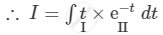
\[ = t \times \int e^{- t} dt - \int\left( \frac{d t}{d t} \times \int e^{- t} dt \right)dt\]
\[ = - t e^t + \int e^{- t} dt\]
\[ = - t e^{- t} - e^{- t} \]
\[ \therefore I = - \frac{1}{y} e^{- \frac{1}{y}} - e^{- \frac{1}{y}} = - e^{- \frac{1}{y}} \left( 1 + \frac{1}{y} \right)\]
Putting the value of `I` in (1), we get
\[x e^{- \frac{1}{y}} = - e^{- \frac{1}{y}} \left( 1 + \frac{1}{y} \right) + C\]
\[ \Rightarrow x = - \left( 1 + \frac{1}{y} \right) + C e^\frac{1}{y}\]
APPEARS IN
RELATED QUESTIONS
If `y=sqrt(sinx+sqrt(sinx+sqrt(sinx+..... oo))),` then show that `dy/dx=cosx/(2y-1)`
Find the particular solution of the differential equation `e^xsqrt(1-y^2)dx+y/xdy=0` , given that y=1 when x=0
If y = P eax + Q ebx, show that
`(d^y)/(dx^2)=(a+b)dy/dx+aby=0`
Find the particular solution of the differential equation log(dy/dx)= 3x + 4y, given that y = 0 when x = 0.
Verify that the given function (explicit or implicit) is a solution of the corresponding differential equation:
y = x2 + 2x + C : y′ – 2x – 2 = 0
Verify that the given function (explicit or implicit) is a solution of the corresponding differential equation:
`y sqrt(1 + x^2) : y' = (xy)/(1+x^2)`
Verify that the given function (explicit or implicit) is a solution of the corresponding differential equation:
y – cos y = x : (y sin y + cos y + x) y′ = y
Verify that the given function (explicit or implicit) is a solution of the corresponding differential equation:
x + y = tan–1y : y2 y′ + y2 + 1 = 0
Verify that the given function (explicit or implicit) is a solution of the corresponding differential equation:
`y = sqrt(a^2 - x^2 ) x in (-a,a) : x + y dy/dx = 0(y != 0)`
The general solution of the differential equation \[\frac{dy}{dx} + y \] cot x = cosec x, is
The solution of the differential equation \[\frac{dy}{dx} = \frac{x^2 + xy + y^2}{x^2}\], is
The general solution of the differential equation \[\frac{y dx - x dy}{y} = 0\], is
The general solution of the differential equation ex dy + (y ex + 2x) dx = 0 is
\[\frac{dy}{dx} = \frac{\sin x + x \cos x}{y\left( 2 \log y + 1 \right)}\]
\[\frac{dy}{dx} - y \tan x = - 2 \sin x\]
`y sec^2 x + (y + 7) tan x(dy)/(dx)=0`
(x3 − 2y3) dx + 3x2 y dy = 0
\[\frac{dy}{dx} + 2y = \sin 3x\]
`x cos x(dy)/(dx)+y(x sin x + cos x)=1`
`(dy)/(dx)+ y tan x = x^n cos x, n ne− 1`
For the following differential equation, find the general solution:- \[\frac{dy}{dx} = \sin^{- 1} x\]
Solve the following differential equation:-
\[\frac{dy}{dx} + \left( \sec x \right) y = \tan x\]
Find a particular solution of the following differential equation:- \[\left( 1 + x^2 \right)\frac{dy}{dx} + 2xy = \frac{1}{1 + x^2}; y = 0,\text{ when }x = 1\]
Find the equation of the curve passing through the point (1, 1) whose differential equation is x dy = (2x2 + 1) dx, x ≠ 0.
Find the equation of a curve passing through the point (−2, 3), given that the slope of the tangent to the curve at any point (x, y) is `(2x)/y^2.`
Solve the differential equation: `(d"y")/(d"x") - (2"x")/(1+"x"^2) "y" = "x"^2 + 2`
If y(x) is a solution of `((2 + sinx)/(1 + y))"dy"/"dx"` = – cosx and y (0) = 1, then find the value of `y(pi/2)`.
If y(t) is a solution of `(1 + "t")"dy"/"dt" - "t"y` = 1 and y(0) = – 1, then show that y(1) = `-1/2`.
The differential equation for y = Acos αx + Bsin αx, where A and B are arbitrary constants is ______.
The solution of `x ("d"y)/("d"x) + y` = ex is ______.
The general solution of the differential equation `("d"y)/("d"x) = "e"^(x^2/2) + xy` is ______.
The solution of the equation (2y – 1)dx – (2x + 3)dy = 0 is ______.
The solution of `("d"y)/("d"x) + y = "e"^-x`, y(0) = 0 is ______.
General solution of the differential equation of the type `("d"x)/("d"x) + "P"_1x = "Q"_1` is given by ______.
Which of the following differential equations has `y = x` as one of its particular solution?
Find the general solution of the differential equation `x (dy)/(dx) = y(logy - logx + 1)`.
Find the general solution of the differential equation:
`(dy)/(dx) = (3e^(2x) + 3e^(4x))/(e^x + e^-x)`
The differential equation of all parabolas that have origin as vertex and y-axis as axis of symmetry is ______.
