हिंदी

Y 2 + ( X + 1 Y ) D Y D X = 0 - Mathematics

Advertisements
Advertisements

प्रश्न

\[y^2 + \left( x + \frac{1}{y} \right)\frac{dy}{dx} = 0\]

योग
Advertisements

उत्तर

We have,

\[y^2 + \left( x + \frac{1}{y} \right)\frac{dy}{dx} = 0\]

\[\Rightarrow \frac{dy}{dx} = - \frac{y^3}{xy + 1}\]

\[ \Rightarrow \frac{dx}{dy} = - \frac{xy + 1}{y^3}\]

\[ \Rightarrow \frac{dx}{dy} = - \frac{x}{y^2} - \frac{1}{y^3}\]

\[ \Rightarrow \frac{dx}{dy} + \frac{x}{y^2} = - \frac{1}{y^3}\]

\[\text{Comparing with }\frac{dx}{dy} + Px = Q,\text{ we get}\]

\[P = \frac{1}{y^2}\]

\[Q = - \frac{1}{y^3}\]

Now,

\[I . F . = e^{\int\frac{1}{y^2}dy} = e^{- \frac{1}{y}} \]

So, the solution is given by

\[x \times e^{- \frac{1}{y}} = \int - e^{- \frac{1}{y}} \frac{1}{y^3} dy + C\]

\[ \Rightarrow x e^{- \frac{1}{y}} = I + C . . . . . \left( 1 \right)\]

Now,

\[I = \int - e^{- \frac{1}{y}} \frac{1}{y^3} dy\]

\[\text{Putting }t = \frac{1}{y},\text{ we get}\]

\[dt = \frac{- 1}{y^2}dy\]
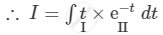
\[ = t \times \int e^{- t} dt - \int\left( \frac{d t}{d t} \times \int e^{- t} dt \right)dt\]

\[ = - t e^t + \int e^{- t} dt\]

\[ = - t e^{- t} - e^{- t} \]

\[ \therefore I = - \frac{1}{y} e^{- \frac{1}{y}} - e^{- \frac{1}{y}} = - e^{- \frac{1}{y}} \left( 1 + \frac{1}{y} \right)\]

Putting the value of `I` in (1), we get

\[x e^{- \frac{1}{y}} = - e^{- \frac{1}{y}} \left( 1 + \frac{1}{y} \right) + C\]

\[ \Rightarrow x = - \left( 1 + \frac{1}{y} \right) + C e^\frac{1}{y}\]

shaalaa.com
  क्या इस प्रश्न या उत्तर में कोई त्रुटि है?
अध्याय 22: Differential Equations - Revision Exercise [पृष्ठ १४६]

APPEARS IN

आरडी शर्मा Mathematics [English] Class 12
अध्याय 22 Differential Equations
Revision Exercise | Q 58 | पृष्ठ १४६

वीडियो ट्यूटोरियलVIEW ALL [2]

संबंधित प्रश्न

The solution of the differential equation dy/dx = sec x – y tan x is:

(A) y sec x = tan x + c

(B) y sec x + tan x = c

(C) sec x = y tan x + c

(D) sec x + y tan x = c


If x = Φ(t) differentiable function of ‘ t ' then prove that `int f(x) dx=intf[phi(t)]phi'(t)dt`


Find the particular solution of the differential equation

(1 – y2) (1 + log x) dx + 2xy dy = 0, given that y = 0 when x = 1.


Find the general solution of the following differential equation : 

`(1+y^2)+(x-e^(tan^(-1)y))dy/dx= 0`


If y = P eax + Q ebx, show that

`(d^y)/(dx^2)=(a+b)dy/dx+aby=0`


Solve the differential equation `[e^(-2sqrtx)/sqrtx - y/sqrtx] dx/dy = 1 (x != 0).`


Find a particular solution of the differential equation`(x + 1) dy/dx = 2e^(-y) - 1`, given that y = 0 when x = 0.


if `y = sin^(-1) (6xsqrt(1-9x^2))`, `1/(3sqrt2) < x < 1/(3sqrt2)` then find `(dy)/(dx)`


Write the order of the differential equation associated with the primitive y = C1 + C2 ex + C3 e−2x + C4, where C1, C2, C3, C4 are arbitrary constants.


How many arbitrary constants are there in the general solution of the differential equation of order 3.


The solution of the differential equation \[\frac{dy}{dx} + \frac{2y}{x} = 0\] with y(1) = 1 is given by


The solution of the differential equation \[x\frac{dy}{dx} = y + x \tan\frac{y}{x}\], is


If m and n are the order and degree of the differential equation \[\left( y_2 \right)^5 + \frac{4 \left( y_2 \right)^3}{y_3} + y_3 = x^2 - 1\], then


The solution of the differential equation \[\left( 1 + x^2 \right)\frac{dy}{dx} + 1 + y^2 = 0\], is


\[\frac{dy}{dx} + \frac{y}{x} = \frac{y^2}{x^2}\]


\[\frac{dy}{dx} - y \tan x = - 2 \sin x\]


\[\frac{dy}{dx} - y \tan x = e^x\]


\[y - x\frac{dy}{dx} = b\left( 1 + x^2 \frac{dy}{dx} \right)\]


\[\frac{dy}{dx} + y = 4x\]


`x cos x(dy)/(dx)+y(x sin x + cos x)=1`


For the following differential equation, find the general solution:- \[\frac{dy}{dx} = \frac{1 - \cos x}{1 + \cos x}\]


Find the equation of a curve passing through the point (0, 0) and whose differential equation is \[\frac{dy}{dx} = e^x \sin x.\]


The general solution of the differential equation x(1 + y2)dx + y(1 + x2)dy = 0 is (1 + x2)(1 + y2) = k.


x + y = tan–1y is a solution of the differential equation `y^2 "dy"/"dx" + y^2 + 1` = 0.


y = x is a particular solution of the differential equation `("d"^2y)/("d"x^2) - x^2 "dy"/"dx" + xy` = x.


Find the general solution of `"dy"/"dx" + "a"y` = emx 


Solve:

`2(y + 3) - xy  (dy)/(dx)` = 0, given that y(1) = – 2.


Solve the differential equation dy = cosx(2 – y cosecx) dx given that y = 2 when x = `pi/2`


Find the general solution of (1 + tany)(dx – dy) + 2xdy = 0.


If y = e–x (Acosx + Bsinx), then y is a solution of ______.


The differential equation for y = Acos αx + Bsin αx, where A and B are arbitrary constants is ______.


Integrating factor of `(x"d"y)/("d"x) - y = x^4 - 3x` is ______.


The general solution of the differential equation `("d"y)/("d"x) = "e"^(x^2/2) + xy` is ______.


The number of arbitrary constants in the general solution of a differential equation of order three is ______.


The solution of the differential equation `x(dy)/("d"x) + 2y = x^2` is ______.


The solution of differential equation coty dx = xdy is ______.


The integrating factor of `("d"y)/("d"x) + y = (1 + y)/x` is ______.


Number of arbitrary constants in the particular solution of a differential equation of order two is two.


Share
Notifications

Englishहिंदीमराठी


      Forgot password?
Use app×