Advertisements
Advertisements
प्रश्न
\[y^2 + \left( x + \frac{1}{y} \right)\frac{dy}{dx} = 0\]
Advertisements
उत्तर
We have,
\[y^2 + \left( x + \frac{1}{y} \right)\frac{dy}{dx} = 0\]
\[\Rightarrow \frac{dy}{dx} = - \frac{y^3}{xy + 1}\]
\[ \Rightarrow \frac{dx}{dy} = - \frac{xy + 1}{y^3}\]
\[ \Rightarrow \frac{dx}{dy} = - \frac{x}{y^2} - \frac{1}{y^3}\]
\[ \Rightarrow \frac{dx}{dy} + \frac{x}{y^2} = - \frac{1}{y^3}\]
\[\text{Comparing with }\frac{dx}{dy} + Px = Q,\text{ we get}\]
\[P = \frac{1}{y^2}\]
\[Q = - \frac{1}{y^3}\]
Now,
\[I . F . = e^{\int\frac{1}{y^2}dy} = e^{- \frac{1}{y}} \]
So, the solution is given by
\[x \times e^{- \frac{1}{y}} = \int - e^{- \frac{1}{y}} \frac{1}{y^3} dy + C\]
\[ \Rightarrow x e^{- \frac{1}{y}} = I + C . . . . . \left( 1 \right)\]
Now,
\[I = \int - e^{- \frac{1}{y}} \frac{1}{y^3} dy\]
\[\text{Putting }t = \frac{1}{y},\text{ we get}\]
\[dt = \frac{- 1}{y^2}dy\]
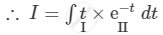
\[ = t \times \int e^{- t} dt - \int\left( \frac{d t}{d t} \times \int e^{- t} dt \right)dt\]
\[ = - t e^t + \int e^{- t} dt\]
\[ = - t e^{- t} - e^{- t} \]
\[ \therefore I = - \frac{1}{y} e^{- \frac{1}{y}} - e^{- \frac{1}{y}} = - e^{- \frac{1}{y}} \left( 1 + \frac{1}{y} \right)\]
Putting the value of `I` in (1), we get
\[x e^{- \frac{1}{y}} = - e^{- \frac{1}{y}} \left( 1 + \frac{1}{y} \right) + C\]
\[ \Rightarrow x = - \left( 1 + \frac{1}{y} \right) + C e^\frac{1}{y}\]
APPEARS IN
संबंधित प्रश्न
If x = Φ(t) differentiable function of ‘ t ' then prove that `int f(x) dx=intf[phi(t)]phi'(t)dt`
Find the particular solution of the differential equation
(1 – y2) (1 + log x) dx + 2xy dy = 0, given that y = 0 when x = 1.
If y = P eax + Q ebx, show that
`(d^y)/(dx^2)=(a+b)dy/dx+aby=0`
Find the particular solution of the differential equation dy/dx=1 + x + y + xy, given that y = 0 when x = 1.
Verify that the given function (explicit or implicit) is a solution of the corresponding differential equation:
y = Ax : xy′ = y (x ≠ 0)
Find the particular solution of the differential equation
`tan x * (dy)/(dx) = 2x tan x + x^2 - y`; `(tan x != 0)` given that y = 0 when `x = pi/2`
Find the differential equation of the family of concentric circles `x^2 + y^2 = a^2`
The general solution of the differential equation \[\frac{dy}{dx} = \frac{y}{x}\] is
The solution of the differential equation \[\frac{dy}{dx} + 1 = e^{x + y}\], is
The general solution of the differential equation \[\frac{y dx - x dy}{y} = 0\], is
Find the particular solution of the differential equation \[\frac{dy}{dx} = \frac{x\left( 2 \log x + 1 \right)}{\sin y + y \cos y}\] given that
\[\frac{dy}{dx} - y \cot x = cosec\ x\]
(1 + y + x2 y) dx + (x + x3) dy = 0
\[\frac{dy}{dx} + y = 4x\]
\[\cos^2 x\frac{dy}{dx} + y = \tan x\]
For the following differential equation, find the general solution:- \[\frac{dy}{dx} = \frac{1 - \cos x}{1 + \cos x}\]
For the following differential equation, find a particular solution satisfying the given condition:
\[x\left( x^2 - 1 \right)\frac{dy}{dx} = 1, y = 0\text{ when }x = 2\]
For the following differential equation, find a particular solution satisfying the given condition:- \[\cos\left( \frac{dy}{dx} \right) = a, y = 1\text{ when }x = 0\]
For the following differential equation, find a particular solution satisfying the given condition:- \[\frac{dy}{dx} = y \tan x, y = 1\text{ when }x = 0\]
Solve the following differential equation:- `y dx + x log (y)/(x)dy-2x dy=0`
Solve the following differential equation:-
\[\frac{dy}{dx} + 3y = e^{- 2x}\]
Solve the following differential equation:-
(1 + x2) dy + 2xy dx = cot x dx
Find the equation of the curve passing through the point (1, 1) whose differential equation is x dy = (2x2 + 1) dx, x ≠ 0.
Find the equation of a curve passing through the point (0, 0) and whose differential equation is \[\frac{dy}{dx} = e^x \sin x.\]
Find the equation of a curve passing through the point (0, 1). If the slope of the tangent to the curve at any point (x, y) is equal to the sum of the x-coordinate and the product of the x-coordinate and y-coordinate of that point.
y = x is a particular solution of the differential equation `("d"^2y)/("d"x^2) - x^2 "dy"/"dx" + xy` = x.
Find the general solution of `(x + 2y^3) "dy"/"dx"` = y
Solve the differential equation dy = cosx(2 – y cosecx) dx given that y = 2 when x = `pi/2`
Solve: `y + "d"/("d"x) (xy) = x(sinx + logx)`
The differential equation for y = Acos αx + Bsin αx, where A and B are arbitrary constants is ______.
Integrating factor of the differential equation `("d"y)/("d"x) + y tanx - secx` = 0 is ______.
The integrating factor of the differential equation `("d"y)/("d"x) + y = (1 + y)/x` is ______.
The solution of the differential equation ydx + (x + xy)dy = 0 is ______.
The solution of differential equation coty dx = xdy is ______.
Find a particular solution, satisfying the condition `(dy)/(dx) = y tan x ; y = 1` when `x = 0`
Find the particular solution of the differential equation `x (dy)/(dx) - y = x^2.e^x`, given y(1) = 0.
The differential equation of all parabolas that have origin as vertex and y-axis as axis of symmetry is ______.
