Advertisements
Advertisements
Question
Write the answers to the questions by observing the following figure.
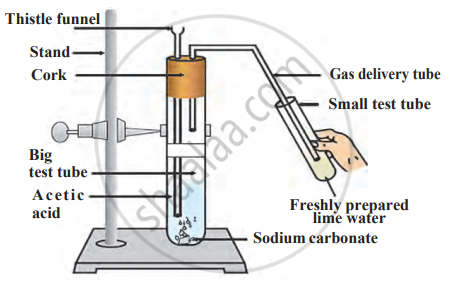
- Write the chemical reaction shown in the figure above in the form of a balanced equation.
- Write the name of the gas coming out of the large test tube in the above chemical reaction.
- Why do small bubbles of lime appear in the small test tube?
- What is the change in colour of lime net?
Advertisements
Solution
- Balanced equation of the reaction between acetic acid and sodium carbonate is as follows:
\[\ce{\underset{\text{Acetic acid}}{2CH3COOH_{(aq)}} + \underset{\text{carbonate}}{\underset{\text{Sodium}}{Na2CO_{3(s)}}} -> \underset{\text{ethanoate}}{\underset{\text{Sodium}}{2CH3COONa_{(aq)}}} + \underset{\text{Water}}{H2O_{(l)}} + \underset{\text{Carbon dioxide}}{CO2\uparrow}}\] - The gas formed in the large test tube is carbon dioxide (CO2) gas.
- The bubbles appear because the carbon dioxide gas generated by the reaction in the large test tube travels through the gas delivery tube and is released into the lime water.
- The freshly prepared lime water turns milky (or cloudy white). This colour change happens because the carbon dioxide gas reacts with the lime water (calcium hydroxide) to form an insoluble white precipitate of calcium carbonate \[\ce{CaCO3}\]
APPEARS IN
RELATED QUESTIONS
A student puts a drop of reaction mixture of a saponification reaction first a blue litmus paper and then on a red litmus paper. He may observe that:
(a) There is no change in the blue litmus paper and the red litmus paper turns white.
(b) There is no change in the red litmus paper and the blue litmus paper turns red.
(c) There is no change in the blue litmus paper and the red litmus paper turns blue.
(d) No change in colour is observed in both the litmus papers
A student adds a few drops of ethanoic acid to test tubes X, Y and Z containing aqueous solutions of sodium chloride, sodium hydroxide and sodium carbonate, respectively. If he now brings a burning splinter near the mouth of the test tubes immediately after adding ethanoic acid in each one of them, in which of the test tube or test tubes the flame will be extinguished?
(A) X and Y
(B) Y and Z
(C) X and Z
(D) only Z
How esters are prepared ?
Complete the following chemical equations :CH3COOH + Na2CO3 →
What is the common name of methanoic acid?
Give any two uses of ethanoic acid.
Write the IUPAC name of the following:
\[\begin{array}{cc}
\ce{CH3}\\
|\\
\ce{CH3 -C -CH3}\\
|\\
\ce{CH3}
\end{array}\]
What do you notice when acetic acid reacts with litmus?
What do you notice when acetic acid reacts with alcohol?
Name the compound formed when acetic acid and ethanol react together.
If you are asked to report your observations about the following two properties of acetic acid, what would you report?
(i) Odour
(ii) Effect on litmus
Explain the following term with example.
Reduction
When acetaldehyde is oxidized with acidified potassium dichromate, it forms ______.
Give a balanced chemical equation for the following conversion:
Calcium carbide to ethyne.
When sodium hydrogen carbonate is added to ethanoic acid, a gas evolves. Consider the following statements about the gas evolved.
- It turns lime water milky.
- It is evolved with brisk effervescence.
- It has a smell of burning sulfur.
- It is also a by-product of respiration.
With a labelled diagram describe in brief an activity to show the formation of ester.
Ester is a sweet-smelling compound.
What are catalysts?
Give a chemical reaction in which a catalyst is used.
Ethanoic acid is also known as which of these?
