Advertisements
Advertisements
प्रश्न
Write the answers to the questions by observing the following figure.
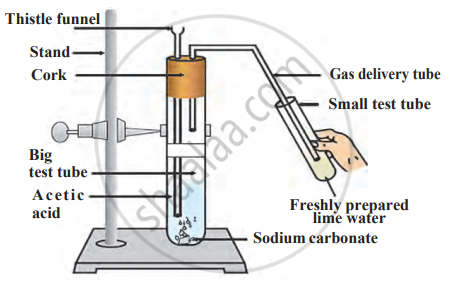
- Write the chemical reaction shown in the figure above in the form of a balanced equation.
- Write the name of the gas coming out of the large test tube in the above chemical reaction.
- Why do small bubbles of lime appear in the small test tube?
- What is the change in colour of lime net?
Advertisements
उत्तर
- Balanced equation of the reaction between acetic acid and sodium carbonate is as follows:
\[\ce{\underset{\text{Acetic acid}}{2CH3COOH_{(aq)}} + \underset{\text{carbonate}}{\underset{\text{Sodium}}{Na2CO_{3(s)}}} -> \underset{\text{ethanoate}}{\underset{\text{Sodium}}{2CH3COONa_{(aq)}}} + \underset{\text{Water}}{H2O_{(l)}} + \underset{\text{Carbon dioxide}}{CO2\uparrow}}\] - The gas formed in the large test tube is carbon dioxide (CO2) gas.
- The bubbles appear because the carbon dioxide gas generated by the reaction in the large test tube travels through the gas delivery tube and is released into the lime water.
- The freshly prepared lime water turns milky (or cloudy white). This colour change happens because the carbon dioxide gas reacts with the lime water (calcium hydroxide) to form an insoluble white precipitate of calcium carbonate \[\ce{CaCO3}\]
APPEARS IN
संबंधित प्रश्न
Consider the following comments about saponification reactions:
I. Heat is evolved in these reactions.
II. For quick precipitation of soap, sodium chloride is added to the reaction mixtures.
III. Saponification reactions are a special kind of neutralisation reactions.
IV. Soaps are basic salts of long-chain fatty acids.
The correct comments are
(a) I, II and III
(b) II, III and IV
(c) I, II and IV
(d) Only I and IV
Complete the following chemical equations : C2H5OH + Na →
When zinc powder is added to acetic acid ______________
(a) the mixture becomes warm
(b) a gas is evolved
(c) the colour of the mixture becomes yellow
(d) a solid settles at the bottom
Give the common name and IUPAC name of the following compound:
HCOOH
Give the name and structural formula of one homologue of HCOOH.
Write the formula of methanoic acid.
Name one chemical compound which can be used to distinguish between ethanol and ethanoic acid.
What type of compound is CH3COOH?
How does ethanoic acid react with sodium hydrogen carbonate? Give equation of the reaction which takes place.
Vinegar is a solution of about:
(a) 5 to 8 per cent ethanoic acid in alcohol
(b) 5 to 8 per cent ethanoic acid in water
(c) 50 to 80 per cent ethanoic acid in water
(d) 50 to 80 per cent ethanoic acid in alcohol
What do you observe when acetic acid is added to ethyl alcohol in the presence of sulphuric acid?
A student is studying the properties of acetic acid in his school laboratory. List two physical and two chemical properties which he must observe and note in his record book.
Write three physical properties of acetic acid.
Fill in the blank with appropriate word/words.
Vinegar is a solution of about ________per cent ________in water.
Why is pure acetic acid also known as glacial acetic acid?
Assertion (A): Esterification is a process in which a sweet-smelling substance is produced.
Reason (R): When esters react with sodium hydroxide an alcohol and sodium salt of carboxylic acid are obtained.
Ester is a sweet-smelling compound.
Give the balanced chemical equation of the following reaction:
Evolution of carbon dioxide by the action of ethanoic acid with NaHCO3.
Ester is formed by the reaction between ______.
Which of the following substance produces brisk effervescence with baking soda solution?
