Advertisements
Advertisements
Question
An organic acid X is a liquid, which often freezes during winter time in cold countries, having the molecular formula C2H4O2. On warming it with methanol in the presence of a few drops of concentrated sulphuric acid, a compound Y with a sweet smell is formed.
(a) Identify X and Y. Also write their formulae showing the functional group present in them.
(b) Write a chemical equation for the reaction involved.
Advertisements
Solution
(a) The organic acid, X, which often freezes in the winters in cold countries, is ethanoic acid. It has the molecular formula CH3COOH.
The formula with its functional group is represented as:
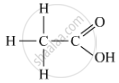
When ethanoic acid is warmed with methanol in the presence of a few drops of concentrated sulphuric acid, the compound 'Y' with sweet fragrance is formed. This compound is called methyl ethanoate, and its molecular formula is CH3COOCH3.
The formula with its functional group is represented as:
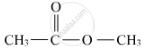
(b) The chemical equation of the above stated reaction is as follows:
`CH_3 COOH + C_2 H_5 OH`
`CH_3 COOC_2 H_5 + H_2O`
APPEARS IN
RELATED QUESTIONS
Write three different chemical reactions showing the conversion of ethanoic acid to sodium ethanoate. Write balanced chemical equation in each case. Write the name of the reactants and the products other ethanoic acid and sodium ethanoate in each case.
What do you observe when you drop a few drops of acetic acid to test tubes containing
(a) phenolphthalein
(b) distilled water
(c) universal indicator
(d) sodium hydrogen carbonate powder
Fill in the blanks from the choices given within brackets:
The basicity of acetic acid is-------- (3, 1, 4).
Write the IUPAC names, common names and formulae of the first two members of the homologous series of carboxylic acids.
What is the physical state of CH3COOH?
Choose those compounds from the following which can turn blue litmus solution red:
HCHO, CH3COOH, CH3OH, C2H5OH, HCOOH, CH3CHO
Give reasons for your choice.
The structural formula of an ester is :

Write the formula of the acid and the alcohol from which it is formed.
What do you observe when acetic acid is added to a neutral FeCl3 solution?
A student takes 2 mL acetic acid in a dry test tube and adds a pinch of sodium hydrogen carbonate to it. He makes the following observations:
I. A colourless and odourless gas evolves with a brisk effervescence.
II. The gas turns lime water milky when passed through it.
III. The gas burns with an explosion when a burning splinter is brought near it.
IV. The gas extinguishes the burning splinter that is brought near it.
The correct observations are:
(A) I, II, and III
(B) II, III and IV
(C) III, IV and I
(D) IV, I and II
Which of the following observations is true about dilute solution of acetic acid?
(A) It smells like vinegar and turns red litmus blue
(B) It smells like onion and turns blue litmus red
(C) It smells like orange and turns red litmus blue
(D) It smells like vinegar and turns blue litmus red
A student takes Na2CO3 powder in a test tube and pours some drops of acetic acid over it. He observes:
(A) no reaction in the test tube
(B) colourless gas with pungent smell
(C) bubbles of a colourless and odourless gas
(D) white fumes with smell of vinegar
Why is Soda lime used not only NaOH?
How is ethyne prepared in the laboratory?
Choose the correct answer:
Select the acid which contains four hydrozen atoms in it.
State how the following conversions can be carried out:
Ethyl alcohol to Ethane
Explain the following reaction with an example.
Esterification
Which of the following represents saponification reaction?
Give the balanced chemical equation of the following reaction:
Neutralization of NaOH with ethanoic acid.
Give the balanced chemical equation of the following reaction:
Combustion of ethanol.
Give the balanced chemical equation of the following reaction:
Neutralization of NaOH with ethanoic acid.
