Advertisements
Advertisements
Question
Which of the following alkyl halides will undergo SN1 reaction most readily?
Options
\[\ce{(CH3)3C-F}\]
\[\ce{(CH3)3C-Cl}\]
\[\ce{(CH3)3C-Br}\]
\[\ce{(CH3)3C-I}\]
Advertisements
Solution
\[\ce{(CH3)3C-I}\]
Explanation:
\[\ce{(CH3)3C-I}\] will undergo SN1 reaction most readily as C-I bond is weakest, due to the large difference in the size of carbon and iodine.
APPEARS IN
RELATED QUESTIONS
In the following pair of halogen compounds, which compound undergoes a faster SN1 reaction?

Write the structure of the major organic product in the following reaction:
\[\ce{CH3CH(Br)CH2CH3 + NaOH ->[water]}\]
Arrange the compounds of the following set in order of reactivity towards SN2 displacement:
1-Bromo-3-methylbutane, 2-Bromo-2-methylbutane, 2-Bromo-3-methylbutane
Arrange the compounds of the following set in order of reactivity towards SN2 displacement:
1-Bromobutane, 1-Bromo-2, 2-dimethylpropane, 1-Bromo-2-methylbutane, 1-Bromo-3-methylbutane
Out of C6H5CH2Cl and C6H5CHClC6H5, which is more easily hydrolysed by aqueous KOH.
What happens when ethyl chloride is treated with aqueous KOH?
What happens when methyl chloride is treated with KCN?
Which of the following is a primary halide?
Most reactive halide towards SN1 reaction is ____________.
Which among MeX, RCH2X, R2CHX and R3CX is most reactive towards SN2 reaction?
Which of the following compounds is optically active?
Identify the end product (C) in the following sequence:
\[\ce{C2H5OH ->[SOCl2][Pyridine] A ->[KCN {(alc.)}] B ->[2H2O/H^+] C}\]
Ethylene chloride and ethylidene chloride are isomers. Identify the correct statements.
(i) Both the compounds form same product on treatment with alcoholic KOH.
(ii) Both the compounds form same product on treatment with aq.NaOH.
(iii) Both the compounds form same product on reduction.
(iv) Both the compounds are optically active.
Why are aryl halides less reactive towards nucleophilic substitution reactions than alkyl halides?
Which one of the following compounds is more reactive towards SN1 reaction?
Identify the product in the following reaction: 
Consider the reactions,
(i) \[\begin{array}{cc}
\phantom{}\ce{\underset{}{(CH3)2CH - CH2Br} ->[C2H5OH] \underset{}{(CH3)2CH - CH2OC2H5 + HBr}}\\
\end{array}\]
(ii) \[\begin{array}{cc}
\phantom{}\ce{\underset{}{(CH3)2CH - CH2Br} ->[C2H5O-] \underset{}{(CH3)2CH - CH2OC2H5 + Br-}}\\
\end{array}\]
The mechanisms of reactions (i) and (ii) are respectively:
The correct order of increasing reactivity of
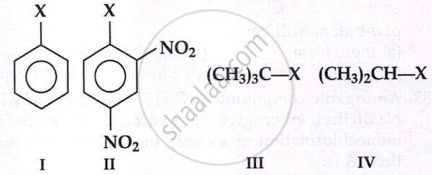
C-X bond towards nucleophile in the following compounds is:
Which of the following reactions is an example of nucleophilic substitution reaction?
The compound that will undergo SN1 reaction with the fastest rate is:
