Advertisements
Advertisements
Question
Which is the most suitable reagent for the following conversion?
\[\begin{array}{cc}
\phantom{....................}\ce{O}\phantom{.....................................}\ce{O}\phantom{.}\\
\phantom{....................}||\phantom{......................................}||\phantom{.}\\
\phantom{}\ce{CH3 - CH = CH - CH2 - C - CH3 -> CH3 - CH = CH - CH2 - C - OH}\phantom{.}
\end{array}\]
Options
Tollen’s reagent
Benzoyl peroxide
\[\ce{I2}\] and \[\ce{NaOH}\] solution
\[\ce{Sn}\] and \[\ce{NaOH}\] solution
Advertisements
Solution
\[\ce{I2}\] and \[\ce{NaOH}\] solution
Explanation:
\[\begin{array}{cc}
\phantom{......................}\ce{O}\phantom{....................................}\ce{O}\phantom{..............}\\
\phantom{....................}||\phantom{.....................................}||\phantom{............}\\
\phantom{}\ce{CH3CH = CH - CH2 - C - CH3 ->[I2 + NaOH] CH3CH = CHCH2 - C - ONa + CHI3}\\
\phantom{............................................}\ce{↓ H2O}\\
\phantom{.......................................................}\ce{O}\\
\phantom{.......................................................}||\\
\phantom{.........................................}\ce{CH3CH = CHCH2 - C - OH}
\end{array}\]
APPEARS IN
RELATED QUESTIONS
How is carbolic acid prepared from chlorobenzene?
Write the structures of A and B in the following reactions

Predict the products of the following reactions:

Show how the following compound can be converted to benzoic acid.
Bromobenzene
Predict the products formed when cyclohexanecarbaldehyde reacts with the following reagent.
Tollens’ reagent
An organic compound (A) (molecular formula C8H16O2) was hydrolysed with dilute sulphuric acid to give a carboxylic acid (B) and an alcohol (C). Oxidation of (C) with chromic acid produced (B). (C) on dehydration gives but-1-ene. Write equations for the reactions involved.
How will you bring about the following conversion in not more than two steps?
Benazaldehyde to α-Hydroxyphenylacetic acid
Complete the synthesis by giving missing starting material, reagent or product.
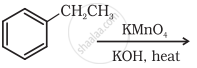
The reagent which does not react with both, acetone and benzaldehyde.
Through which of the following reactions number of carbon atoms can be increased in the chain?
(i) Grignard reaction
(ii) Cannizaro’s reaction
(iii) Aldol condensation
(iv) HVZ reaction
Match the reactions given in Column I with the suitable reagents given in Column II.
| Column I (Reactions) |
Column II (Reagents) |
| (i) Benzophenone Diphenylmethane | (a) \[\ce{LiAlH4}\] |
| (ii) Benzaldehyde 1-Phenylethanol | (b) \[\ce{DIBAL-H}\] |
| (iii) Cyclohexanone Cyclohexanol | (c) \[\ce{Zn(Hg)/Conc. HCl}\] |
| (iv) Phenyl benzoate Benzaldehyde | (d) \[\ce{CH3MgBr}\] |
Assertion: Aldehydes and ketones, both react with Tollen’s reagent to form silver mirror.
Reason: Both, aldehydes and ketones contain a carbonyl group.
Substitution of one alkyl group by replacing hydrogen of primary amines
The end product Y in the sequence of reaction:
\[\ce{RX ->[CN^-] X ->[NaOH] Y}\] is:
Alkaline hydrolysis of C4H8Cl2 gives a compound (A) which on heating with NaOH and I2 produces a yellow precipitate of CHI3. The compound (A) should be ______.
Fill in the blanks by choosing the appropriate words from those given in the brackets:
[stable, low, aldehyde, unstable, 6, 4, ethane, Clemmensen’s, 2, 3, carboxylic acid, high, propane, Rosenmund's]
The primary alcohols are easily oxidised first into ______ and then into ______.
