Advertisements
Advertisements
Question
Name the reagents used in the following reactions:

Advertisements
Solution

Name of the reagent: Alkaline potassium permanganate (KMnO4-KOH)
APPEARS IN
RELATED QUESTIONS
Write the structures of A and B in the following reactions

Show how the following compound can be converted to benzoic acid.
Bromobenzene
How will you prepare the given compound from benzene? You may use any inorganic reagent and any organic reagent having not more than one carbon atom.
m-Nitrobenzoic acid
How will you prepare the given compound from benzene? You may use any inorganic reagent and any organic reagent having not more than one carbon atom.
Phenylacetic acid
How is methoxy benzene prepared from carbolic acid?
The reagent which does not react with both, acetone and benzaldehyde.
Substitution of one alkyl group by replacing hydrogen of primary amines
Benzoic acid can be obtained by the oxidation of all of the following EXCEPT ______.
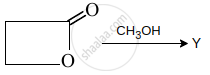
Y is:
Hex-4-ene-2-ol on treatment with PCC gives 'A'. 'A' on reaction with sodium hypoiodite gives 'B', which on further heating with soda lime gives 'C. The compound 'C' is ______.
