Advertisements
Advertisements
Question
Which of the curves in the following figure represents the relation between Celsius and Fahrenheit temperatures?
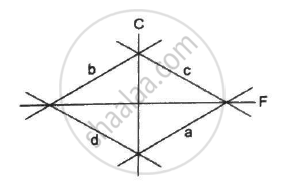
Options
a
b
c
d
Advertisements
Solution
The correct option is (a).
Celsius and Fahrenheit temperatures are related in the following way:
C = `5/9"F" - 160/9`
Here, F = temperature in Fahrenheit
C = temperature in Celsius
If this equation is plotted on the graph, then the curve will be represented by curve 'a' lying in the fourth quadrant with slope 5/9.
Notes
Figure is missing in the question.
APPEARS IN
RELATED QUESTIONS
The dimensions of emissive power are ______.
Answer the following:
There were two fixed points in the original Celsius scale as mentioned above which were assigned the number 0 °C and 100 °C respectively. On the absolute scale, one of the fixed points is the triple-point of water, which on the Kelvin absolute scale is assigned the number 273.16 K. What is the other fixed point on this (Kelvin) scale?
What is the temperature of the triple-point of water on an absolute scale whose unit interval size is equal to that of the Fahrenheit scale?
A spherical shell is heated. The volume changes according to the equation Vθ = V0 (1 + γθ). Does the volume refer to the volume enclosed by the shell or the volume of the material making up the shell?
The temperature of water at the surface of a deep lake is 2°C. The temperature expected at the bottom is
As the temperature is increased, the time period of a pendulum
Two bodies at different temperatures are mixed in a calorimeter. Which of the following quantities remains conserved?
If heat is supplied to a solid, its temperature
(a) must increase
(b) may increase
(c) may remain constant
(d) may decrease
The temperature of an object is observed to rise in a period. In this period
(a) heat is certainly supplied to it
(b) heat is certainly not supplied to it
(c) heat may have been supplied to it
(d) work may have been done on it
Heat and work are equivalent. This means, ____________ .
The volume of a glass vessel is 1000 cc at 20°C. What volume of mercury should be poured into it at this temperature so that the volume of the remaining space does not change with temperature? Coefficients of cubical expansion of mercury and glass are 1.8 × 10⁻⁶ °C–1 and 9.0 × 10⁻⁶ °C–1 , respectively.
A steel rod of length 1 m rests on a smooth horizontal base. If it is heated from 0°C to 100°C, what is the longitudinal strain developed?
A steel ball that is initially at a pressure of 1.0 × 10⁵ Pa is heated from 20°C to 120°C, keeping its volume constant.
Find the pressure inside the ball. Coefficient of linear expansion of steel = 12 × 10–6 °C–1and bulk modulus of steel = 1.6 × 10¹¹ Nm–2.
Answer the following question.
Clearly, state the difference between heat and temperature?
Our normal body temperature is ______.
The temperature of a liquid drops from 365 K to 361 K in 2 min. Find the time during which the temperature of the liquid drops from 344 K to 342 K.
(Take, room temperature = 293 K)
What is the SI unit of heat?
When two bodies at different temperatures are placed in contact, heat flows from ______.
What is the approximate interatomic spacing in gases at NTP (Normal Temperature and Pressure)?
