Advertisements
Advertisements
प्रश्न
Which of the curves in the following figure represents the relation between Celsius and Fahrenheit temperatures?
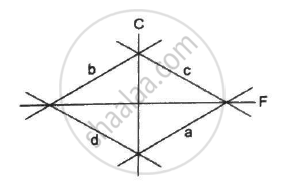
पर्याय
a
b
c
d
Advertisements
उत्तर
The correct option is (a).
Celsius and Fahrenheit temperatures are related in the following way:
C = `5/9"F" - 160/9`
Here, F = temperature in Fahrenheit
C = temperature in Celsius
If this equation is plotted on the graph, then the curve will be represented by curve 'a' lying in the fourth quadrant with slope 5/9.
Notes
Figure is missing in the question.
APPEARS IN
संबंधित प्रश्न
What is the temperature of the triple-point of water on an absolute scale whose unit interval size is equal to that of the Fahrenheit scale?
A body cools from 80° C to 70° C in 5 minutes and to 62° C in the next 5 minutes. Calculate the temperature of the surroundings.
Does the temperature of a body depend on the frame from which it is observed?
Which of the following pairs may give equal numerical values of the temperature of a body?
If the temperature of a uniform rod is slightly increased by ∆t, its moment of inertia I about a line parallel to itself will increase by
An aluminium sphere is dipped into water at 10°C. If the temperature is increased, the force of buoyancy
As the temperature is increased, the time period of a pendulum
The atmospheric temperature in the cities on sea-coast change very little. Explain
Should a thermometer bulb have large heat capacity or small heat capacity?
The heat capacity of a body depends on
(a) the heat given
(b) the temperature raised
(c) the mass of the body
(d) the material of the body
The temperature of an object is observed to rise in a period. In this period
(a) heat is certainly supplied to it
(b) heat is certainly not supplied to it
(c) heat may have been supplied to it
(d) work may have been done on it
Heat and work are equivalent. This means, ____________ .
A steel rod of length 1 m rests on a smooth horizontal base. If it is heated from 0°C to 100°C, what is the longitudinal strain developed?
A steel ball that is initially at a pressure of 1.0 × 10⁵ Pa is heated from 20°C to 120°C, keeping its volume constant.
Find the pressure inside the ball. Coefficient of linear expansion of steel = 12 × 10–6 °C–1and bulk modulus of steel = 1.6 × 10¹¹ Nm–2.
Answer the following question.
Clearly, state the difference between heat and temperature?
Two objects are said to be in thermal contact if they can exchange heat energy.
The normal temperature of our body is 37°C.
Analogy
Evaporation:: 100°C: Freezing:: ______.
Heat given to a body that raises its temperature by 1°C is ______.
When two bodies at different temperatures are placed in contact, heat flows from ______.
