Advertisements
Advertisements
प्रश्न
Which of the curves in the following figure represents the relation between Celsius and Fahrenheit temperatures?
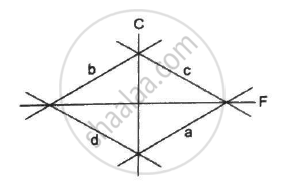
विकल्प
a
b
c
d
Advertisements
उत्तर
The correct option is (a).
Celsius and Fahrenheit temperatures are related in the following way:
C = `5/9"F" - 160/9`
Here, F = temperature in Fahrenheit
C = temperature in Celsius
If this equation is plotted on the graph, then the curve will be represented by curve 'a' lying in the fourth quadrant with slope 5/9.
Notes
Figure is missing in the question.
APPEARS IN
संबंधित प्रश्न
Compute the temperature at which the r.m.s. speed of nitrogen molecules is 832 m/s. [Universal gas constant, R = 8320 J/k mole K, molecular weight of nitrogen = 28.]
The light from the Sun is found to have a maximum intensity near the wavelength of 470 nm. Assuming the surface of the Sun as a black body, the temperature of the Sun is _____________.
[Wien's constant b = 2 .898 x l0- 3mK]
What is the temperature of the triple-point of water on an absolute scale whose unit interval size is equal to that of the Fahrenheit scale?
The susceptibility of magnesium at 300K is 1.2 x 10⁻⁵. At what temperature will the susceptibility increase to 1.8 X 10⁻⁵?
The kinetic energy per molecule of a gs at temperature T is ________.
(a) `(3/2)RT`
(b) `(3/2)K_BT`
(c) `(2/3) RT`
(d) `(3/2)("RT"/M)`
Does the temperature of a body depend on the frame from which it is observed?
Why do marine animals live deep inside a lake when the surface of the lake freezes?
In a calorimeter, the heat given by the hot object is assumed to be equal to the heat taken by the cold object. Does it mean that heat of the two objects taken together remains constant?
The heat capacity of a body depends on
(a) the heat given
(b) the temperature raised
(c) the mass of the body
(d) the material of the body
A resistance thermometer reads R = 20.0 Ω, 27.5 Ω, and 50.0 Ω at the ice point (0°C), the steam point (100°C) and the zinc point (420°C), respectively. Assuming that the resistance varies with temperature as Rθ = R0 (1 + αθ + βθ2), find the values of R0, α and β. Here θ represents the temperature on the Celsius scale.
A concrete slab has a length of 10 m on a winter night when the temperature is 0°C. Find the length of the slab on a summer day when the temperature is 35°C. The coefficient of linear expansion of concrete is 1.0 × 10⁻⁵ °C–1.
A metre scale made of steel is calibrated at 20°C to give correct reading. Find the distance between the 50 cm mark and the 51 cm mark if the scale is used at 10°C. Coefficient of linear expansion of steel is 1.1 × 10⁻⁵ °C–1.
A circular hole of diameter 2.00 cm is made in an aluminium plate at 0°C. What will be the diameter at 100°C? α for aluminium = 2.3 × 10⁻⁵ °C–1.
The densities of wood and benzene at 0°C are 880 kg m3 and 900 kg m–3 , respectively. The coefficients of volume expansion are 1.2 × 10⁻³ °C–1 for wood and 1.5 × 10⁻³ °C–1for benzene. At what temperature will a piece of wood just sink in benzene?
Explain the meaning of heat and work with suitable examples.
Two objects are said to be in thermal contact if they can exchange heat energy.
Two identical beakers A and B contain equal volumes of two different liquids at 60°C each and is left to cool down. Liquid in A has a density of 8 × 10² kg/m3 and specific heat of 2000 J kg-1 K-1 while the liquid in B has a density of 103 kg m-3 and specific heat of 4000 J kg-1 K-1. Which of the following best describes their temperature versus time graph schematically? (assume the emissivity of both the beakers to be the same.)
Heat given to a body that raises its temperature by 1°C is ______.
What is the SI unit of heat?
