Advertisements
Advertisements
प्रश्न
Explain the meaning of heat and work with suitable examples.
Advertisements
उत्तर
Meaning of heat: When an object at a higher temperature is placed in contact with another object at a lower temperature, there will be a spontaneous flow of energy from the object at a higher temperature to the one at a lower temperature. This energy is called heat. This process of energy transfer from higher temperature objects to lower temperature objects is called heating. Due to the flow of heat sometimes the temperature of the body will increase or sometimes it may not increase.
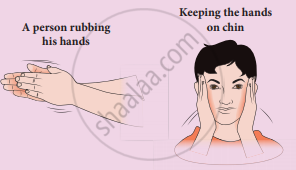
Meaning of work: When you rub your hands against each other the temperature of the hand's increases. You have done some work on your hands by rubbing. The temperature of the hands increases due to this work. Now if you place your hands on the cheek, the temperature of the cheek increases. This is because the hands are at a higher temperature than the cheek. In the above example, the temperature of the hands is increased due to work, and the temperature of the cheek is increased due to heat transfer from the hands to the chin. It is shown in the Figure. By doing work on the system, the temperature in the system will increase and sometimes may not. Like heat, work is also not a quantity and through the work-energy is transferred to the system. So we cannot use the word ‘the object contains more work’ or ‘less work’.
Either the system can transfer energy to the surrounding by doing work on surrounding or the surrounding may transfer energy to the system by doing work on the system. For the transfer of energy from one body to another body through the process of work, they need not be at different temperatures.
APPEARS IN
संबंधित प्रश्न
Define emissive power and coefficient of emmision of a body.
A pinhole is made in a hollow sphere of radius 5 cm whose inner wall is at temperature 727oC. Find the power radiated per unit area. [Stefan’s constant σ = 5.7 x 10⁻⁸ J/m2 s K4 , emissivity (e) = 0.2]
Can the bulb of a thermometer be made of an adiabatic wall?
The atmospheric temperature in the cities on sea-coast change very little. Explain
When a hot liquid is mixed with a cold liquid, the temperature of the mixture ____________ .
Our normal body temperature is ______.
What is the SI unit of heat?
What is the approximate interatomic spacing in gases at NTP (Normal Temperature and Pressure)?
Which of the following correctly differentiates heat from temperature?
The concept of thermal equilibrium, where heat flows between bodies until they reach the same temperature, is the basis of which law of thermodynamics?
