Advertisements
Advertisements
Question
Explain the meaning of heat and work with suitable examples.
Advertisements
Solution
Meaning of heat: When an object at a higher temperature is placed in contact with another object at a lower temperature, there will be a spontaneous flow of energy from the object at a higher temperature to the one at a lower temperature. This energy is called heat. This process of energy transfer from higher temperature objects to lower temperature objects is called heating. Due to the flow of heat sometimes the temperature of the body will increase or sometimes it may not increase.
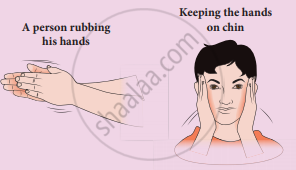
Meaning of work: When you rub your hands against each other the temperature of the hand's increases. You have done some work on your hands by rubbing. The temperature of the hands increases due to this work. Now if you place your hands on the cheek, the temperature of the cheek increases. This is because the hands are at a higher temperature than the cheek. In the above example, the temperature of the hands is increased due to work, and the temperature of the cheek is increased due to heat transfer from the hands to the chin. It is shown in the Figure. By doing work on the system, the temperature in the system will increase and sometimes may not. Like heat, work is also not a quantity and through the work-energy is transferred to the system. So we cannot use the word ‘the object contains more work’ or ‘less work’.
Either the system can transfer energy to the surrounding by doing work on surrounding or the surrounding may transfer energy to the system by doing work on the system. For the transfer of energy from one body to another body through the process of work, they need not be at different temperatures.
APPEARS IN
RELATED QUESTIONS
What is the temperature of the triple-point of water on an absolute scale whose unit interval size is equal to that of the Fahrenheit scale?
If the temperature of a uniform rod is slightly increased by ∆t, its moment of inertia I about a line parallel to itself will increase by
The atmospheric temperature in the cities on sea-coast change very little. Explain
Water equivalent of a body is measured in ___________ .
If heat is supplied to a solid, its temperature
(a) must increase
(b) may increase
(c) may remain constant
(d) may decrease
A circular hole of diameter 2.00 cm is made in an aluminium plate at 0°C. What will be the diameter at 100°C? α for aluminium = 2.3 × 10⁻⁵ °C–1.
A steel rod of length 1 m rests on a smooth horizontal base. If it is heated from 0°C to 100°C, what is the longitudinal strain developed?
The normal temperature of our body is 37°C.
Give reasons for the following:
Hot metal ball of 80° C is dipped into water of 80°C. The ball will not contract.
An earthen pitcher loses 1 gm of water per minute due to evaporation. If the water equivalent of the pitcher is 0.5 kg and the pitcher contains 9.5 kg of water, calculate the time required for the water in a pitcher to cool to 28°C from the original temperature of 30°C. Neglect radiation effects. The latent heat of vaporization in this range of temperature is 580 Cal/gm and the specific heat of water is 1 Cal/gm°C.
