Advertisements
Advertisements
Question
When BCl3 is treated with water, it hydrolyses and forms [B[OH]4]– only whereas AlCl3 in acidified aqueous solution forms [Al(H2O)6]3+ ion. Explain what is the hybridisation of boron and aluminium in these species?
Advertisements
Solution
\[\ce{BCl3 + 3H2O -> B(OH)3 + 3HCl}\]
\[\ce{B(OH)3 + H2O -> [B(OH)4]– + H+}\]
B(OH)3 due to its incomplete octet accepts an electron pair (as OH–) to give [B(OH)4]–. Boron in this ion involves one 2s orbital and three 2p orbitals. Thus, hybridisation of B in [B(OH)4]– is sp3.
\[\ce{AlCl3 + 6H2O ->[HCl] [Al(H2O)6]^{3+} + 3Cl-}\]
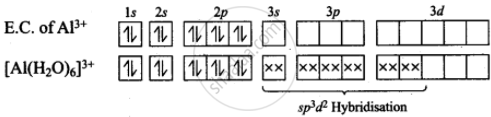
Hence, hybridisation of Al is sp3d2.
APPEARS IN
RELATED QUESTIONS
If B–Cl bond has a dipole moment, explain why BCl3 molecule has zero dipole moment.
Suggest reasons why the B–F bond lengths in BF3 (130 pm) and `"BF"_4^(-)` (143 pm) differ.
What happens when BF3 is reacted with ammonia?
What do you understand by inert pair effect?
Write a balanced equation for B2H6 + NH3 → ?
A compound X, of boron reacts with NH3 on heating to give another compound Y which is called inorganic benzene. The compound X can be prepared by treating BF3 with Lithium aluminium hydride. The compounds X and Y are represented by the formulas.
The most commonly used reducing agent is ______.
Cement, the important building material is a mixture of oxides of several elements. Besides calcium, iron and sulphur, oxides of elements of which of the group (s) are present in the mixture?
Explain why the following compounds behave as Lewis acids?
AlCl3
Aluminium dissolves in mineral acids and aqueous alkalies and thus shows amphoteric character. A piece of aluminium foil is treated with dilute hydrochloric acid or dilute sodium hydroxide solution in a test tube and on bringing a burning matchstick near the mouth of the test tube, a pop sound indicates the evolution of hydrogen gas. The same activity when performed with concentrated nitric acid, reaction doesn’t proceed. Explain the reason.
Explain the following:
PbX2 is more stable than PbX4.
Explain the following:
Tl (NO3)3 acts as an oxidising agent.
Describe the general trends in the following properties of the elements in Groups 13 and 14.
Ionisation enthalpy
Describe the general trends in the following properties of the elements in Groups 13 and 14.
Metallic character
Describe the general trends in the following properties of the elements in Groups 13 and 14.
Nature of halides
Account for the following observations:
PbO2 is a stronger oxidising agent than SnO2
Three pairs of compounds are given below. Identify that compound in each of the pairs which has group 13 element in more stable oxidation state. Give reason for your choice. State the nature of bonding also.
AlCl3 , AlCl
Boron compounds behave as Lewis acids because of their ______.
Which one of the following is the correct statement?
