Advertisements
Advertisements
Question
What type of a quadrilateral do the points A(2, –2), B(7, 3), C(11, –1) and D(6, –6) taken in that order, form?
Advertisements
Solution
The points are A(2, –2), B(7, 3), C(11, –1) and D(6, –6)
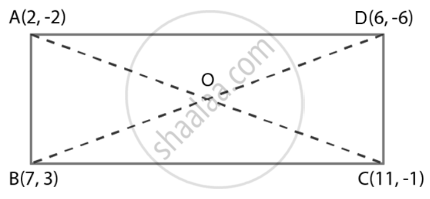
Using distance formula,
d = `sqrt((x_2 - x_1)^2 + (y_2 - y_1)^2`
AB = `sqrt((7 - 2)^2 + (3 + 2)^2`
= `sqrt((5)^2 + (5)^2`
= `sqrt(25 + 25)`
= `sqrt(50)`
= 5`sqrt(2)`
BC = `sqrt((11 - 7)^2 + (-1 - 3)^2`
= `sqrt((4)^2 + (-4)^2`
= `sqrt(16 + 16)`
= `sqrt(32)`
= `4sqrt(2)`
CD = `sqrt((6 - 11)^2 + (-6 + 1)^2`
= `sqrt((-5)^2 + (-5)^2`
= `sqrt(25 + 25)`
= `sqrt(50)`
= `5sqrt(2)`
DA = `sqrt((2 - 6)^2 + (-2 + 6)^2`
= `sqrt((-4)^2 + (4)^2`
= `sqrt(16 + 16)`
= `sqrt(32)`
= `4sqrt(2)`
Finding diagonals AC and BD, we get,
AC = `sqrt((11 - 2)^2 + (-1 + 2)^2`
= `sqrt((9)^2 + (1)^2`
= `sqrt(81 + 1)`
= `sqrt(82)`
And BD = `sqrt((6 - 7)^2 + (-6 - 3)^2`
= `sqrt((-1)^2 + (-9)^2`
= `sqrt(1 + 81)`
= `sqrt(82)`
The quadrilateral formed is rectangle.
APPEARS IN
RELATED QUESTIONS
Find the distance between two points
(i) P(–6, 7) and Q(–1, –5)
(ii) R(a + b, a – b) and S(a – b, –a – b)
(iii) `A(at_1^2,2at_1)" and " B(at_2^2,2at_2)`
If A (-1, 3), B (1, -1) and C (5, 1) are the vertices of a triangle ABC, find the length of the median through A.
Find the distance between the points:
P(a + b, a - b) and Q(a - b, a + b)
Find the distance of the following points from the origin:
(ii) B(-5,5)
If the point A(x,2) is equidistant form the points B(8,-2) and C(2,-2) , find the value of x. Also, find the value of x . Also, find the length of AB.
For what values of k are the points (8, 1), (3, –2k) and (k, –5) collinear ?
Find the distance between the following pairs of point.
W `((- 7)/2 , 4)`, X (11, 4)
AB and AC are the two chords of a circle whose radius is r. If p and q are
the distance of chord AB and CD, from the centre respectively and if
AB = 2AC then proove that 4q2 = p2 + 3r2.
Find the distance between the following point :
(sec θ , tan θ) and (- tan θ , sec θ)
Find the relation between a and b if the point P(a ,b) is equidistant from A (6,-1) and B (5 , 8).
Show that the points (2, 0), (–2, 0), and (0, 2) are the vertices of a triangle. Also, a state with the reason for the type of triangle.
Show that (-3, 2), (-5, -5), (2, -3) and (4, 4) are the vertices of a rhombus.
The centre of a circle is (2x - 1, 3x + 1). Find x if the circle passes through (-3, -1) and the length of its diameter is 20 unit.
Calculate the distance between A (7, 3) and B on the x-axis whose abscissa is 11.
Find distance CD where C(– 3a, a), D(a, – 2a)
Show that A(1, 2), (1, 6), C(1 + 2 `sqrt(3)`, 4) are vertices of a equilateral triangle
Point P(0, 2) is the point of intersection of y-axis and perpendicular bisector of line segment joining the points A(–1, 1) and B(3, 3).
Points A(4, 3), B(6, 4), C(5, –6) and D(–3, 5) are the vertices of a parallelogram.
Show that Alia's house, Shagun's house and library for an isosceles right triangle.
