English

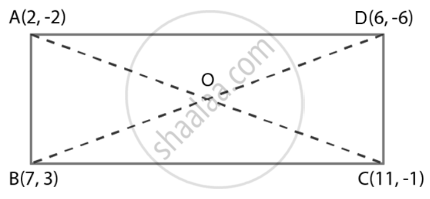
What type of a quadrilateral do the points A(2, –2), B(7, 3), C(11, –1) and D(6, –6) taken in that order, form? - Mathematics
Advertisements
Advertisements

Question

What type of a quadrilateral do the points A(2, –2), B(7, 3), C(11, –1) and D(6, –6) taken in that order, form?

Sum
Advertisements

Solution

The points are A(2, –2), B(7, 3), C(11, –1) and D(6, –6)


Using distance formula,

d = `sqrt((x_2 - x_1)^2 + (y_2 - y_1)^2`

AB = `sqrt((7 - 2)^2 + (3 + 2)^2`

= `sqrt((5)^2 + (5)^2`

= `sqrt(25 + 25)`

= `sqrt(50)`

= 5`sqrt(2)`

BC = `sqrt((11 - 7)^2 + (-1 - 3)^2`

= `sqrt((4)^2 + (-4)^2`

= `sqrt(16 + 16)`

= `sqrt(32)`

= `4sqrt(2)`

CD = `sqrt((6 - 11)^2 + (-6 + 1)^2`

= `sqrt((-5)^2 + (-5)^2`

= `sqrt(25 + 25)`

= `sqrt(50)`

= `5sqrt(2)`

DA = `sqrt((2 - 6)^2 + (-2 + 6)^2`

= `sqrt((-4)^2 + (4)^2`

= `sqrt(16 + 16)`

= `sqrt(32)`

= `4sqrt(2)`

Finding diagonals AC and BD, we get,

AC = `sqrt((11 - 2)^2 + (-1 + 2)^2`

= `sqrt((9)^2 + (1)^2`

= `sqrt(81 + 1)`

= `sqrt(82)`

And BD = `sqrt((6 - 7)^2 + (-6 - 3)^2`

= `sqrt((-1)^2 + (-9)^2`

= `sqrt(1 + 81)`

= `sqrt(82)`

The quadrilateral formed is rectangle.

shaalaa.com
  Is there an error in this question or solution?
Chapter 7: Coordinate Geometry - Exercise 7.3 [Page 83]

APPEARS IN

NCERT Exemplar Mathematics [English] Class 10
Chapter 7 Coordinate Geometry
Exercise 7.3 | Q 3 | Page 83

Video TutorialsVIEW ALL [1]

RELATED QUESTIONS

If two vertices of an equilateral triangle be (0, 0), (3, √3 ), find the third vertex


Find the distance between the following pairs of points:

(a, b), (−a, −b)


Find the distance between the points (0, 0) and (36, 15). Can you now find the distance between the two towns A and B discussed in Section 7.2.


If a≠b≠0, prove that the points (a, a2), (b, b2) (0, 0) will not be collinear.


Show that the points A (1, −2), B (3, 6), C (5, 10) and D (3, 2) are the vertices of a parallelogram.


If the point A(x,2) is equidistant form the points B(8,-2) and C(2,-2) , find the value of x. Also, find the value of x . Also, find the length of AB.


Using the distance formula, show that the given points are collinear:

(-2, 5), (0,1) and (2, -3)


Find the distance between the following pair of points.

L(5, –8), M(–7, –3)


If the point P(2, 1) lies on the line segment joining points A(4, 2) and B(8, 4), then ______.


Find the distance of the following point from the origin :

(8 , 15)


Find the distance between the following point :

(Sin θ - cosec θ , cos θ - cot θ) and (cos θ - cosec θ , -sin θ - cot θ)


Prove that the points (7 , 10) , (-2 , 5) and (3 , -4) are vertices of an isosceles right angled triangle.


Find the distance between the origin and the point:
(-5, -12)


Show that the points P (0, 5), Q (5, 10) and R (6, 3) are the vertices of an isosceles triangle.


Show that (-3, 2), (-5, -5), (2, -3) and (4, 4) are the vertices of a rhombus.


By using the distance formula prove that each of the following sets of points are the vertices of a right angled triangle.
(i) (6, 2), (3, -1) and (- 2, 4)
(ii) (-2, 2), (8, -2) and (-4, -3).


The distance between the points A(0, 6) and B(0, -2) is ______.


Find the points on the x-axis which are at a distance of `2sqrt(5)` from the point (7, – 4). How many such points are there?


Show that points A(–1, –1), B(0, 1), C(1, 3) are collinear.


Share
Notifications

Englishहिंदीमराठी


      Forgot password?
Use app×