हिंदी

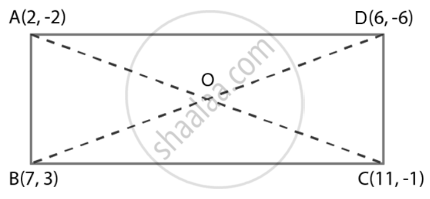
What type of a quadrilateral do the points A(2, –2), B(7, 3), C(11, –1) and D(6, –6) taken in that order, form? - Mathematics
Advertisements
Advertisements

प्रश्न

What type of a quadrilateral do the points A(2, –2), B(7, 3), C(11, –1) and D(6, –6) taken in that order, form?

योग
Advertisements

उत्तर

The points are A(2, –2), B(7, 3), C(11, –1) and D(6, –6)


Using distance formula,

d = `sqrt((x_2 - x_1)^2 + (y_2 - y_1)^2`

AB = `sqrt((7 - 2)^2 + (3 + 2)^2`

= `sqrt((5)^2 + (5)^2`

= `sqrt(25 + 25)`

= `sqrt(50)`

= 5`sqrt(2)`

BC = `sqrt((11 - 7)^2 + (-1 - 3)^2`

= `sqrt((4)^2 + (-4)^2`

= `sqrt(16 + 16)`

= `sqrt(32)`

= `4sqrt(2)`

CD = `sqrt((6 - 11)^2 + (-6 + 1)^2`

= `sqrt((-5)^2 + (-5)^2`

= `sqrt(25 + 25)`

= `sqrt(50)`

= `5sqrt(2)`

DA = `sqrt((2 - 6)^2 + (-2 + 6)^2`

= `sqrt((-4)^2 + (4)^2`

= `sqrt(16 + 16)`

= `sqrt(32)`

= `4sqrt(2)`

Finding diagonals AC and BD, we get,

AC = `sqrt((11 - 2)^2 + (-1 + 2)^2`

= `sqrt((9)^2 + (1)^2`

= `sqrt(81 + 1)`

= `sqrt(82)`

And BD = `sqrt((6 - 7)^2 + (-6 - 3)^2`

= `sqrt((-1)^2 + (-9)^2`

= `sqrt(1 + 81)`

= `sqrt(82)`

The quadrilateral formed is rectangle.

shaalaa.com
  क्या इस प्रश्न या उत्तर में कोई त्रुटि है?
अध्याय 7: Coordinate Geometry - Exercise 7.3 [पृष्ठ ८३]

APPEARS IN

एनसीईआरटी एक्झांप्लर Mathematics [English] Class 10
अध्याय 7 Coordinate Geometry
Exercise 7.3 | Q 3 | पृष्ठ ८३

वीडियो ट्यूटोरियलVIEW ALL [1]

संबंधित प्रश्न

If the point P(2, 2) is equidistant from the points A(−2, k) and B(−2k, −3), find k. Also find the length of AP.


Find the distance between two points

(i) P(–6, 7) and Q(–1, –5)

(ii) R(a + b, a – b) and S(a – b, –a – b)

(iii) `A(at_1^2,2at_1)" and " B(at_2^2,2at_2)`


Prove that the points (–3, 0), (1, –3) and (4, 1) are the vertices of an isosceles right angled triangle. Find the area of this triangle


Find the distance between the following pairs of points:

(2, 3), (4, 1)


Name the type of quadrilateral formed, if any, by the following point, and give reasons for your answer:

 (−3, 5), (3, 1), (0, 3), (−1, −4)


Two opposite vertices of a square are (-1, 2) and (3, 2). Find the coordinates of other two
vertices.


Given a triangle ABC in which A = (4, −4), B = (0, 5) and C = (5, 10). A point P lies on BC such that BP : PC = 3 : 2. Find the length of line segment AP.


Determine whether the points are collinear.

 L(–2, 3), M(1, –3), N(5, 4)


Show that the ▢PQRS formed by P(2, 1), Q(–1, 3), R(–5, –3) and S(–2, –5) is a rectangle.


Prove that the points (0 , -4) , (6 , 2) , (3 , 5) and (-3 , -1) are the vertices of a rectangle.


A(2, 5), B(-2, 4) and C(-2, 6) are the vertices of a triangle ABC. Prove that ABC is an isosceles triangle. 


From the given number line, find d(A, B):


Find the distance between the points (a, b) and (−a, −b).


A point P lies on the x-axis and another point Q lies on the y-axis.
Write the abscissa of point Q.


Calculate the distance between A (7, 3) and B on the x-axis whose abscissa is 11.


The points A (3, 0), B (a, -2) and C (4, -1) are the vertices of triangle ABC right angled at vertex A. Find the value of a.


The points (– 4, 0), (4, 0), (0, 3) are the vertices of a ______.


If (– 4, 3) and (4, 3) are two vertices of an equilateral triangle, find the coordinates of the third vertex, given that the origin lies in the interior of the triangle.


The distance between the points (0, 5) and (–3, 1) is ______.


The distance of the point (5, 0) from the origin is ______.


Share
Notifications

Englishहिंदीमराठी


      Forgot password?
Use app×