Advertisements
Advertisements
प्रश्न
What type of a quadrilateral do the points A(2, –2), B(7, 3), C(11, –1) and D(6, –6) taken in that order, form?
Advertisements
उत्तर
The points are A(2, –2), B(7, 3), C(11, –1) and D(6, –6)
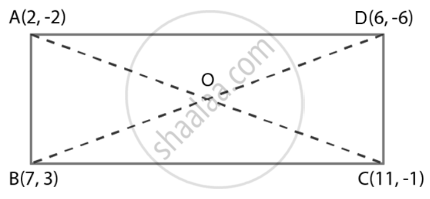
Using distance formula,
d = `sqrt((x_2 - x_1)^2 + (y_2 - y_1)^2`
AB = `sqrt((7 - 2)^2 + (3 + 2)^2`
= `sqrt((5)^2 + (5)^2`
= `sqrt(25 + 25)`
= `sqrt(50)`
= 5`sqrt(2)`
BC = `sqrt((11 - 7)^2 + (-1 - 3)^2`
= `sqrt((4)^2 + (-4)^2`
= `sqrt(16 + 16)`
= `sqrt(32)`
= `4sqrt(2)`
CD = `sqrt((6 - 11)^2 + (-6 + 1)^2`
= `sqrt((-5)^2 + (-5)^2`
= `sqrt(25 + 25)`
= `sqrt(50)`
= `5sqrt(2)`
DA = `sqrt((2 - 6)^2 + (-2 + 6)^2`
= `sqrt((-4)^2 + (4)^2`
= `sqrt(16 + 16)`
= `sqrt(32)`
= `4sqrt(2)`
Finding diagonals AC and BD, we get,
AC = `sqrt((11 - 2)^2 + (-1 + 2)^2`
= `sqrt((9)^2 + (1)^2`
= `sqrt(81 + 1)`
= `sqrt(82)`
And BD = `sqrt((6 - 7)^2 + (-6 - 3)^2`
= `sqrt((-1)^2 + (-9)^2`
= `sqrt(1 + 81)`
= `sqrt(82)`
The quadrilateral formed is rectangle.
APPEARS IN
संबंधित प्रश्न
Find the distance between the following pairs of points:
(2, 3), (4, 1)
Find the distance between the following pairs of points:
(a, b), (−a, −b)
Name the type of quadrilateral formed, if any, by the following points, and give reasons for your answer:
(- 1, - 2), (1, 0), (- 1, 2), (- 3, 0)
Find the values of x, y if the distances of the point (x, y) from (-3, 0) as well as from (3, 0) are 4.
Two opposite vertices of a square are (-1, 2) and (3, 2). Find the coordinates of other two
vertices.
Given a triangle ABC in which A = (4, −4), B = (0, 5) and C = (5, 10). A point P lies on BC such that BP : PC = 3 : 2. Find the length of line segment AP.
Find the distance of the following points from the origin:
(ii) B(-5,5)
Using the distance formula, show that the given points are collinear:
(-2, 5), (0,1) and (2, -3)
Find the distance between the following pairs of point in the coordinate plane :
(4 , 1) and (-4 , 5)
Find the distance of the following point from the origin :
(13 , 0)
Prove that the points (0 , 0) , (3 , 2) , (7 , 7) and (4 , 5) are the vertices of a parallelogram.
Find the distance between the points (a, b) and (−a, −b).
The distance between the points (3, 1) and (0, x) is 5. Find x.
Point P (2, -7) is the center of a circle with radius 13 unit, PT is perpendicular to chord AB and T = (-2, -4); calculate the length of: AT

Calculate the distance between A (7, 3) and B on the x-axis whose abscissa is 11.
The distances of point P (x, y) from the points A (1, - 3) and B (- 2, 2) are in the ratio 2: 3.
Show that: 5x2 + 5y2 - 34x + 70y + 58 = 0.
The coordinates of the point which is equidistant from the three vertices of the ΔAOB as shown in the figure is ______.

A circle drawn with origin as the centre passes through `(13/2, 0)`. The point which does not lie in the interior of the circle is ______.
Name the type of triangle formed by the points A(–5, 6), B(–4, –2) and C(7, 5).
Find the value of a, if the distance between the points A(–3, –14) and B(a, –5) is 9 units.
