Advertisements
Advertisements
प्रश्न
The points A(–1, –2), B(4, 3), C(2, 5) and D(–3, 0) in that order form a rectangle.
पर्याय
True
False
Advertisements
उत्तर
This statement is True.
Explanation:
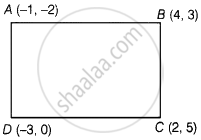
Distance between A(–1, –2), B(4, 3),
AB = `sqrt((x_2 - x_1)^2 + (y_2 - y_1)^2`
AB = `sqrt((4 + 1)^2 + (3 + 2)^2`
= `sqrt(5^2 + 5^2)`
= `sqrt(25 + 25)`
= `5sqrt(2)`
Distance between C(2, 5) and D(–3, 0),
CD = `sqrt((x_2 - x_1)^2 + (y_2 - y_1)^2`
CD = `sqrt((-3 - 2)^2 + (0 - 5)^2`
= `sqrt((-5)^2 + (-5)^2)`
= `sqrt(25 + 25)`
= `5sqrt(2)`
Distance between A(–1, –2) and D(–3, 0),
AD = `sqrt((-3 + 1)^2 + (0 + 2)^2`
= `sqrt((-2)^2 + 2^2)`
= `sqrt(4 + 4)`
= `2sqrt(2)`
And distance between B(4, 3) and C(2, 5),
BC = `sqrt((4 - 2)^2 + (3 - 5)^2`
= `sqrt(2^2 + (-2)^2)`
= `sqrt(4 + 4)`
= `2sqrt(2)`
We know that, in a rectangle, opposite sides and equal diagonals are equal and bisect each other.
Since, AB = CD and AD = BC
Also, distance between A(–1, –2) and C(2, 5),
AC = `sqrt((2 + 1)^2 + (5 + 2)^2`
= `sqrt(3^2 + 7^2)`
= `sqrt(9 + 49)`
= `sqrt(58)`
And distance between D(–3, 0) and B(4, 3),
DB = `sqrt((4 + 3)^2 + (3 - 0)^2`
= `sqrt(7^2 + 3^2)`
= `sqrt(49 + 9)`
= `sqrt(58)`
Since, diagonals AC and BD are equal.
Hence, the points A(–1, – 2), B(4, 3), C(2, 5) and D(–3, 0) form a rectangle.
APPEARS IN
संबंधित प्रश्न
If the distance between the points (4, k) and (1, 0) is 5, then what can be the possible values of k?
Find the distance between the following pair of points:
(asinα, −bcosα) and (−acos α, bsin α)
Find the value of a when the distance between the points (3, a) and (4, 1) is `sqrt10`
Given a triangle ABC in which A = (4, −4), B = (0, 5) and C = (5, 10). A point P lies on BC such that BP : PC = 3 : 2. Find the length of line segment AP.
Using the distance formula, show that the given points are collinear:
(-1, -1), (2, 3) and (8, 11)
Using the distance formula, show that the given points are collinear:
(-2, 5), (0,1) and (2, -3)
For what values of k are the points (8, 1), (3, –2k) and (k, –5) collinear ?
Determine whether the points are collinear.
L(–2, 3), M(1, –3), N(5, 4)
Find the distances between the following point.
R(–3a, a), S(a, –2a)
If A and B are the points (−6, 7) and (−1, −5) respectively, then the distance
2AB is equal to
Find the distance of the following point from the origin :
(0 , 11)
Find the coordinates of O, the centre passing through A( -2, -3), B(-1, 0) and C(7, 6). Also, find its radius.
Prove that the points (6 , -1) , (5 , 8) and (1 , 3) are the vertices of an isosceles triangle.
The centre of a circle is (2x - 1, 3x + 1). Find x if the circle passes through (-3, -1) and the length of its diameter is 20 unit.
Find the distance of the following points from origin.
(5, 6)
Find the distance of the following points from origin.
(a+b, a-b)
Give the relation that must exist between x and y so that (x, y) is equidistant from (6, -1) and (2, 3).
If the length of the segment joining point L(x, 7) and point M(1, 15) is 10 cm, then the value of x is ______
Show that the point (0, 9) is equidistant from the points (– 4, 1) and (4, 1)
What is the distance of the point (– 5, 4) from the origin?
