Advertisements
Advertisements
प्रश्न
The points A(–1, –2), B(4, 3), C(2, 5) and D(–3, 0) in that order form a rectangle.
विकल्प
True
False
Advertisements
उत्तर
This statement is True.
Explanation:
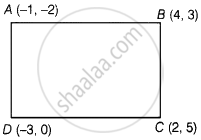
Distance between A(–1, –2), B(4, 3),
AB = `sqrt((x_2 - x_1)^2 + (y_2 - y_1)^2`
AB = `sqrt((4 + 1)^2 + (3 + 2)^2`
= `sqrt(5^2 + 5^2)`
= `sqrt(25 + 25)`
= `5sqrt(2)`
Distance between C(2, 5) and D(–3, 0),
CD = `sqrt((x_2 - x_1)^2 + (y_2 - y_1)^2`
CD = `sqrt((-3 - 2)^2 + (0 - 5)^2`
= `sqrt((-5)^2 + (-5)^2)`
= `sqrt(25 + 25)`
= `5sqrt(2)`
Distance between A(–1, –2) and D(–3, 0),
AD = `sqrt((-3 + 1)^2 + (0 + 2)^2`
= `sqrt((-2)^2 + 2^2)`
= `sqrt(4 + 4)`
= `2sqrt(2)`
And distance between B(4, 3) and C(2, 5),
BC = `sqrt((4 - 2)^2 + (3 - 5)^2`
= `sqrt(2^2 + (-2)^2)`
= `sqrt(4 + 4)`
= `2sqrt(2)`
We know that, in a rectangle, opposite sides and equal diagonals are equal and bisect each other.
Since, AB = CD and AD = BC
Also, distance between A(–1, –2) and C(2, 5),
AC = `sqrt((2 + 1)^2 + (5 + 2)^2`
= `sqrt(3^2 + 7^2)`
= `sqrt(9 + 49)`
= `sqrt(58)`
And distance between D(–3, 0) and B(4, 3),
DB = `sqrt((4 + 3)^2 + (3 - 0)^2`
= `sqrt(7^2 + 3^2)`
= `sqrt(49 + 9)`
= `sqrt(58)`
Since, diagonals AC and BD are equal.
Hence, the points A(–1, – 2), B(4, 3), C(2, 5) and D(–3, 0) form a rectangle.
APPEARS IN
संबंधित प्रश्न
If the point P(x, y) is equidistant from the points A(a + b, b – a) and B(a – b, a + b). Prove that bx = ay.
In a classroom, 4 friends are seated at the points A, B, C and D as shown in the following figure. Champa and Chameli walk into the class and after observing for a few minutes, Champa asks Chameli, “Don’t you think ABCD is a square?” Chameli disagrees.
Using distance formula, find which of them is correct.

ABC is a triangle and G(4, 3) is the centroid of the triangle. If A = (1, 3), B = (4, b) and C = (a, 1), find ‘a’ and ‘b’. Find the length of side BC.
Show that the quadrilateral whose vertices are (2, −1), (3, 4) (−2, 3) and (−3,−2) is a rhombus.
If A (-1, 3), B (1, -1) and C (5, 1) are the vertices of a triangle ABC, find the length of the median through A.
Find the distance between the points
P(a sin ∝,a cos ∝ )and Q( acos ∝ ,- asin ∝)
Find the distance between the following pairs of point in the coordinate plane :
(13 , 7) and (4 , -5)
Find the point on the x-axis equidistant from the points (5,4) and (-2,3).
P(5 , -8) , Q (2 , -9) and R(2 , 1) are the vertices of a triangle. Find tyhe circumcentre and the circumradius of the triangle.
Prove that the points (1 ,1),(-4 , 4) and (4 , 6) are the certices of an isosceles triangle.
Prove that the points (0,3) , (4,3) and `(2, 3+2sqrt 3)` are the vertices of an equilateral triangle.
Find the distance between the origin and the point:
(8, −15)
The distance between the points (3, 1) and (0, x) is 5. Find x.
What point on the x-axis is equidistant from the points (7, 6) and (-3, 4)?
A point P lies on the x-axis and another point Q lies on the y-axis.
If the abscissa of point P is -12 and the ordinate of point Q is -16; calculate the length of line segment PQ.
Find the distance of the following points from origin.
(a+b, a-b)
Find distance between point A(– 3, 4) and origin O
Find distance of point A(6, 8) from origin
AOBC is a rectangle whose three vertices are A(0, 3), O(0, 0) and B(5, 0). The length of its diagonal is ______.
The point which lies on the perpendicular bisector of the line segment joining the points A(–2, –5) and B(2, 5) is ______.
