Advertisements
Advertisements
प्रश्न
If a≠b≠0, prove that the points (a, a2), (b, b2) (0, 0) will not be collinear.
Advertisements
उत्तर
Let A(a, a2), B(b, b2) and C(0, 0) be the coordinates of the given points.
We know that the area of triangle having vertices (x1, y1), (x2, y2) and (x3, y3) is ∣∣`1/2`[x1(y2−y3)+x2(y3−y1)+x3(y1−y2)]∣∣ square units.
So,
Area of ∆ABC
`= |1/2|a(b^2 - 0) + b(0 - a^2) + 0(a^2 - b^2)||`
`=|1/2(ab^2 - a^2b)|`
`= 1/2|ab(b -a)|`
`!= 0 (∵ a!= b != 0)`
Since the area of the triangle formed by the points (a, a2), (b, b2) and (0, 0) is not zero, so the given points are not collinear.
APPEARS IN
संबंधित प्रश्न
If the point (x, y) is equidistant from the points (a + b, b – a) and (a – b, a + b), prove that bx = ay.
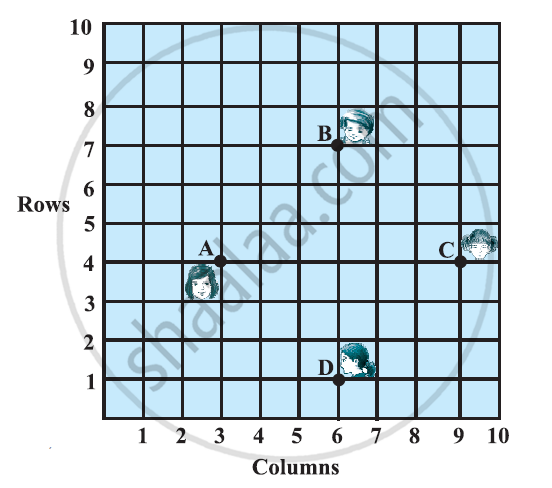
In a classroom, 4 friends are seated at the points A, B, C and D as shown in the following figure. Champa and Chameli walk into the class and after observing for a few minutes, Champa asks Chameli, “Don’t you think ABCD is a square?” Chameli disagrees.
Using distance formula, find which of them is correct.
If Q (0, 1) is equidistant from P (5, − 3) and R (x, 6), find the values of x. Also find the distance QR and PR.
Two opposite vertices of a square are (-1, 2) and (3, 2). Find the coordinates of other two
vertices.
A(–8, 0), B(0, 16) and C(0, 0) are the vertices of a triangle ABC. Point P lies on AB and Q lies on AC such that AP : PB = 3 : 5 and AQ : QC = 3 : 5. Show that : PQ = `3/8` BC.
For what values of k are the points (8, 1), (3, –2k) and (k, –5) collinear ?
Show that the points A(1, 2), B(1, 6), C(1 + 2`sqrt3`, 4) are vertices of an equilateral triangle.
Find the distance of a point (7 , 5) from another point on the x - axis whose abscissa is -5.
Prove that the following set of point is collinear :
(5 , 1),(3 , 2),(1 , 3)
ABCD is a square . If the coordinates of A and C are (5 , 4) and (-1 , 6) ; find the coordinates of B and D.
Find the distance between the following pairs of points:
(–3, 6) and (2, –6)
The distance between the points (3, 1) and (0, x) is 5. Find x.
A point P lies on the x-axis and another point Q lies on the y-axis.
Write the ordinate of point P.
Use distance formula to show that the points A(-1, 2), B(2, 5) and C(-5, -2) are collinear.
Show that each of the triangles whose vertices are given below are isosceles :
(i) (8, 2), (5,-3) and (0,0)
(ii) (0,6), (-5, 3) and (3,1).
Show that A(1, 2), (1, 6), C(1 + 2`sqrt(3)`, 4) are vertices of an equilateral triangle.
A circle drawn with origin as the centre passes through `(13/2, 0)`. The point which does not lie in the interior of the circle is ______.
The point A(2, 7) lies on the perpendicular bisector of line segment joining the points P(6, 5) and Q(0, – 4).
Find a point which is equidistant from the points A(–5, 4) and B(–1, 6)? How many such points are there?
The distance between the points (0, 5) and (–3, 1) is ______.
