Advertisements
Advertisements
Question
What is the action of following on ethyl bromide?
alcoholic sodium hydroxide
Advertisements
Solution
When ethyl bromide is boiled with an alcoholic solution of sodium hydroxide \[\ce{(NaOH)}\], an alkene is formed due to the elimination of hydrogen atoms from carbon and halogen from α-carbon, which is called dehydrohalogenation.
\[\ce{\underset{(Ethyl bromide)}{\overset{\beta\phantom{.............}\alpha\phantom{............}}{CH3 - CH2 - Br}} + \underset{(alc.)}{NaOH} ->[\Delta] \underset{(Ethene)}{CH2 = CH2} + NaBr + H2O}\]
APPEARS IN
RELATED QUESTIONS
from the following pair would undergo SN2 faster from the other?
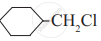

Complete the following reaction giving major products.
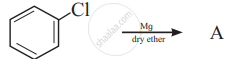
Name the reagent used to bring about the following conversion.
Ethyl bromide to ethyl isocyanide
Give reasons:
Haloarenes are less reactive than haloalkanes.
Convert the following:
2-Chloropropane to propan-1-ol
Convert the following:
tert-Butyl bromide to isobutyl bromide
Complete the following reaction sequence by writing the structural formulae of the organic compound 'A', 'B' and 'C'.
\[\ce{2-Bromobutane->[Alc.KOH]A->[][Br2]B->[][NaNH2]C}\]
Major product of the following reaction is _______________
\[\ce{CH3-CH2-Mg-Br + NH3 ->?}\]
In alkaline hydrolysis of tertiary butyl bromide, ____________.
How many metameric ethers are represented by the molecular formula C4H10O?
\[\ce{C6H5CH2Cl + KCN(alc) -> X + Y}\]
Compounds X and Y are ____________.
Which of the following carbocation is the most stable?
When C2H5Br is treated with excess of alc. NH3, the major product obtained is ____________.
The order of reactivity of the given haloalkanes towards nucleophiles is:
With which halogen the reactions, of alkanes are explosive?
The compound that reacts the fastest with sodium methoxide is ______.
Explain the dehydrohalogenation reaction of 2-chlorobutane.
Complete the following reaction giving a major product.
\[\begin{array}{cc}
\ce{CH3}\phantom{.................}\\
|\phantom{...................}\\
\ce{CH3 - C - CH2 - Cl->[Na/dry ether]A}\\
|\phantom{..................}\\
\ce{CH3}\phantom{................}
\end{array}\]
Observe the following and answer the questions given below:

Name the type of halogen derivative.
Observe the following and answer the question given below:

Comment on the bond length of C-X bond in it.
Complete the following reactions giving major product.
\[\begin{array}{cc}
\ce{CH3}\phantom{................}\\
|\phantom{...................}\\
\ce{CH3 - C - CH2 - Cl ->[Na/dry ether] A}\\
|\phantom{...................}\\
\ce{CH3}\phantom{.................}
\end{array}\]
Complete the following reaction giving major product.
\[\begin{array}{cc}
\ce{CH3}\phantom{...............}\\
|\phantom{..................}\\
\ce{CH3 - C - CH2 - Cl->[Na/dry ether]A}\\
|\phantom{..................}\\
\ce{CH3}\phantom{...............}\\
\end{array}\]
Complete the reaction:
\[\ce{CH3CH2Cl ->[AgCN][alc.\Delta]}\] ?
Identify the chiral molecule from the following.
Complete the following reaction giving major product.
\[\begin{array}{cc}
\ce{CH3}\phantom{................}\\
|\phantom{...................}\\
\ce{CH3 - C - CH2 - Cl->[Na/ dry ether]A}\\
|\phantom{...................}\\
\ce{CH3}\phantom{................}\\
\end{array}\]
Which of the following pair of compounds on heating gives butanenitrile?
