Advertisements
Advertisements
Question
Give reasons:
Haloarenes are less reactive than haloalkanes.
Advertisements
Solution
- The low reactivity of aryl halides is due to resonance effect and sp2 hybrid state of carbon to which halogen atom is attached.
- In aryl halides, one of the lone pairs of electrons on halogen atom is in conjugation with π-electrons of the ring. Due to resonance, the C–X bond acquires partial double bond character. Thus, the C–X bond in haloarenes is stronger and shorter than haloalkanes. Hence, it is difficult to break C–X bond in haloarenes. (e.g. C–Cl bond length in chlorobenzene is 169 pm as compared to C–Cl bond length in alkyl chloride which is 178 pm).
Therefore, haloarenes are less reactive than haloalkanes.
APPEARS IN
RELATED QUESTIONS
Complete the following reaction giving major products.
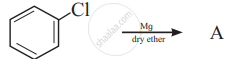
Name the reagent used to bring about the following conversion.
Bromoethane to ethoxyethane
Distinguish between SN1 and SN2 mechanism of substitution reaction.
Convert the following:
Propene to propan-1-ol
Convert the following:
Ethanol to propane nitrile
Convert the following:
tert-Butyl bromide to isobutyl bromide
Observe the following and answer the question given below.

Can it react by SN1 mechanism? Justify your answer.
Major product of the following reaction is _______________
\[\ce{CH3-CH2-Mg-Br + NH3 ->?}\]
Nucleophilic substitution reaction of 2, 4-dinitrochlorobenzene is faster than p-nitrochlorobenzene. Give reason.
Explain primary benzylic halide shows higher reactivity by SN1 mechanism than other primary alkyl halide.
What is dehydrohalogenation? State the rule for the formation of the preferred product of dehydrohalogenation.
The least reactive towards nucleophilic addition reactions is ____________.
Which of the following is least reactive towards nucleophilic addition?
Dehydrohalogenation of an alkyl halide is ____________.
How many metameric ethers are represented by the molecular formula C4H10O?
Which of the following carbocation is the most stable?
Which of the following is FALSE regarding SN2 reaction mechanism?
What is the major product obtained in the sulphonation of chlorobenzene with concentrated sulphuric acid?
Convert the following.
p-Nitrochlorobenzene to p-nitrophenol
The order of reactivities of the following alkyl halides for an SN2 reaction is ______.
Which of the following statements is incorrect regarding the dehydrohalogenation of alkenes?
The order of reactivity of the given haloalkanes towards nucleophiles is:
With which halogen the reactions, of alkanes are explosive?
Complete the following reaction giving major products.
\[\begin{array}{cc}
\ce{CH3}\phantom{.......}\\
|\phantom{.........}\\
\ce{CH3 - c - CH2 - Cl ->[Na/dry ether]}\\
|\phantom{.........}\\
\ce{CH3}\phantom{.......}
\end{array}\]
Observe the following and answer the question given below:

Can react by SN1 mechanism? Justify your answer.
Complete the following reactions giving major product.
\[\begin{array}{cc}
\ce{CH3}\phantom{................}\\
|\phantom{...................}\\
\ce{CH3 - C - CH2 - Cl ->[Na/dry ether] A}\\
|\phantom{...................}\\
\ce{CH3}\phantom{.................}
\end{array}\]
Complete the following reaction giving major product.
\[\begin{array}{cc}
\ce{CH3}\phantom{...............}\\
|\phantom{..................}\\
\ce{CH3 - C - CH2 - Cl->[Na/dry ether]A}\\
|\phantom{..................}\\
\ce{CH3}\phantom{...............}\\
\end{array}\]
What is the action of following on ethyl bromide?
alcoholic sodium hydroxide
Complete the following reaction, giving a major product.
\[\begin{array}{cc}
\ce{CH3}\phantom{................}\\
|\phantom{...................}\\
\ce{CH3 - C - CH2 - Cl ->[Na/dry ether] A}\\
|\phantom{...................}\\
\ce{CH3}\phantom{................}
\end{array}\]
Complete the following reaction giving major product.
\[\begin{array}{cc}
\ce{CH3}\phantom{................}\\
|\phantom{..................}\\
\ce{CH3 - C - CH2 - Cl ->[Na/dry ether]A}\\
|\phantom{..................}\\
\ce{CH3}\phantom{................}
\end{array}\]
