Advertisements
Advertisements
Question
Complete the reaction:
\[\ce{CH3CH2Cl ->[AgCN][alc.\Delta]}\] ?
Advertisements
Solution
\[\ce{\underset{(Ethyl chloride)}{CH3CH2Cl} ->[AgCN][alc.\Delta] \underset{(Ethyl isocyanide)}{CH3 - CH2 - NC}}\]
APPEARS IN
RELATED QUESTIONS
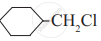
from the following pair would undergo SN2 faster from the other?

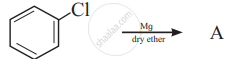
Complete the following reaction giving major products.
Give reasons:
Haloarenes are less reactive than haloalkanes.
Convert the following:
Propene to propan-1-ol
Convert the following:
Benzyl alcohol to benzyl cyanide
Convert the following:
Ethanol to propane nitrile
Observe the following and answer the question given below.

Name the type of halogen derivative.
Observe the following and answer the question given below.
Can it react by SN1 mechanism? Justify your answer.
Major product of the following reaction is _______________
\[\ce{CH3-CH2-Mg-Br + NH3 ->?}\]
Nucleophilic substitution reaction of 2, 4-dinitrochlorobenzene is faster than p-nitrochlorobenzene. Give reason.
Explain primary benzylic halide shows higher reactivity by SN1 mechanism than other primary alkyl halide.
In alkaline hydrolysis of tertiary butyl bromide, ____________.
The least reactive towards nucleophilic addition reactions is ____________.
How many metameric ethers are represented by the molecular formula C4H10O?
\[\ce{C6H5CH2Cl + KCN(alc) -> X + Y}\]
Compounds X and Y are ____________.
Which of the following carbocation is the most stable?
Identify 'B' in the following reaction.
\[\ce{2-Bromobutane ->[KOH alc.][\Delta] A ->[HI] B}\]
What is the major product obtained in the sulphonation of chlorobenzene with concentrated sulphuric acid?
Write the product formed when alkyl halide reacts with silver nitrite.
Convert the following.
p-Nitrochlorobenzene to p-nitrophenol
Explain the dehydrohalogenation reaction of 2-chlorobutane.
Complete the following reaction giving major product.
\[\begin{array}{cc}
\ce{CH3}\phantom{...............}\\
|\phantom{..................}\\
\ce{CH3 - C - CH2 - Cl->[Na/dry ether]A}\\
|\phantom{..................}\\
\ce{CH3}\phantom{...............}\\
\end{array}\]
Identify the chiral molecule from the following.
Complete the following reaction giving major product.
\[\begin{array}{cc}
\ce{CH3}\phantom{...............}\\
|\phantom{..................}\\
\ce{CH3 - C - CH2 - Cl ->[Na/dry ether]A}\\
|\phantom{...................}\\
\ce{CH3}\phantom{.................}
\end{array}\]
Complete the following reaction giving major product.
\[\begin{array}{cc}
\ce{CH3}\phantom{.................}\\
|\phantom{...................}\\
\ce{CH3 - C - CH2 - Cl ->[Na/dry ether] A}\\
|\phantom{...................}\\
\ce{CH3}\phantom{.................}
\end{array}\]
Complete the following reaction giving major product.
\[\begin{array}{cc}
\ce{CH3}\phantom{.................}\\
|\phantom{...................}\\
\ce{CH3 - C - CH2 - Cl ->[Na/dry ether] A}\\
|\phantom{...................}\\
\ce{CH3}\phantom{.................}\\
\end{array}\]
Complete the following reaction giving major product.
\[\begin{array}{cc}
\ce{CH3}\phantom{................}\\
|\phantom{...................}\\
\ce{CH3 - C - CH2 - Cl ->[Na/dry ether] A}\\
|\phantom{...................}\\
\ce{CH3}\phantom{................}\\
\end{array}\]
