Advertisements
Advertisements
Question
Advertisements
Solution

(a) Positive zero error
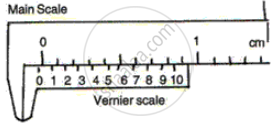
When two jaws are in contact, the zero of the vernier must coincide with the zero of the main scale. If this is not so, the instrument has zero error. These are of two types:-
a. If the zero of the vernier scale lies to the right of the zero of the main scale then it is called a positive zero error.
b. If the zero of the vernier scale lies to the left of the zero of the main scale then it is called negative zero error
To determine the zero error, note the vernier division coinciding with any main scale division when two jaws are completely closed. Suppose nth division is coinciding with the main scale. Multiply this with the least count of vernier caliper.
Positive zero error = n × L.C.
Negative zero error = - (10 - n) × L.C.
To get the correct reading, the zero error is usually subtracted from the observed reading with its proper sign
Correct reading = observed reading - zero error
APPEARS IN
RELATED QUESTIONS
The wavelength of light is 589 nm. what is its wavelength in Å?
State the purpose of ratchet in a screw gauge.
The pitch of a screw gauge is 0.5 mm and the head scale is divided in 100 parts. What is the least count of a screw gauge?
How can the least count of a screw gauge be decreased?
The final result of the calculation in an experiment is 125,347,200. Express the number in term of significant place when accuracy is between 1 and 1000
State the formula for calculating length if:
Number of vernier scale division coinciding with the main scale and number of division of main scale on the left-hand side of zero of vernier scale is known.
Name the measuring employed to measure the diameter of a needle.
State whether the following statement is true or false by writing T/F against it.
The metre scale, vernier calipers, and screw gauge are in decreasing order of least count.
