Advertisements
Advertisements
Question
What is interference?
Advertisements
Solution
Interference of light is defined as the modification in the intensity of light (larger at some places and smaller at some places) produced by the superposition of two or more light waves.
APPEARS IN
RELATED QUESTIONS
A narrow slit S transmitting light of wavelength λ is placed a distance d above a large plane mirror, as shown in the following figure. The light coming directly from the slit and that coming after the reflection interfere at a screen ∑ placed at a distance D from the slit. (a) What will be the intensity at a point just above the mirror, i.e. just above O? (b) At what distance from O does the first maximum occur?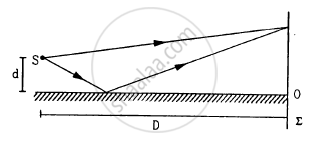
The intensity at the central maximum (O) in a Young’s double slit experimental set-up shown in the figure is IO. If the distance OP equals one-third of the fringe width of the pattern, show that the intensity at point P, would equal `(I_0)/4`.
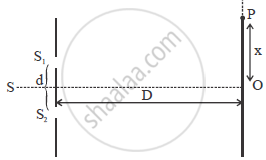
Answer the following question.
Describe any two characteristic features which distinguish between interference and diffraction phenomena. Derive the expression for the intensity at a point of the interference pattern in Young's double-slit experiment.
Answer in brief:
In Young's double-slit experiment what will we observe on the screen when white light is incident on the slits but one slit is covered with a red filter and the other with a violet filter? Give reasons for your answer.
The intensity of the light coming from one of the slits in Young's experiment is twice the intensity of the light coming from the other slit. What will be the approximate ratio of the intensities of the bright and dark fringes in the resulting interference pattern?
Two coherent sources whose intensity ratio is 25:1 produce interference fringes. Calculate the ratio of amplitudes of light waves coming from them.
Draw a neat labelled ray diagram of the Fresnel Biprism experiment showing the region of interference.
One of Young’s double slits is covered with a glass plate as shown in figure. The position of central maximum will,

What is phase of a wave?
What is a bandwidth of interference pattern?
Discuss the interference in thin films and obtain the equations for constructive and destructive interference for transmitted and reflected light.
In Young’s double slit experiment, the slits are 2 mm apart and are illuminated with a mixture of two wavelength λ0 = 750 nm and λ = 900 nm. What is the minimum distance from the common central bright fringe on a screen 2 m from the slits where a bright fringe from one interference pattern coincides with a bright fringe from the other?
The ratio of maximum and minimum intensities in an interference pattern is 36 : 1. What is the ratio of the amplitudes of the two interfering waves?
In Young's double-slit experiment, if the width of the 2nd bright fringe is 4 x 10⁻² cm, then the width of the 4th bright fringe will be ______ cm.
In Young's double-slit experiment, in an interference pattern, a second minimum is observed exactly in front of one slit. The distance between the two coherent sources is 'd' and the distance between source and screen is 'D'. The wavelength of the light source used is ______
If the monochromatic source in Young's double slit experiment is white light, then ____________.
On a rainy day, a small oil film on water shows brilliant colours. This is due to ____________.
In a Young's experiment, two coherent sources are placed 0.60 mm apart and the fringes are observed one metre away. If it produces the second dark fringe at a distance of 1 mm from the central fringe, the wavelength of monochromatic light used would be ____________.
In Young's double slit experiment, the two slits act as coherent sources of equal amplitude A and wavelength `lambda`. In another experiment with the same set up the two slits are of equal amplitude A and wavelength `lambda`. but are incoherent. The ratio of the intensity of light at the mid-point of the screen in the first case to that in the second case is ____________.
In a double slit experiment, the separation between the slits is d and distance of screen from slits is D. If the wavelength of light used is `lambda` and I is the intensity of central bright fringe, then intensity at distance x from central maximum is given by ____________.
In the biprism experiment, the fringe width is 0.4 mm. What is the distance between the 4th dark band and the 6th bright band on the same side?
In an interference experiment, the intensity at a point is `(1/4)^"th"` of the maximum intensity. The angular position of this point is at ____________.
(cos 60° = 0.5, `lambda` = wavelength of light, d = slit width)
Two coherent sources of intensities I1 and I2 produce an interference pattern on the screen. The maximum intensity in the interference pattern is ______
What is meant by Constructive interference?
A beam of electrons is used in Young's double-slit experiment. If the speed of electrons is increased then the fringe width will ______.
Describe Young's double-slit interference experiment.
In biprism experiment, the distance of 20th bright band from the central bright band is 1.2 cm. Without changing the experimental set-up, the distance of 30th bright band from the central bright band will be ______.
In a biprism experiment, fifth dark fringe is obtained at a point. A thin transparent film of refractive index ‘μ’ is placed in one of the interfering paths. Now 7th bright fringe is obtained at the same point. If ‘A’ is the wavelength of light used, the thickness of film is equal to ______.
