Advertisements
Advertisements
Question
The ratio of maximum and minimum intensities in an interference pattern is 36 : 1. What is the ratio of the amplitudes of the two interfering waves?
Advertisements
Solution
`"I"_"max"/"I"_"min" = 36/1`
`"I"_"max"/"I"_"min" = ("a"_1 + "a"_2)^2/("a"_1 - "a"_2)^2`
`("a"_1 + "a"_2)^2/("a"_1 - "a"_2)^2 = 36/1 = 6^2/1^2`
`("a"_1 + "a"_2)/("a"_1 - "a"_2) = 6/1`
a1 + a2 = 6a1 - 6a2
a2 + 6a2 = 6a1 - a1
7a2 = 5a1
`7/5 = "a"_1/"a"_2`
a1 : a2 = 7 : 5
APPEARS IN
RELATED QUESTIONS
Write the necessary conditions to obtain sustained interference fringes.
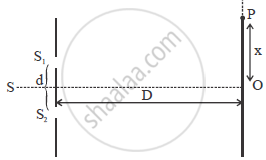
The intensity at the central maximum (O) in a Young’s double slit experimental set-up shown in the figure is IO. If the distance OP equals one-third of the fringe width of the pattern, show that the intensity at point P, would equal `(I_0)/4`.
Two coherent sources whose intensity ratio is 25:1 produce interference fringes. Calculate the ratio of amplitudes of light waves coming from them.
In a Young’s double-slit experiment, the slit separation is doubled. To maintain the same fringe spacing on the screen, the screen-to-slit distance D must be changed to ______.
What is phase of a wave?
In Young’s double-slit experiment, 62 fringes are seen in the visible region for sodium light of wavelength 5893 Å. If violet light of wavelength 4359 Å is used in place of sodium light, then what is the number of fringes seen?
The interference pattern is obtained with two coherent light sources of intensity ratio n. In the interference pattern, the ratio `("I"_"max" - "I"_"min")/("I"_"max" + "I"_"min")` will be ______
In a double slit experiment, the two slits are 2 mm apart and the screen is placed 1 m away. A monochromatic light of wavelength 500 nm is used. What will be the width of each slit for obtaining ten maxima of double slit within the central maxima of single slit pattern?
In Young's double-slit experiment, an interference pattern is obtained on a screen by a light of wavelength 4000 Å, coming from the coherent sources S1 and S2 At certain point P on the screen, third dark fringe is formed. Then the path difference S1P - S2P in microns is ______.
If the two slits in Young's double slit experiment have width ratio 9 : 1, the ratio of maximum to minimum intensity in the interference pattern is ______.
`phi "and" phi_2 (phi_1 > phi_2)` are the work functions of metals A and B. When light of same wavelength is incident on A and B, the fastest emitted electrons from A are ____________ those emitted from B.
In the biprism experiment, a source of monochromatic light is used for a certain distance between slit and eyepiece. When the distance between two virtual sources is changed from dA to dB, then the fringe width is changed from ZA to ZB. The ratio ZA to ZB is ______
In Young's double slit experiment, for wavelength λ1 the nth bright fringe is obtained at a point P on the screen. Keeping the same setting, source of light is replaced by wavelength λ2 and now (n + 1)th bright fringe is obtained at the same point P on the screen. The value of n is ______.
Young's double slit experiment is performed in water, instead of air, then fringe width ______.
In an interference experiment, the intensity at a point is `(1/4)^"th"` of the maximum intensity. The angular position of this point is at ____________.
(cos 60° = 0.5, `lambda` = wavelength of light, d = slit width)
If we have two coherent sources S1 and S2 vibrating in phase, then for an arbitrary point P constructive interference is observed whenever the path difference is ______.
A beam of electrons is used in Young's double-slit experiment. If the speed of electrons is increased then the fringe width will ______.
In biprism experiment, the distance of 20th bright band from the central bright band is 1.2 cm. Without changing the experimental set-up, the distance of 30th bright band from the central bright band will be ______.
