Advertisements
Advertisements
Question
In Young’s double-slit experiment, 62 fringes are seen in the visible region for sodium light of wavelength 5893 Å. If violet light of wavelength 4359 Å is used in place of sodium light, then what is the number of fringes seen?
Advertisements
Solution
From young’s double slit experiment,
λ1 = 5893 Å ; λ2 = 4359 Å
`("n"_1lambda_1"D")/"d" = ("n"_2lambda_2"D")/"d"`
The above condition is total extent of fringes is constant for both wavelengths.
`(62 xx 5893 xx 10^-10 xx "D")/"d" = ("n"_2 xx 4359 xx 10^-10 xx "D")/"d"`
`"n"_2 = (62 xx 5893)/4359 = 365366/4359 = 83.8`
`"n"_2 = 84`
APPEARS IN
RELATED QUESTIONS
State any one difference between interference of light and diffraction of light
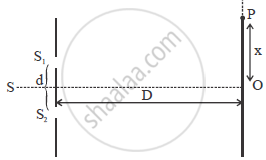
The intensity at the central maximum (O) in a Young’s double slit experimental set-up shown in the figure is IO. If the distance OP equals one-third of the fringe width of the pattern, show that the intensity at point P, would equal `(I_0)/4`.
Why are multiple colours observed over a thin film of oil floating on water? Explain with the help of a diagram.
Obtain the equation for resultant intensity due to interference of light.
In Young’s double slit experiment, the slits are 2 mm apart and are illuminated with a mixture of two wavelength λ0 = 750 nm and λ = 900 nm. What is the minimum distance from the common central bright fringe on a screen 2 m from the slits where a bright fringe from one interference pattern coincides with a bright fringe from the other?
The ratio of maximum and minimum intensities in an interference pattern is 36 : 1. What is the ratio of the amplitudes of the two interfering waves?
In Young's double-slit experiment, in an interference pattern, a second minimum is observed exactly in front of one slit. The distance between the two coherent sources is 'd' and the distance between source and screen is 'D'. The wavelength of the light source used is ______
A thin transparent sheet is placed in front of a slit in Young's double slit experiment. The fringe width will ____________.
The light waves from two independent monochromatic light sources are given by, y1 = 2 sin ωt and y2 = 3 cos ωt. Then the correct statement is ____________.
The distance between the first and ninth bright fringes formed in a biprism experiment is ______.
(`lambda` = 6000 A, D = 1.0 m, d = 1.2 mm)
Two identical light waves having phase difference 'Φ' propagate in same direction. When they superpose, the intensity of the resultant wave is proportional to ______.
In interference experiment, intensity at a point is `(1/4)^"th"` of the maximum intensity. The angular position of this point is at (sin30° = cos60° = 0.5, `lambda` = wavelength of light, d = slit width) ____________.
In biprism experiment, the 4th dark band is formed opposite to one of the slits. The wavelength of light used is ______.
In a double slit experiment, the separation between the slits is d and distance of screen from slits is D. If the wavelength of light used is `lambda` and I is the intensity of central bright fringe, then intensity at distance x from central maximum is given by ____________.
`phi "and" phi_2 (phi_1 > phi_2)` are the work functions of metals A and B. When light of same wavelength is incident on A and B, the fastest emitted electrons from A are ____________ those emitted from B.
Waves from two coherent sources of light having an intensity ratio I1 : I2 equal to 'x' interfere. Then in the interference pattern obtained on the screen, the value of (Imax - Imin)/(Imax + Imin) is ______
The path difference between two interference light waves meeting at a point on the screen is `(87/2)lambda`. The band obtained at that point is ______.
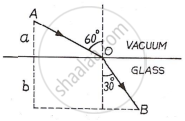
A ray of light AO in a vacuum is incident on a glass slab at an angle of 60° and refracted at an angle of 30° along OB as shown in the figure. The optical path length of the light ray from A to B is ______.
Describe Young's double-slit interference experiment.
