Advertisements
Advertisements
Question
Discuss the interference in thin films and obtain the equations for constructive and destructive interference for transmitted and reflected light.
Advertisements
Solution
- Interference in thin films:
- Let us consider a thin film of transparent material of refractive index p (not to confuse with an order of fringe n) and thickness d. A parallel beam of light is incident on the film at an angle i.
- The wave is divided into two parts at the upper surface, one is reflected and the other is refracted. The refracted part, which enters into the film, again gets divided at the lower surface into two parts; one is transmitted out of the film and the other is reflected back into the film.

Interference in thin films
- For transmitted light:
- The light transmitted may interfere to produce a resultant intensity. Let us consider the path difference between the two light waves transmitted from B and D. The two waves moved together and remained in phase up to B where splitting occurred.
- The extra path travelled by the wave transmitted from D is the path inside the film, BC + CD. If we approximate the incidence to be nearly normal (i = 0), then points B and D are very close to each other. The extra distance travelled by the wave is approximately twice thickness of the film, BC + CD = 2d. As this extra path is travelled in a medium of refractive index p, the optical path difference is,
δ = 2μd. - The condition for constructive interference in transmitted ray is,
2μd = nλ
Similarly, the condition for destructive interference in transmitted ray is
2μd = (2n-l) `λ/2`
- For reflected light:
- Wave while travelling in a rarer medium and getting reflected by a denser medium, undergoes a phase change of n or an additional path difference of `λ/2`.
- Let us consider the path difference between the light waves reflected by the upper surface at A and the other wave coming out at C after passing through the film.
- The additional path travelled by wave coming out from C is the path inside the film, AB + BC. For nearly normal incidence this distance could be approximated as, AB + BC = 2d. As this extra path is travelled in the medium of refractive index p, the optical path difference is, δ = 2μd.
- The condition for constructive interference for reflected ray is,
2μd + `λ/2` = nλ (or)
2μd = (2n – 1) `λ/2` - The additional path difference λ/2 is due to the phase change of n in rarer to denser reflection taking place at A. The condition for destructive interference for a reflected ray is,
2μd + `λ/2` = (2n + l)`λ/2` (or)
2μd = nλ
APPEARS IN
RELATED QUESTIONS
Answer the following question.
Describe any two characteristic features which distinguish between interference and diffraction phenomena. Derive the expression for the intensity at a point of the interference pattern in Young's double-slit experiment.
What are the two methods for obtaining coherent sources in the laboratory?
The intensity of the light coming from one of the slits in Young's experiment is twice the intensity of the light coming from the other slit. What will be the approximate ratio of the intensities of the bright and dark fringes in the resulting interference pattern?
What are coherent sources of light?
One of Young’s double slits is covered with a glass plate as shown in figure. The position of central maximum will,

What is phase of a wave?
Obtain the equation for resultant intensity due to interference of light.
Does diffraction take place at Young’s double-slit?
A graph is plotted between the fringe-width Z and the distance D between the slit and eye-piece, keeping other adjustment same. The correct graph is
A.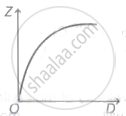 |
B.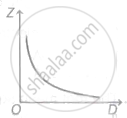 |
C.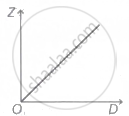 |
D.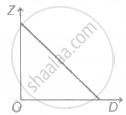 |
If the monochromatic source in Young's double slit experiment is white light, then ____________.
Two identical light waves having phase difference 'Φ' propagate in same direction. When they superpose, the intensity of the resultant wave is proportional to ______.
In a Young's double-slit experiment, the intensity at a point where the path difference is `lambda/3` (`lambda` being the wavelength of the light used) is I. If I0 denotes the maximum intensity, then `"I"/"I"_0` is equal to ______.
In a biprism experiment, red light of wavelength 6500 Å was used. It was then replaced by green light of wavelength 5200 Å. The value of n for which (n + 1)th green bright band would coincide with nth red bright band for the same setting is ______.
If two waves represented by `"y"_1 = 3 "sin" omega "t"` and `"y"_2 = 5 "sin" (omega "t" + pi/3)` interfere at a point, then the amplitude of the resulting wave will be about ____________.
In the biprism experiment, the fringe width is 0.4 mm. What is the distance between the 4th dark band and the 6th bright band on the same side?
In a biprism experiment, monochromatic light of wavelength (λ) is used. The distance between two coherent sources is kept constant. If the distance between slit and eyepiece (D) is varied as D1, D2, D3, and D4, the corresponding measured fringe widths are z1, z2, z3, and z4 then ______
In the biprism experiment, a source of monochromatic light is used for a certain distance between slit and eyepiece. When the distance between two virtual sources is changed from dA to dB, then the fringe width is changed from ZA to ZB. The ratio ZA to ZB is ______
Two coherent sources of intensities I1 and I2 produce an interference pattern on the screen. The maximum intensity in the interference pattern is ______
White light is passed through a double slit and interference is observed on a screen 1.5 m away. The separation between the slits is 0.3 mm. The first violet and red fringes are formed 2.0 mm and 3.5 mm away from the central white fringes. The difference in wavelengths of red and violet light is ______ nm.
Interference fringes are produced on a screen by using two light sources of intensities I and 9I. The phase difference between the beams is `pi/2` at point P and π at point Q on the screen. The difference between the resultant intensities at point P and Q is ______.
