Advertisements
Advertisements
प्रश्न
Discuss the interference in thin films and obtain the equations for constructive and destructive interference for transmitted and reflected light.
Advertisements
उत्तर
- Interference in thin films:
- Let us consider a thin film of transparent material of refractive index p (not to confuse with an order of fringe n) and thickness d. A parallel beam of light is incident on the film at an angle i.
- The wave is divided into two parts at the upper surface, one is reflected and the other is refracted. The refracted part, which enters into the film, again gets divided at the lower surface into two parts; one is transmitted out of the film and the other is reflected back into the film.

Interference in thin films
- For transmitted light:
- The light transmitted may interfere to produce a resultant intensity. Let us consider the path difference between the two light waves transmitted from B and D. The two waves moved together and remained in phase up to B where splitting occurred.
- The extra path travelled by the wave transmitted from D is the path inside the film, BC + CD. If we approximate the incidence to be nearly normal (i = 0), then points B and D are very close to each other. The extra distance travelled by the wave is approximately twice thickness of the film, BC + CD = 2d. As this extra path is travelled in a medium of refractive index p, the optical path difference is,
δ = 2μd. - The condition for constructive interference in transmitted ray is,
2μd = nλ
Similarly, the condition for destructive interference in transmitted ray is
2μd = (2n-l) `λ/2`
- For reflected light:
- Wave while travelling in a rarer medium and getting reflected by a denser medium, undergoes a phase change of n or an additional path difference of `λ/2`.
- Let us consider the path difference between the light waves reflected by the upper surface at A and the other wave coming out at C after passing through the film.
- The additional path travelled by wave coming out from C is the path inside the film, AB + BC. For nearly normal incidence this distance could be approximated as, AB + BC = 2d. As this extra path is travelled in the medium of refractive index p, the optical path difference is, δ = 2μd.
- The condition for constructive interference for reflected ray is,
2μd + `λ/2` = nλ (or)
2μd = (2n – 1) `λ/2` - The additional path difference λ/2 is due to the phase change of n in rarer to denser reflection taking place at A. The condition for destructive interference for a reflected ray is,
2μd + `λ/2` = (2n + l)`λ/2` (or)
2μd = nλ
APPEARS IN
संबंधित प्रश्न
Write the important characteristic features by which the interference can be distinguished from the observed diffraction pattern.
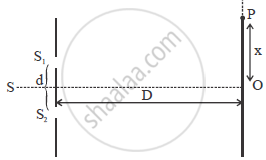
The intensity at the central maximum (O) in a Young’s double slit experimental set-up shown in the figure is IO. If the distance OP equals one-third of the fringe width of the pattern, show that the intensity at point P, would equal `(I_0)/4`.
Why are multiple colours observed over a thin film of oil floating on water? Explain with the help of a diagram.
What are the conditions for obtaining a good interference pattern? Give reasons.
A double-slit arrangement produces interference fringes for sodium light (λ = 589 nm) that are 0.20° apart. What is the angular fringe separation if the entire arrangement is immersed in water (n = 1.33)?
Explain constructive and destructive interference with the help of a diagram?
How does wavefront division provide coherent sources?
Obtain the equation for bandwidth in Young’s double slit experiment.
In Young’s double-slit experiment, 62 fringes are seen in the visible region for sodium light of wavelength 5893 Å. If violet light of wavelength 4359 Å is used in place of sodium light, then what is the number of fringes seen?
A graph is plotted between the fringe-width Z and the distance D between the slit and eye-piece, keeping other adjustment same. The correct graph is
A.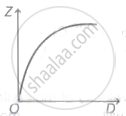 |
B.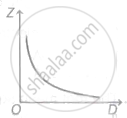 |
C.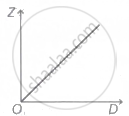 |
D.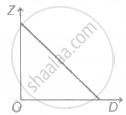 |
On a rainy day, a small oil film on water shows brilliant colours. This is due to ____________.
In Young's double slit experiment with a source of light of wavelength 5860 Å, the first maxima will occur when ____________.
Two sources of light 0.5 mm apart are placed at a distance of 2.4 m and wavelength of light is 5000 Å. The phase difference between the two light waves interfering on the screen at a point at a distance 3 mm from central bright band is ____________.
Two coherent light sources of intensity ratio 'n' are employed in an interference experiment. The ratio of the intensities of the maxima and minima in the interference pattern is (I1 > I2).
In a double slit experiment, the separation between the slits is d and distance of screen from slits is D. If the wavelength of light used is `lambda` and I is the intensity of central bright fringe, then intensity at distance x from central maximum is given by ____________.
Two identical light sources s1 and s2 emit light of same wavelength `lambda`. These light rays will exhibit interference if their ______.
In Young's double slit experiment, for wavelength λ1 the nth bright fringe is obtained at a point P on the screen. Keeping the same setting, source of light is replaced by wavelength λ2 and now (n + 1)th bright fringe is obtained at the same point P on the screen. The value of n is ______.
A double slit experiment is immersed in water of refractive index 1.33. The slit separation is 1 mm, distance between slit and screen is 1.33 m. The slits are illuminated by a light of wavelength 6300 Å. The fringe width is ______.
White light is passed through a double slit and interference is observed on a screen 1.5 m away. The separation between the slits is 0.3 mm. The first violet and red fringes are formed 2.0 mm and 3.5 mm away from the central white fringes. The difference in wavelengths of red and violet light is ______ nm.
