Advertisements
Advertisements
प्रश्न
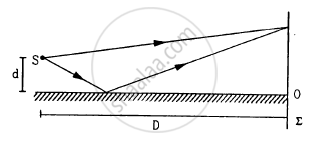
A narrow slit S transmitting light of wavelength λ is placed a distance d above a large plane mirror, as shown in the following figure. The light coming directly from the slit and that coming after the reflection interfere at a screen ∑ placed at a distance D from the slit. (a) What will be the intensity at a point just above the mirror, i.e. just above O? (b) At what distance from O does the first maximum occur?
Advertisements
उत्तर
(a) The phase of a light wave reflecting from a surface differs by \[\pi\] from the light directly coming from the source.
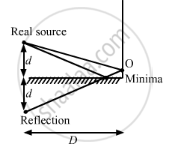
Thus, the wave fronts reaching just above the mirror directly from the source and after reflecting from the mirror have a phase difference of \[\pi,\] which is the condition of distractive interference. So, the intensity at a point just above the mirror is zero.
(b) Here, separation between two slits is 2d.
Wavelength of the light is `lambda.`
Distance of the screen from the slit is `D.`
Consider that the bright fringe is formed at position y. Then,
path difference, \[∆ x = \frac{y \times 2d}{D} = n\lambda.\]
After reflection from the mirror, path difference between two waves is \[\frac{\lambda}{2}.\]
\[\Rightarrow \frac{y \times 2d}{D} = \frac{\lambda}{2} + n\lambda\]
For first order, put n = 0
\[ \Rightarrow y = \frac{\lambda D}{4d}\]
APPEARS IN
संबंधित प्रश्न
State any one difference between interference of light and diffraction of light
When a drop of oil is spread on a water surface, it displays beautiful colours in daylight because of ______________ .
Answer in brief:
In Young's double-slit experiment what will we observe on the screen when white light is incident on the slits but one slit is covered with a red filter and the other with a violet filter? Give reasons for your answer.
What are the two methods for obtaining coherent sources in the laboratory?
A double-slit arrangement produces interference fringes for sodium light (λ = 589 nm) that are 0.20° apart. What is the angular fringe separation if the entire arrangement is immersed in water (n = 1.33)?
Why two light sources must be of equal intensity to obtain a well-defined interference pattern?
What are coherent sources of light?
Explain Young’s double-slit experimental setup and obtain the equation for path difference.
Obtain the equation for bandwidth in Young’s double slit experiment.
In Young's double slit experiment green light is incident on the two slits. The interference pattern is observed on a screen. Which one of the following changes would cause the observed fringes to be more closely spaced?
A wire of length 'L' and area of cross-section · A' is made of material of Young's modulus 'Y'. It is stretched by an amount 'x'. The work done in stretching the wire is ______.
In Young's double slit experiment the source is white light. One slit is covered with red filter and the other with blue filter. There shall be ____________.
If two waves represented by `"y"_1 = 3 "sin" omega "t"` and `"y"_2 = 5 "sin" (omega "t" + pi/3)` interfere at a point, then the amplitude of the resulting wave will be about ____________.
`phi "and" phi_2 (phi_1 > phi_2)` are the work functions of metals A and B. When light of same wavelength is incident on A and B, the fastest emitted electrons from A are ____________ those emitted from B.
In biprism experiment, if the 5th bright band with wavelength 'λ1' coincides with the 6th dark band with wavelength 'λ2' then the ratio `(lambda_2/lambda_1)` is ______
If two light waves reaching a point produce destructive interference, then the condition of phase difference is ______
A double slit experiment is immersed in water of refractive index 1.33. The slit separation is 1 mm, distance between slit and screen is 1.33 m. The slits are illuminated by a light of wavelength 6300 Å. The fringe width is ______.
The path difference between two interference light waves meeting at a point on the screen is `(87/2)lambda`. The band obtained at that point is ______.
Describe Young's double-slit interference experiment.
In biprism experiment, the distance of 20th bright band from the central bright band is 1.2 cm. Without changing the experimental set-up, the distance of 30th bright band from the central bright band will be ______.
