मराठी
कर्नाटक बोर्ड पी.यू.सी.पीयूसी विज्ञान इयत्ता ११

A Narrow Slit S Transmitting Light of Wavelength λ is Placed a Distance D Above a Large Plane Mirror, as Shown in the Following Figure. - Physics

Advertisements
Advertisements

प्रश्न

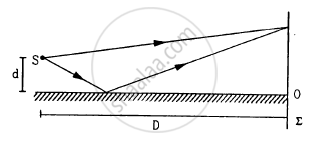
A narrow slit S transmitting light of wavelength λ is placed a distance d above a large plane mirror, as shown in the following figure. The light coming directly from the slit and that coming after the reflection interfere at a screen ∑ placed at a distance D from the slit. (a) What will be the intensity at a point just above the mirror, i.e. just above O? (b) At what distance from O does the first maximum occur?
बेरीज
Advertisements

उत्तर

(a) The phase of a light wave reflecting from a surface differs by \[\pi\] from the light directly coming from the source.
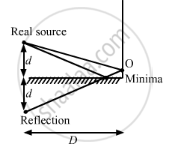
Thus, the wave fronts reaching just above the mirror directly from the source and after reflecting from the mirror have a phase difference of \[\pi,\] which is the condition of distractive interference. So, the intensity at a point just above the mirror is zero.

(b) Here, separation between two slits is 2d.

Wavelength of the light is `lambda.`

Distance of the screen from the slit is `D.`

Consider that the bright fringe is formed at position y. Then,

path difference, \[∆ x = \frac{y \times 2d}{D} = n\lambda.\]

After reflection from the mirror, path difference between two waves is \[\frac{\lambda}{2}.\]

\[\Rightarrow \frac{y \times 2d}{D} = \frac{\lambda}{2} + n\lambda\]

For first order, put n = 0

\[ \Rightarrow y = \frac{\lambda D}{4d}\]

shaalaa.com
  या प्रश्नात किंवा उत्तरात काही त्रुटी आहे का?
पाठ 17: Light Waves - Exercise [पृष्ठ ३८१]

APPEARS IN

एचसी वर्मा Concepts of Physics Vol. 1 [English] Class 11 and 12
पाठ 17 Light Waves
Exercise | Q 21 | पृष्ठ ३८१

संबंधित प्रश्‍न

How does the angular separation between fringes in single-slit diffraction experiment change when the distance of separation between the slit screens is doubled?


Four light waves are represented by

(i) \[y =  a_1   \sin  \omega t\]

(ii) \[y =  a_2   \sin  \left( \omega t + \epsilon \right)\]

(iii) \[y =  a_1   \sin  2\omega t\]

(iv) \[y =  a_2   \sin  2\left( \omega t + \epsilon \right).\]

Interference fringes may be observed due to superposition of

(a) (i) and (ii)

(b) (i) and (iii)

(c) (ii) and (iv)

(d) (iii) and (iv)


What are the two methods for obtaining coherent sources in the laboratory?


The intensity of the light coming from one of the slits in Young's experiment is twice the intensity of the light coming from the other slit. What will be the approximate ratio of the intensities of the bright and dark fringes in the resulting interference pattern?


Explain constructive and destructive interference with the help of a diagram?


One of Young’s double slits is covered with a glass plate as shown in figure. The position of central maximum will,


What is interference of light?


In a Young's experiment, two coherent sources are placed 0.60 mm apart and the fringes are observed one metre away. If it produces the second dark fringe at a distance of 1 mm from the central fringe, the wavelength of monochromatic light used would be ____________.


In Young's double-slit experiment, an interference pattern is obtained on a screen by a light of wavelength 4000 Å, coming from the coherent sources S1 and S2 At certain point P on the screen, third dark fringe is formed. Then the path difference S1P - S2P in microns is ______.


Two coherent light sources of intensity ratio 'n' are employed in an interference experiment. The ratio of the intensities of the maxima and minima in the interference pattern is (I1 > I2).


If the two slits in Young's double slit experiment have width ratio 9 : 1, the ratio of maximum to minimum intensity in the interference pattern is ______.


If two waves represented by `"y"_1 = 3  "sin" omega "t"` and `"y"_2 = 5  "sin" (omega "t" + pi/3)` interfere at a point, then the amplitude of the resulting wave will be about ____________.


Waves from two coherent sources of light having an intensity ratio I1 : I2 equal to 'x' interfere. Then in the interference pattern obtained on the screen, the value of (Imax - Imin)/(Imax + Imin) is ______ 


In Young's double slit experiment, for wavelength λ1 the nth bright fringe is obtained at a point P on the screen. Keeping the same setting, source of light is replaced by wavelength λ2 and now (n + 1)th bright fringe is obtained at the same point P on the screen. The value of n is ______.


A beam of electrons is used in Young's double-slit experiment. If the speed of electrons is increased then the fringe width will ______.


How will the interference pattern of Young's double slit change if one of the two slits is covered by a paper which transmits only half of the light intensity?


Interference fringes are produced on a screen by using two light sources of intensities I and 9I. The phase difference between the beams is `pi/2` at point P and π at point Q on the screen. The difference between the resultant intensities at point P and Q is ______.


Two coherent sources P and Q produce interference at point A on the screen where there is a dark band which is formed between 4th bright band and 5th bright band. Wavelength of light used is 6000 Å. The path difference between PA and QA is ______.


The path difference between two interference light waves meeting at a point on the screen is `(87/2)lambda`. The band obtained at that point is ______.


Share
Notifications

Englishहिंदीमराठी


      Forgot password?
Use app×