Advertisements
Advertisements
प्रश्न
The intensity of the light coming from one of the slits in Young's experiment is twice the intensity of the light coming from the other slit. What will be the approximate ratio of the intensities of the bright and dark fringes in the resulting interference pattern?
Advertisements
उत्तर
Data: I1 : I2 = 2 : 1
If E10 and E20 are the amplitudes of the interfering waves, the ratio of the maximum intensity to the minimum intensity in the fringe system is
`("I"_"max")/("I"_"min") = (("E"_10 + "E"_20)/("E"_10 - "E"_20))^2 = (("r + 1")/("r - 1"))^2`
where r = `"E"_10/"E"_20`
∴ `"I"_1/"I"_2 = (("E"_10)/("E"_20))^2 = "r"^2`
∴ r = `sqrt("I"_1/"I"_2) = sqrt2`
∴ `("I"_"max")/("I"_"min") = ((sqrt2 + 1)/(sqrt2 - 1))^2 = (2.414/0.414)^2 = (5.83)^2`
= 33.99 ≈ 34.
∴ The ratio of the intensities of the bright and dark fringes in the resulting interference pattern is 34: 1.
APPEARS IN
संबंधित प्रश्न
Laser light of wavelength 630 nm is incident on a pair of slits which are separated by 1.8 mm. If the screen is kept 80 cm away from the two slits, calculate:
1) fringe separation i.e. fringe width.
2) distance of 10th bright fringe from the centre of the interference pattern
The intensity at the central maximum (O) in a Young’s double slit experimental set-up shown in the figure is IO. If the distance OP equals one-third of the fringe width of the pattern, show that the intensity at point P, would equal `(I_0)/4`.
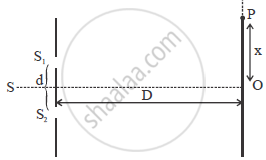
Answer the following question.
Describe any two characteristic features which distinguish between interference and diffraction phenomena. Derive the expression for the intensity at a point of the interference pattern in Young's double-slit experiment.
Answer in brief:
In Young's double-slit experiment what will we observe on the screen when white light is incident on the slits but one slit is covered with a red filter and the other with a violet filter? Give reasons for your answer.
In a Young’s double-slit experiment, the slit separation is doubled. To maintain the same fringe spacing on the screen, the screen-to-slit distance D must be changed to ______.
Obtain the relation between phase difference and path difference.
Obtain the equation for resultant intensity due to interference of light.
Explain Young’s double-slit experimental setup and obtain the equation for path difference.
Obtain the equation for bandwidth in Young’s double slit experiment.
In Young's double slit experiment green light is incident on the two slits. The interference pattern is observed on a screen. Which one of the following changes would cause the observed fringes to be more closely spaced?
In a double slit experiment, the two slits are 2 mm apart and the screen is placed 1 m away. A monochromatic light of wavelength 500 nm is used. What will be the width of each slit for obtaining ten maxima of double slit within the central maxima of single slit pattern?
In a Young's experiment, two coherent sources are placed 0.60 mm apart and the fringes are observed one metre away. If it produces the second dark fringe at a distance of 1 mm from the central fringe, the wavelength of monochromatic light used would be ____________.
The phenomenon of interference is based on ______.
In biprism experiment, the 4th dark band is formed opposite to one of the slits. The wavelength of light used is ______.
In the Young's double slit experiment, if the phase difference between the two waves interfering at a point is `phi`, the intensity at that point is proportional to ____________.
`phi "and" phi_2 (phi_1 > phi_2)` are the work functions of metals A and B. When light of same wavelength is incident on A and B, the fastest emitted electrons from A are ____________ those emitted from B.
In biprism experiment, if the 5th bright band with wavelength 'λ1' coincides with the 6th dark band with wavelength 'λ2' then the ratio `(lambda_2/lambda_1)` is ______
The graph shows the variation of fringe width (β) versus distance of the screen from the plane of the slits (D) in Young's double-slit experiment Keeping other parameters the same. The wavelength of light used can be calculated as d = distance between the slits ______

In Young's double slit experiment, for wavelength λ1 the nth bright fringe is obtained at a point P on the screen. Keeping the same setting, source of light is replaced by wavelength λ2 and now (n + 1)th bright fringe is obtained at the same point P on the screen. The value of n is ______.
Two coherent sources of intensities I1 and I2 produce an interference pattern on the screen. The maximum intensity in the interference pattern is ______
What is meant by Constructive interference?
A beam of electrons is used in Young's double-slit experiment. If the speed of electrons is increased then the fringe width will ______.
Describe Young's double-slit interference experiment.
In biprism experiment, the distance of 20th bright band from the central bright band is 1.2 cm. Without changing the experimental set-up, the distance of 30th bright band from the central bright band will be ______.
In biprism experiment the maximum intensity is ‘I0’. If the path difference between the two interfering waves is ‘λ/4’ then intensity at the point on the screen is ______.
`[sin 45^circ = cos 45^circ = 1/sqrt 2]`
In biprism experiment, the 3rd dark band is formed opposite to one of the slits. The wavelength of light used is ______.
(D = distance between source and screen, d = distance between the two narrow slits)
