Advertisements
Advertisements
प्रश्न
What are coherent sources of light?
What are coherent sources?
Advertisements
उत्तर १
Two sources that emit light waves of the same frequency, having a constant phase difference, independent of time, are called coherent sources of light.
उत्तर २
Light or wave sources that produce waves with a consistent phase relationship across time are known as coherent sources. This indicates that the waves' phase difference either stays constant or varies predictably.
APPEARS IN
संबंधित प्रश्न
Write the necessary conditions to obtain sustained interference fringes.
Laser light of wavelength 630 nm is incident on a pair of slits which are separated by 1.8 mm. If the screen is kept 80 cm away from the two slits, calculate:
1) fringe separation i.e. fringe width.
2) distance of 10th bright fringe from the centre of the interference pattern
In Young’s double slit experiment, the slits are separated by 0.5 mm and screen is placed 1.0 m away from the slit. It is found that the 5th bright fringe is at a distance of 4.13 mm from the 2nd dark fringe. Find the wavelength of light used.
What is meant by coherent sources?
Describe Young's double-slit interference experiment and derive conditions for occurrence of dark and bright fringes on the screen. Define fringe width and derive a formula for it.
What are the conditions for obtaining a good interference pattern? Give reasons.
What are the two methods for obtaining coherent sources in the laboratory?
A double-slit arrangement produces interference fringes for sodium light (λ = 589 nm) that are 0.20° apart. What is the angular fringe separation if the entire arrangement is immersed in water (n = 1.33)?
The intensity of the light coming from one of the slits in Young's experiment is twice the intensity of the light coming from the other slit. What will be the approximate ratio of the intensities of the bright and dark fringes in the resulting interference pattern?
Draw a neat labelled ray diagram of the Fresnel Biprism experiment showing the region of interference.
Describe geometry of the Young’s double slit experiment with the help of a ray diagram. What is fringe width? Obtain an expression of it. Write the conditions for constructive as well as destructive interference.
Explain constructive and destructive interference with the help of a diagram?
Obtain the equation for resultant intensity due to interference of light.
Explain Young’s double-slit experimental setup and obtain the equation for path difference.
The ratio of maximum and minimum intensities in an interference pattern is 36 : 1. What is the ratio of the amplitudes of the two interfering waves?
The distance between the first and ninth bright fringes formed in a biprism experiment is ______.
(`lambda` = 6000 A, D = 1.0 m, d = 1.2 mm)
If the two slits in Young's double slit experiment have width ratio 9 : 1, the ratio of maximum to minimum intensity in the interference pattern is ______.
`phi "and" phi_2 (phi_1 > phi_2)` are the work functions of metals A and B. When light of same wavelength is incident on A and B, the fastest emitted electrons from A are ____________ those emitted from B.
In the biprism experiment, the fringe width is 0.4 mm. What is the distance between the 4th dark band and the 6th bright band on the same side?
In Young's double slit experiment, for wavelength λ1 the nth bright fringe is obtained at a point P on the screen. Keeping the same setting, source of light is replaced by wavelength λ2 and now (n + 1)th bright fringe is obtained at the same point P on the screen. The value of n is ______.
If we have two coherent sources S1 and S2 vibrating in phase, then for an arbitrary point P constructive interference is observed whenever the path difference is ______.
A beam of electrons is used in Young's double-slit experiment. If the speed of electrons is increased then the fringe width will ______.
Interference fringes are produced on a screen by using two light sources of intensities I and 9I. The phase difference between the beams is `pi/2` at point P and π at point Q on the screen. The difference between the resultant intensities at point P and Q is ______.
The path difference between two interference light waves meeting at a point on the screen is `(87/2)lambda`. The band obtained at that point is ______.
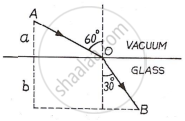
A ray of light AO in a vacuum is incident on a glass slab at an angle of 60° and refracted at an angle of 30° along OB as shown in the figure. The optical path length of the light ray from A to B is ______.
Describe Young's double-slit interference experiment.
In a biprism experiment, fifth dark fringe is obtained at a point. A thin transparent film of refractive index ‘μ’ is placed in one of the interfering paths. Now 7th bright fringe is obtained at the same point. If ‘A’ is the wavelength of light used, the thickness of film is equal to ______.
In biprism experiment, the 3rd dark band is formed opposite to one of the slits. The wavelength of light used is ______.
(D = distance between source and screen, d = distance between the two narrow slits)
