Advertisements
Advertisements
प्रश्न
Obtain the relation between phase difference and path difference.
Advertisements
उत्तर
- Phase difference (Φ):
It is the difference expressed in degrees or radians between two waves having same frequency and referenced to same point in time. - Path difference (δ):
It is the difference between the lengths of two paths of the two different having same frequency and travelling at same velocity.
δ = `lambda/(2pi) Φ`
APPEARS IN
संबंधित प्रश्न
Write the important characteristic features by which the interference can be distinguished from the observed diffraction pattern.
The intensity at the central maximum (O) in a Young’s double slit experimental set-up shown in the figure is IO. If the distance OP equals one-third of the fringe width of the pattern, show that the intensity at point P, would equal `(I_0)/4`.
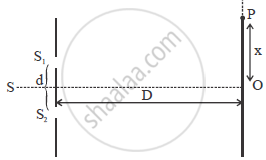
In Young’s double slit experiment, the slits are separated by 0.5 mm and screen is placed 1.0 m away from the slit. It is found that the 5th bright fringe is at a distance of 4.13 mm from the 2nd dark fringe. Find the wavelength of light used.
What are the conditions for obtaining a good interference pattern? Give reasons.
A double-slit arrangement produces interference fringes for sodium light (λ = 589 nm) that are 0.20° apart. What is the angular fringe separation if the entire arrangement is immersed in water (n = 1.33)?
Two coherent sources whose intensity ratio is 25:1 produce interference fringes. Calculate the ratio of amplitudes of light waves coming from them.
In a Young’s double-slit experiment, the slit separation is doubled. To maintain the same fringe spacing on the screen, the screen-to-slit distance D must be changed to ______.
What is phase of a wave?
Light of wavelength 600 nm that falls on a pair of slits producing interference pattern on a screen in which the bright fringes are separated by 7.2 mm. What must be the wavelength of another light which produces bright fringes separated by 8.1 mm with the same apparatus?
A thin transparent sheet is placed in front of a slit in Young's double slit experiment. The fringe width will ____________.
Band width for red light of wavelength 6600 Å is 0.42 mm. If red Light is replaced by blue light of wavelength 4400 Å, then the change m bandwidth will be ____________.
A thin mica sheet of thickness 4 x 10⁻⁶ m and refractive index 1.5 is introduced in the path of the first wave. The wavelength of the wave used is 5000 A. The central bright maximum will shift ______.
In a Young's experiment, two coherent sources are placed 0.60 mm apart and the fringes are observed one metre away. If it produces the second dark fringe at a distance of 1 mm from the central fringe, the wavelength of monochromatic light used would be ____________.
In Young's double-slit experiment, an interference pattern is obtained on a screen by a light of wavelength 4000 Å, coming from the coherent sources S1 and S2 At certain point P on the screen, third dark fringe is formed. Then the path difference S1P - S2P in microns is ______.
If two waves represented by `"y"_1 = 3 "sin" omega "t"` and `"y"_2 = 5 "sin" (omega "t" + pi/3)` interfere at a point, then the amplitude of the resulting wave will be about ____________.
If two light waves reaching a point produce destructive interference, then the condition of phase difference is ______
Waves from two coherent sources of light having an intensity ratio I1 : I2 equal to 'x' interfere. Then in the interference pattern obtained on the screen, the value of (Imax - Imin)/(Imax + Imin) is ______
Describe Young's double-slit interference experiment.
