Advertisements
Advertisements
प्रश्न
A double-slit arrangement produces interference fringes for sodium light (λ = 589 nm) that are 0.20° apart. What is the angular fringe separation if the entire arrangement is immersed in water (n = 1.33)?
Advertisements
उत्तर
Given: θ1 = 0.20°, nw = 1.33
In the first approximation,
D sin θ1 = y1 and D sin θ2 = y2
`therefore (sin theta_2)/(sin theta_1) = "y"_2/"y"_1` ...(1)
Now, `y prop (lambdaD)/d`
For given d and D,
y ∝ λ
∴ `y_2/y_1 = lambda_2/lambda_1` ...(2)
Now, `n_w = lambda_1/lambda_2` ...(3)
From Eqs. (1), (2) and (3), we get
`(sin theta_2)/(sin theta_1) = lambda_2/lambda_1 = 1/n_w`
∴ `sin theta_2 = sin theta_1/n_w`
`sin theta_2 = (sin 0.2)/1.33`
`sin theta_2 = 0.0035/1.33`
sinθ2 = 0.0026
θ2 = sin−1 0.0026
θ2 = 9'
θ2 = 0.15°
This is the required angular fringe separation.
संबंधित प्रश्न
State any one difference between interference of light and diffraction of light
Laser light of wavelength 630 nm is incident on a pair of slits which are separated by 1.8 mm. If the screen is kept 80 cm away from the two slits, calculate:
1) fringe separation i.e. fringe width.
2) distance of 10th bright fringe from the centre of the interference pattern
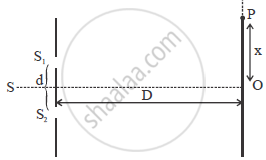
The intensity at the central maximum (O) in a Young’s double slit experimental set-up shown in the figure is IO. If the distance OP equals one-third of the fringe width of the pattern, show that the intensity at point P, would equal `(I_0)/4`.
Why are multiple colours observed over a thin film of oil floating on water? Explain with the help of a diagram.
The intensity of the light coming from one of the slits in Young's experiment is twice the intensity of the light coming from the other slit. What will be the approximate ratio of the intensities of the bright and dark fringes in the resulting interference pattern?
What are coherent sources of light?
In a Young’s double-slit experiment, the slit separation is doubled. To maintain the same fringe spacing on the screen, the screen-to-slit distance D must be changed to ______.
Obtain the equation for resultant intensity due to interference of light.
Two independent monochromatic sources cannot act as coherent sources, why?
In Young's double-slit experiment, in an interference pattern, a second minimum is observed exactly in front of one slit. The distance between the two coherent sources is 'd' and the distance between source and screen is 'D'. The wavelength of the light source used is ______
On a rainy day, a small oil film on water shows brilliant colours. This is due to ____________.
A wire of length 'L' and area of cross-section · A' is made of material of Young's modulus 'Y'. It is stretched by an amount 'x'. The work done in stretching the wire is ______.
In Young's experiment, the distance between the slits is doubled and the distance between the slit and screen is reduced to half, then the fringe width ____________.
In a double slit experiment, the two slits are 2 mm apart and the screen is placed 1 m away. A monochromatic light of wavelength 500 nm is used. What will be the width of each slit for obtaining ten maxima of double slit within the central maxima of single slit pattern?
In a Young's experiment, two coherent sources are placed 0.60 mm apart and the fringes are observed one metre away. If it produces the second dark fringe at a distance of 1 mm from the central fringe, the wavelength of monochromatic light used would be ____________.
In Young's double slit experiment the source is white light. One slit is covered with red filter and the other with blue filter. There shall be ____________.
The phenomenon of interference is based on ______.
In biprism experiment, the 4th dark band is formed opposite to one of the slits. The wavelength of light used is ______.
In the Young's double slit experiment, if the phase difference between the two waves interfering at a point is `phi`, the intensity at that point is proportional to ____________.
If two waves represented by `"y"_1 = 3 "sin" omega "t"` and `"y"_2 = 5 "sin" (omega "t" + pi/3)` interfere at a point, then the amplitude of the resulting wave will be about ____________.
In a double slit experiment, the separation between the slits is d and distance of screen from slits is D. If the wavelength of light used is `lambda` and I is the intensity of central bright fringe, then intensity at distance x from central maximum is given by ____________.
`phi "and" phi_2 (phi_1 > phi_2)` are the work functions of metals A and B. When light of same wavelength is incident on A and B, the fastest emitted electrons from A are ____________ those emitted from B.
Waves from two coherent sources of light having an intensity ratio I1 : I2 equal to 'x' interfere. Then in the interference pattern obtained on the screen, the value of (Imax - Imin)/(Imax + Imin) is ______
In Young's double slit experiment, for wavelength λ1 the nth bright fringe is obtained at a point P on the screen. Keeping the same setting, source of light is replaced by wavelength λ2 and now (n + 1)th bright fringe is obtained at the same point P on the screen. The value of n is ______.
Two waves with same amplitude and frequency superpose at a point. The ratio of resultant intensities when they arrive in phase to that when they arrive 90° out of phase is ______.
`[cos pi/2=0]`
A double slit experiment is immersed in water of refractive index 1.33. The slit separation is 1 mm, distance between slit and screen is 1.33 m. The slits are illuminated by a light of wavelength 6300 Å. The fringe width is ______.
If we have two coherent sources S1 and S2 vibrating in phase, then for an arbitrary point P constructive interference is observed whenever the path difference is ______.
Describe Young's double-slit interference experiment.
