Advertisements
Advertisements
Question
A double-slit arrangement produces interference fringes for sodium light (λ = 589 nm) that are 0.20° apart. What is the angular fringe separation if the entire arrangement is immersed in water (n = 1.33)?
Advertisements
Solution
Given: θ1 = 0.20°, nw = 1.33
In the first approximation,
D sin θ1 = y1 and D sin θ2 = y2
`therefore (sin theta_2)/(sin theta_1) = "y"_2/"y"_1` ...(1)
Now, `y prop (lambdaD)/d`
For given d and D,
y ∝ λ
∴ `y_2/y_1 = lambda_2/lambda_1` ...(2)
Now, `n_w = lambda_1/lambda_2` ...(3)
From Eqs. (1), (2) and (3), we get
`(sin theta_2)/(sin theta_1) = lambda_2/lambda_1 = 1/n_w`
∴ `sin theta_2 = sin theta_1/n_w`
`sin theta_2 = (sin 0.2)/1.33`
`sin theta_2 = 0.0035/1.33`
sinθ2 = 0.0026
θ2 = sin−1 0.0026
θ2 = 9'
θ2 = 0.15°
This is the required angular fringe separation.
RELATED QUESTIONS
Write the important characteristic features by which the interference can be distinguished from the observed diffraction pattern.
Write the necessary conditions to obtain sustained interference fringes.
State any one difference between interference of light and diffraction of light
A narrow slit S transmitting light of wavelength λ is placed a distance d above a large plane mirror, as shown in the following figure. The light coming directly from the slit and that coming after the reflection interfere at a screen ∑ placed at a distance D from the slit. (a) What will be the intensity at a point just above the mirror, i.e. just above O? (b) At what distance from O does the first maximum occur?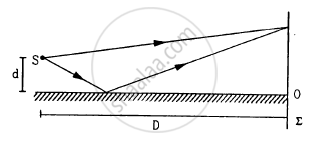
What is meant by coherent sources?
Answer in brief:
In Young's double-slit experiment what will we observe on the screen when white light is incident on the slits but one slit is covered with a red filter and the other with a violet filter? Give reasons for your answer.
The intensity of the light coming from one of the slits in Young's experiment is twice the intensity of the light coming from the other slit. What will be the approximate ratio of the intensities of the bright and dark fringes in the resulting interference pattern?
Two coherent sources whose intensity ratio is 25:1 produce interference fringes. Calculate the ratio of amplitudes of light waves coming from them.
What are coherent sources of light?
Obtain the relation between phase difference and path difference.
Obtain the equation for resultant intensity due to interference of light.
Discuss the interference in thin films and obtain the equations for constructive and destructive interference for transmitted and reflected light.
Two independent monochromatic sources cannot act as coherent sources, why?
The ratio of maximum and minimum intensities in an interference pattern is 36 : 1. What is the ratio of the amplitudes of the two interfering waves?
Light of wavelength 600 nm that falls on a pair of slits producing interference pattern on a screen in which the bright fringes are separated by 7.2 mm. What must be the wavelength of another light which produces bright fringes separated by 8.1 mm with the same apparatus?
In Young's double slit experiment green light is incident on the two slits. The interference pattern is observed on a screen. Which one of the following changes would cause the observed fringes to be more closely spaced?
A metal rod has length, cross-sectional area and Young's modulus as L, A and Y, respectively. If the elongation in the rod produced is l, then work done is proportional to ______.
In Young's experiment for the interference of light, the separation between the silts is d and the distance of the screen from the slits is D. If D is increased by 0.6% and d is decreased by 0.2%, then for the light of a given wavelength, which one of the following is true?
"The fringe width ____________."
In a biprism experiment, D = 1 m, `lambda` = 6000 Å. When a convex lens is interposed between the biprism ru1d the eyepiece, then the distance between the images of the slits given by the Jens at two positions are 1.5 mm and 6.0 mm. The fringe width will be ______.
In a biprism experiment, the slit separation is 1 mm. Using monochromatic light of wavelength 5000 Å, an interference pattern is obtained on the screen. Where should the screen be moved? so that the change in fringe width is 12.5 x 10⁵ m?
The graph shows the variation of fringe width (β) versus distance of the screen from the plane of the slits (D) in Young's double-slit experiment Keeping other parameters the same. The wavelength of light used can be calculated as d = distance between the slits ______

In Young's double-slit experiment, the distance between the slits is 3 mm and the slits are 2 m away from the screen. Two interference patterns can be obtained on the screen due to light of wavelength 480 nm and 600 run respectively. The separation on the screen between the 5th order bright fringes on the two interference patterns is ______
In an interference experiment, the intensity at a point is `(1/4)^"th"` of the maximum intensity. The angular position of this point is at ____________.
(cos 60° = 0.5, `lambda` = wavelength of light, d = slit width)
If we have two coherent sources S1 and S2 vibrating in phase, then for an arbitrary point P constructive interference is observed whenever the path difference is ______.
A beam of electrons is used in Young's double-slit experiment. If the speed of electrons is increased then the fringe width will ______.
White light is passed through a double slit and interference is observed on a screen 1.5 m away. The separation between the slits is 0.3 mm. The first violet and red fringes are formed 2.0 mm and 3.5 mm away from the central white fringes. The difference in wavelengths of red and violet light is ______ nm.
Interference fringes are produced on a screen by using two light sources of intensities I and 9I. The phase difference between the beams is `pi/2` at point P and π at point Q on the screen. The difference between the resultant intensities at point P and Q is ______.
In a biprism experiment, fifth dark fringe is obtained at a point. A thin transparent film of refractive index ‘μ’ is placed in one of the interfering paths. Now 7th bright fringe is obtained at the same point. If ‘A’ is the wavelength of light used, the thickness of film is equal to ______.
