Advertisements
Advertisements
प्रश्न
Describe Young's double-slit interference experiment and derive conditions for occurrence of dark and bright fringes on the screen. Define fringe width and derive a formula for it.
Advertisements
उत्तर
Description of Young's double-slit interference experiment:
- a plane wavefront is made to fall on an opaque screen AB having two similar narrow slits S1 and S2.
- The plane wavefront can be either obtained by placing a linear source S far away from the screen or by placing it at the focus of a convex lens kept close to AB.
- The rays coming out of the lens will be parallel rays and the wavefront will be a plane wave front as shown in Figure.
- The figure shows a cross-section of the experimental set up and the slits have their lengths perpendicular to the plane of the paper. For better results, the slits should be about 2-4 mm apart from each other. An observing screen PQ is placed behind of AB.
- For simplicity, we assume that the slits S1 and S2 are equidistant from the S so that the wavefronts starting from S and reaching the S1 and S2 at every instant of time are in phase.

Young's double-slit experiment - S1 and S2 act as secondary sources. The crests/troughs of the secondary wavelets superpose and interfere constructively along straight lines joining the black dots shown in the above figure. The point where these lines meet the screen have high intensity and is bright.
- Similarly, there are points shown with red dots where the crest of one wave coincides with the trough of the other. The corresponding points on the screen are dark due to destructive interference. These dark and bright regions are called fringes or bands and the whole pattern is called an interference pattern.
Conditions for the occurrence of dark and bright lunges on the screen:
Consider Young's double-slit experimental set up. Wavefront splitting produces two narrow coherent light sources as monochromatic light of wavelength emerges from two narrow and closely spaced, parallel slits S1 and S2 of equal widths. The separation S1 S2 = d is very small. The interference pattern is observed on a screen placed parallel to the plane of S1S2 and at a considerable distance D (D >> d) from the slits. OO' is the perpendicular bisector of a segment S1S2.
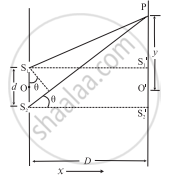
Geometry of the double-slit experiment
Consider, a point P on the screen at a distance y from O' (y << 0). The two light waves from S1 and S2 reach P along paths S1P and S2P, respectively. If the path difference (Δl) between S1P and S2P is an integral multiple of λ, the two waves arriving there will interfere constructively producing a bright fringe at P. On the contrary, if the path difference between S1P and S2P is a half-integral multiple of λ, there will be destructive interference and a dark fringe will be produced at P.
From the above figure,
(S2P)2 = (S2S2')2 + (PS2')2
= (S2S2')2 + (PO' + O'S2')2
`= "D"^2 + ("y" + "d"/2)^2` ....(1)
and (S1P)2 = (S1S1')2 + (PS1')2
= (S1S1')2 + (PQ' - Q'S1)2
= `"D"^2 + ("y" - "d"/2)^2` .....(2)
(S2P)2 - (S1P)2 = `{"D"^2 + ("y" + "d"/2)^2} - {"D"^2 + ("y" - "d"/2)^2}`
∴ (S2P + S1P)(S2P - S1P)
`= ["D"^2 + "y"^2 + "d"^2/4 + "yd"] - ["D"^2 + "y"^2 + "d"^2/4 - "yd"] = 2"yd"`
∴ S2P + S1P = Δ l = 2yd/S2P + S1P
In practice, D >> y and D >> d,
∴ S2P + S1P ≅ 2D
∴ Path difference,
Δ l = S2P + S1P ≅ 2 `"yd"/"2D" = "y" "d"/"D"` ....(3)
The expression for the fringe width (or band width):
The distance between consecutive bright (or dark) fringes is called the fringe width (or bandwidth) W. Point P will be bright (maximum intensity), if the
path difference, Δ l = `"y"_"n" "d"/"D" = "n" lambda` where n = 0, 1, 2, 3, .....
Point P will be dark (minimum intensity equal to zero), if `"y"_"m" "d"/"D" = ("2m" - 1) lambda/2`, where, m = 1,2,3...,
Thus, for bright fringes (or bands),
`"y"_"n" = 0, lambda "D"/"d", (2lambda"D")/"d"` ...
and for dark fringes (or bands),
`"y"_"n" = lambda/2 "D"/"d", 3 lambda/2 "D"/"d", 5lambda/2 "D"/"d"` ....
The bright and dark fringes (or bands) alternate and are evenly spaced in these situations. For Point O', the path difference (S2O' - S1O') = 0. Hence, point O' will be bright. It corresponds to the centre of the central bright fringe (or band). On both sides of O', the interference pattern consists of alternate dark and bright fringes (or band) parallel to the slit.
Let `"y"_"n"` and `"y"_"n + 1"`, be the distances of the nth and (m + 1)th bright fringes from the central bright fringe.
∴ `("y"_"n""d")/"D" = "n" lambda`
∴ `"y"_"n" = ("n" lambda "D")/"d"` .....(4)
and `("y"_("n + 1")"d")/"D" = ("n + 1")lambda`
∴ `("y"_("n + 1")) = (("n + 1") lambda "D")/"d"` .....(5)
The distance between consecutive bright fringes
`= "y"_("n + 1") - "y"_"n" = (lambda "D")/"d" [("n + 1") - "n"] = (lambda"D")/"d"` ....(6)
Hence, the fringe width,
∴ W = `triangle "y" = "y"_("n + 1") - "y"_"n" = (lambda"D")/"d"` (for bright fringes) ... (7)
Alternately, let `"y"_"m"` and `"y"_"m + 1"` be the distances of the m th and (m + 1)th dark fringes respectively from the central bright fringe.
∴ `("y"_"m""d")/"D" = (2"m" - 1) lambda/2` and
`("y"_("m+1")"d")/"D" = [2("m + 1") - 1] lambda/2 = (2"m" + 1) lambda/2` ....(8)
∴ `"y"_"m" = (2"m - 1") (lambda"D")/"2d"` and
`"y"_"m + 1" = (2"m" + 1) (lambda"D")/"2d"` .....(9)
∴ The distance between consecutive dark fringes,
`"y"_"m + 1" - "y"_"m" = (lambda"D")/"2d" [(2"m" + 1) - (2"m" - 1)] = (lambda"D")/"d"` ....(10)
∴ W = `"y"_"m + 1" - "y"_"m"`
`= (lambda"D")/"d"` (for dark fringes) .....(11)
Eqs. (7) and (11) show that the fringe width is the same for bright and dark fringes.
संबंधित प्रश्न
Write the important characteristic features by which the interference can be distinguished from the observed diffraction pattern.
A long narrow horizontal slit is paced 1 mm above a horizontal plane mirror. The interference between the light coming directly from the slit and that after reflection is seen on a screen 1.0 m away from the slit. Find the fringe-width if the light used has a wavelength of 700 nm.
Answer in brief:
In Young's double-slit experiment what will we observe on the screen when white light is incident on the slits but one slit is covered with a red filter and the other with a violet filter? Give reasons for your answer.
What are the conditions for obtaining a good interference pattern? Give reasons.
What are the two methods for obtaining coherent sources in the laboratory?
Why two light sources must be of equal intensity to obtain a well-defined interference pattern?
One of Young’s double slits is covered with a glass plate as shown in figure. The position of central maximum will,

What is phase of a wave?
How do source and images behave as coherent sources?
Obtain the equation for resultant intensity due to interference of light.
Two independent monochromatic sources cannot act as coherent sources, why?
In Young’s double slit experiment, the slits are 2 mm apart and are illuminated with a mixture of two wavelength λ0 = 750 nm and λ = 900 nm. What is the minimum distance from the common central bright fringe on a screen 2 m from the slits where a bright fringe from one interference pattern coincides with a bright fringe from the other?
The interference pattern is obtained with two coherent light sources of intensity ratio n. In the interference pattern, the ratio `("I"_"max" - "I"_"min")/("I"_"max" + "I"_"min")` will be ______
A metal rod has length, cross-sectional area and Young's modulus as L, A and Y, respectively. If the elongation in the rod produced is l, then work done is proportional to ______.
In Young's experiment for the interference of light, the separation between the silts is d and the distance of the screen from the slits is D. If D is increased by 0.6% and d is decreased by 0.2%, then for the light of a given wavelength, which one of the following is true?
"The fringe width ____________."
In a biprism experiment, D = 1 m, `lambda` = 6000 Å. When a convex lens is interposed between the biprism ru1d the eyepiece, then the distance between the images of the slits given by the Jens at two positions are 1.5 mm and 6.0 mm. The fringe width will be ______.
In a Young's experiment, two coherent sources are placed 0.60 mm apart and the fringes are observed one metre away. If it produces the second dark fringe at a distance of 1 mm from the central fringe, the wavelength of monochromatic light used would be ____________.
In biprism experiment, the 4th dark band is formed opposite to one of the slits. The wavelength of light used is ______.
In the biprism experiment, the fringe width is 0.4 mm. What is the distance between the 4th dark band and the 6th bright band on the same side?
Light waves from two coherent sources arrive at two points on a screen with a path difference of zero and λ/2. The ratio of the intensities at the points is ______
In Young's double slit experiment, for wavelength λ1 the nth bright fringe is obtained at a point P on the screen. Keeping the same setting, source of light is replaced by wavelength λ2 and now (n + 1)th bright fringe is obtained at the same point P on the screen. The value of n is ______.
Young's double slit experiment is performed in water, instead of air, then fringe width ______.
White light is passed through a double slit and interference is observed on a screen 1.5 m away. The separation between the slits is 0.3 mm. The first violet and red fringes are formed 2.0 mm and 3.5 mm away from the central white fringes. The difference in wavelengths of red and violet light is ______ nm.
The path difference between two interference light waves meeting at a point on the screen is `(87/2)lambda`. The band obtained at that point is ______.
With a neat labelled ray diagram explain the use of Fresnel's biprism to obtain two coherent sources.
In biprism experiment the maximum intensity is ‘I0’. If the path difference between the two interfering waves is ‘λ/4’ then intensity at the point on the screen is ______.
`[sin 45^circ = cos 45^circ = 1/sqrt 2]`
In a biprism experiment, fifth dark fringe is obtained at a point. A thin transparent film of refractive index ‘μ’ is placed in one of the interfering paths. Now 7th bright fringe is obtained at the same point. If ‘A’ is the wavelength of light used, the thickness of film is equal to ______.
